Share
Share







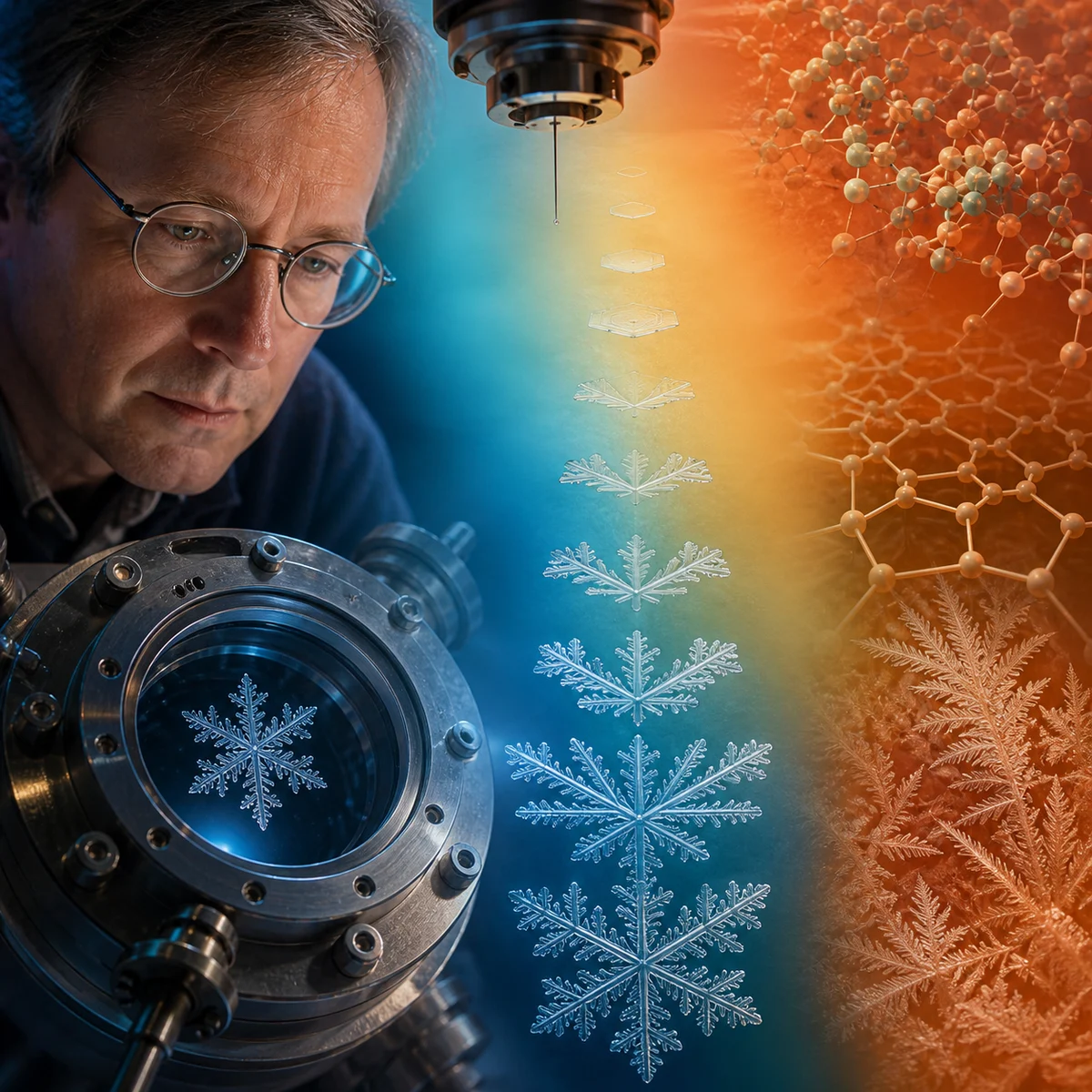
Snowflakes do not need a cloud if a laboratory can reproduce the right sequence of cold and moisture. Caltech physicist Kenneth Libbrecht grows individual snow crystals in controlled chambers, adjusting temperature and humidity as water vapor joins an ice surface. Different conditions favor plates, columns, branches, and other structures, turning each crystal into a visible record of its growth environment.
The work is not microscopic carving. Libbrecht does not cut a predetermined shape into ice. He sets physical conditions and lets molecular attachment build the form. By changing those conditions during growth, he can guide a crystal toward unusually symmetrical or elaborate shapes. The result looks designed because the experiment controls the rules under which natural crystal facets advance.
That control serves science as well as beauty. Ice crystal growth remains a problem of how molecules attach to a structured surface, and the final geometry makes invisible processes visible. A thin plate or branching arm contains evidence about temperature, humidity, and the dynamics at its edge. “Designer snowflake” is therefore a useful nickname if it keeps the mechanism intact: the physicist designs the environment, while water molecules assemble the crystal one layer at a time.
Sources