Share
Share







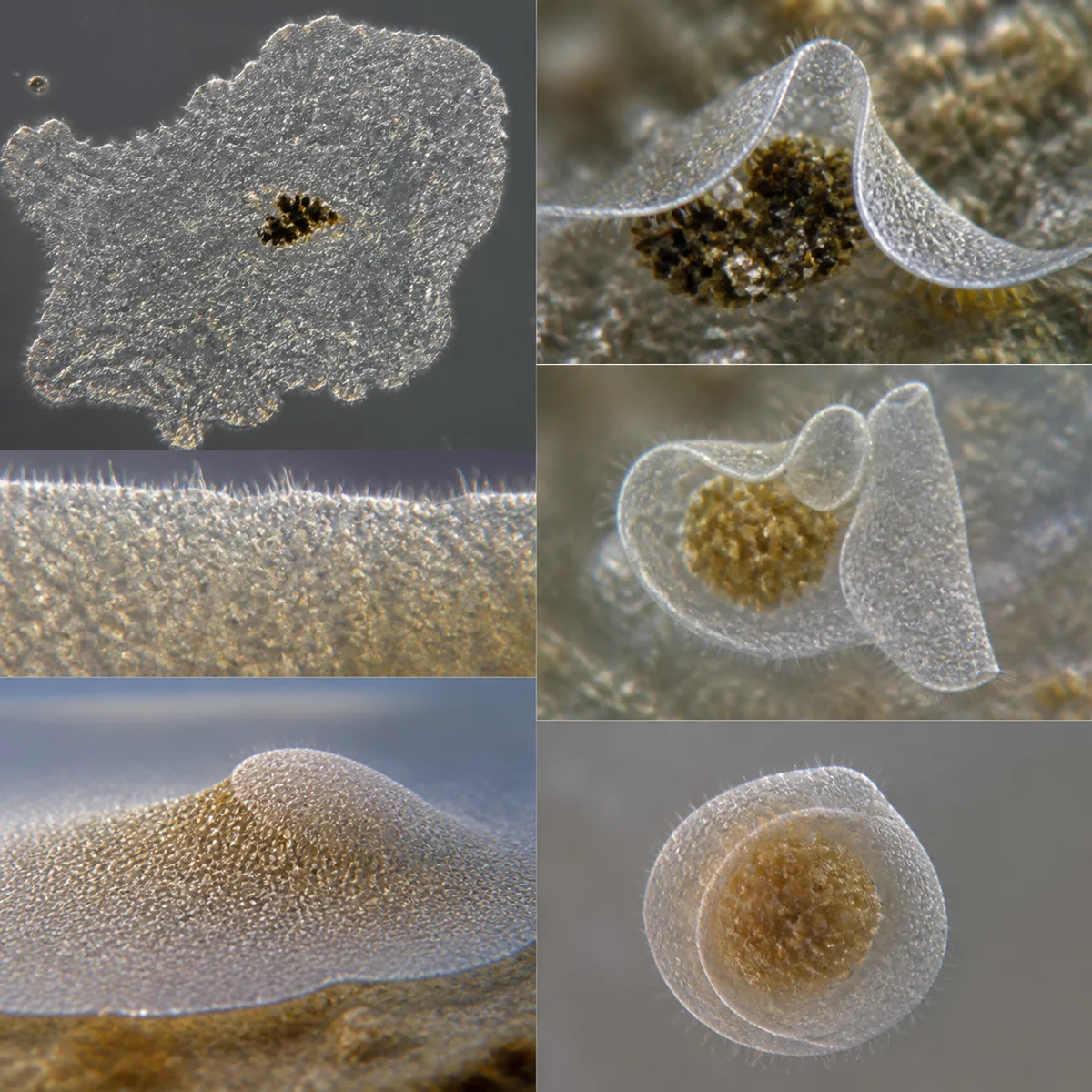
Placozoans are extraordinarily simple animals: thin, flattened bodies only a few cell layers thick, with no brain, nervous system, or muscles organized like ours. Stanford researchers observed that they can nonetheless create coordinated tissue shapes by using tiny hairlike cilia against the surface below.
Individual cilia push and pull locally. Across the sheet, those forces combine so edges curl, regions bend, and the body molds itself around food or terrain. The animal does not require a central controller issuing a geometric plan. Mechanical coupling and local cellular activity let large-scale form emerge from many small contacts with the substrate.
The experiments describe particular placozoans under laboratory observation, not a universal rule for every organism lacking a brain. “Origami” is a useful shape metaphor, not evidence that the animal understands folds. Its real achievement is more interesting: coordinated body architecture can arise before a nervous system enters the story. A sheet of cells changes form because its smallest moving hairs share the same floor.
Sources