Share
Share







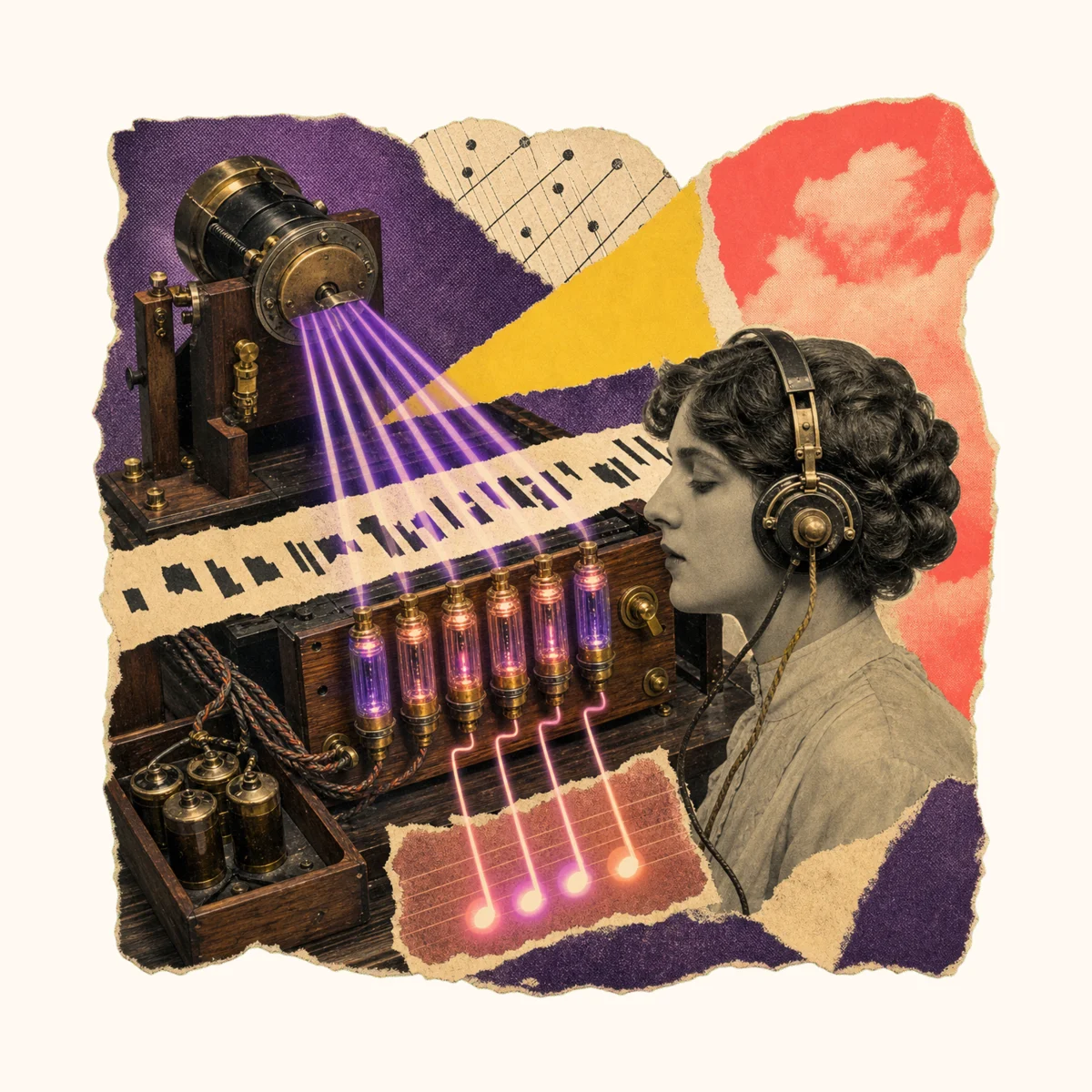
Edmund Edward Fournier d’Albe’s Optophone did not read printed words aloud. It turned their shapes into patterns of musical tones. A user moved the apparatus across a line of print while light-sensitive elements detected where dark ink interrupted the page. Five notes corresponded to different vertical positions in the scanning field.
As the scan crossed a letter, its strokes switched those notes on and off in sequence. A tall line, curve, or crossbar therefore produced a different time-varying chord pattern. Reading meant learning to recognize those compact sound signatures and combine them into text. The machine translated appearance directly into sound without first identifying a character or synthesizing speech.
Fournier d’Albe demonstrated the reading idea in 1913. The Science Museum Group preserves an original type-heading Optophone made in 1918 with its batteries. That distinction matters: the date on the museum object marks one surviving instrument, not the first moment the concept appeared.
For a blind reader, the page did not become a spoken voice. It became an unfamiliar musical code generated by the physical geometry of ink. The Optophone asked the ear to perform the pattern recognition normally assigned to the eye: every printed letter arrived as a tiny chord moving through time.