Share
Share







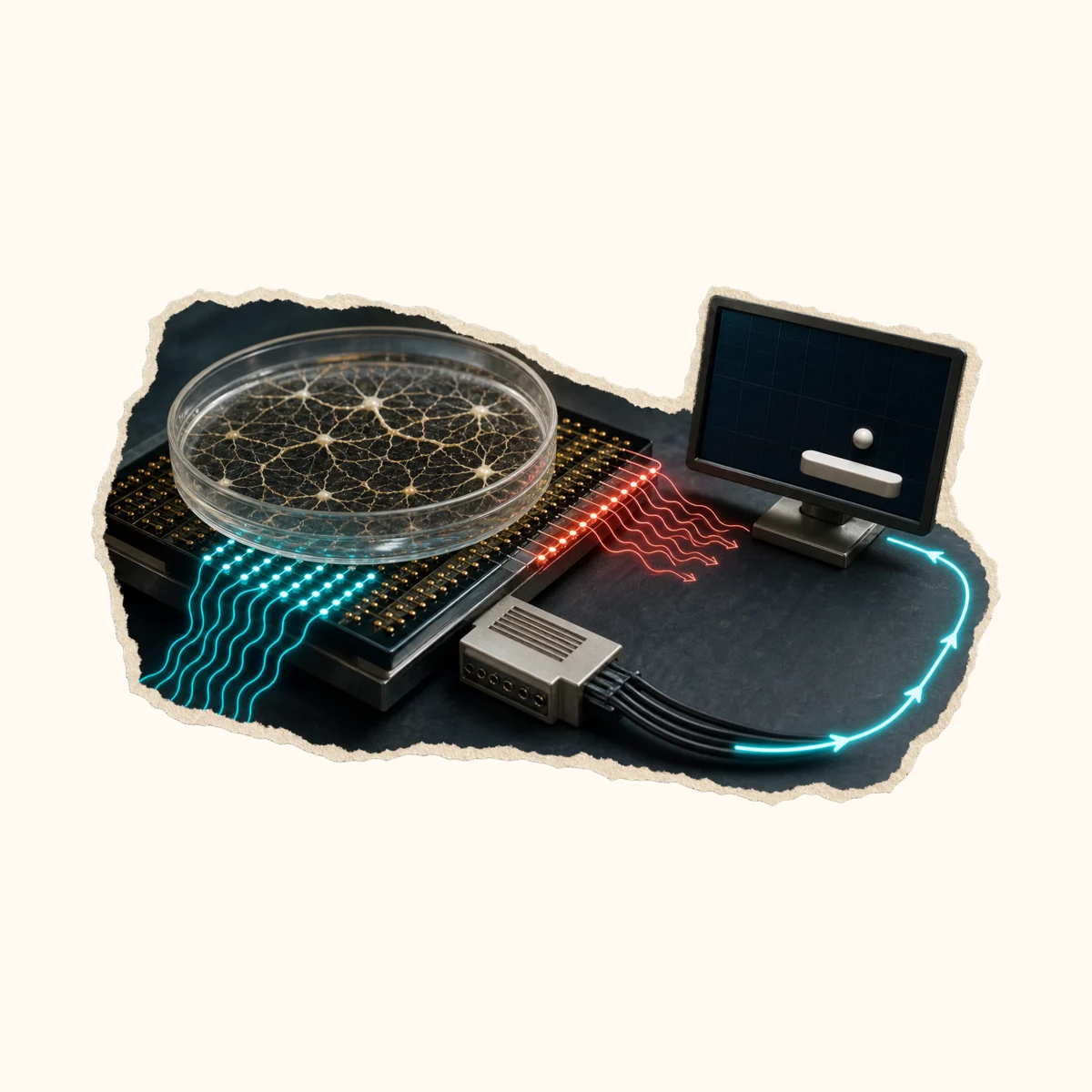
DishBrain did not place a tiny brain in front of a monitor. Researchers grew networks of mouse cortical neurons and human stem-cell-derived neurons on high-density multielectrode arrays, then connected those arrays to a simplified Pong-like environment. The cells received no picture of a ball or paddle. Patterns of electrical stimulation represented the game state.
Activity recorded from different regions of the culture was translated into paddle movement. The system then returned structured electrical feedback. Hits and misses produced different stimulation conditions, closing a loop between what the neurons did and what arrived next. The culture’s changing activity therefore had consequences inside the simulated task without implying that any cell understood a game. This was an engineered input-output relationship: stimulation entered through electrodes, neural firing was measured, and software converted that firing into action.
Across experimental sessions, cultures receiving the structured closed-loop feedback improved their performance relative to control conditions. The Neuron paper describes this cautiously as apparent learning or adaptation in an embodied in-vitro network. The striking result is not that a conscious dish became a gamer. It is that living neural tissue, separated from an animal and given only electrodes, could alter its collective firing when electrical consequences were made contingent on its previous activity.