Share
Share







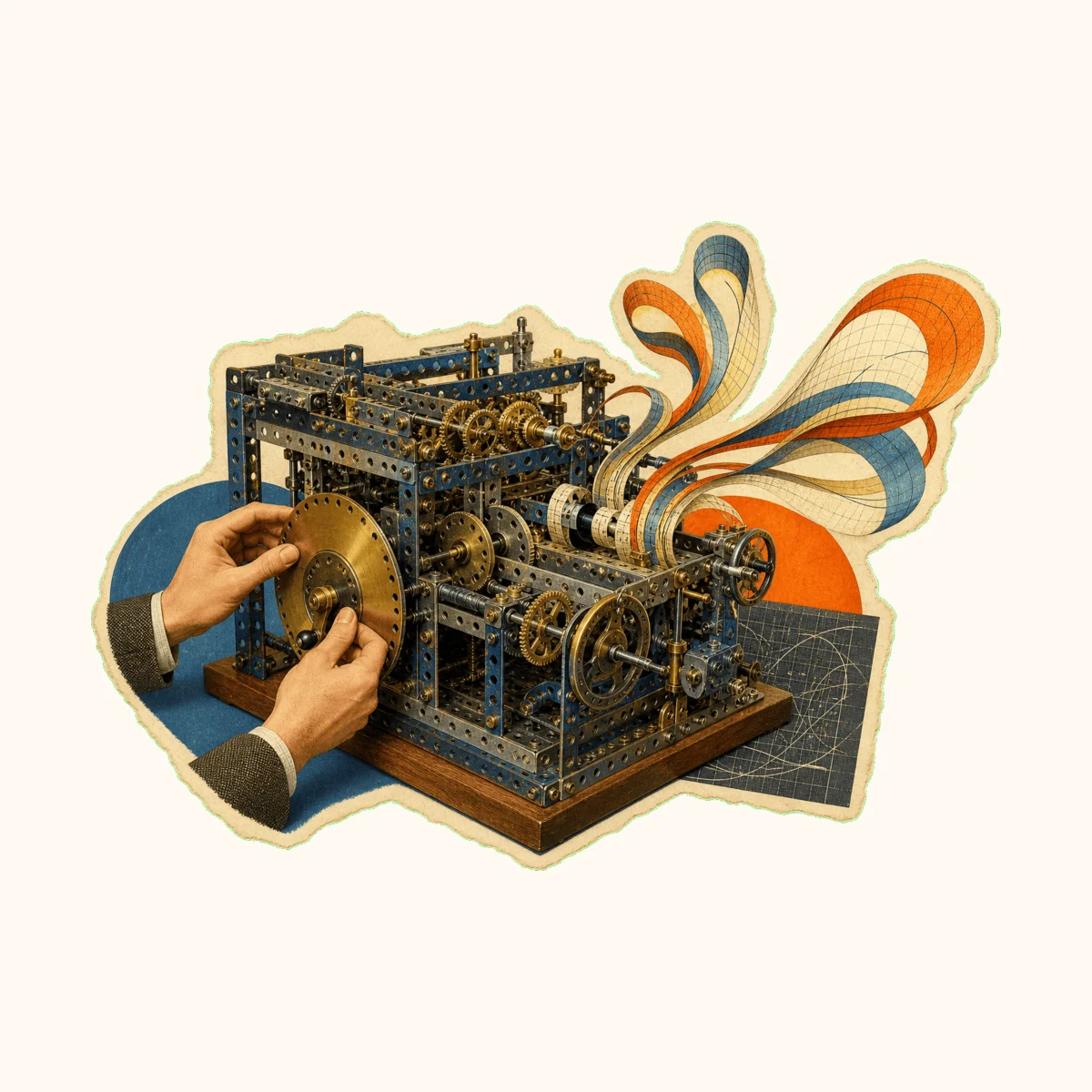
In 1934, research student Arthur Porter built a working differential analyser at the University of Manchester from Meccano—the perforated strips, shafts, gears, and fasteners better known for model bridges and cranes. Under mathematician Douglas Hartree’s supervision, Porter spent about eighteen months turning construction-set parts into an analogue computer.
The machine solved difficult equations through a wheel-and-disc mechanism. It was not digital or electronic, and it did not run unattended. An operator had to set and work it by hand while rotating mechanical relationships represented changing mathematical quantities. The humble parts did not simplify the mathematics; they made a workable physical model of it affordable and adjustable.
The Science Museum Group records that Hartree was waiting for a full-size analyser when the smaller machine was built. The Meccano version therefore occupied an unusual space between model and instrument. Its components belonged to a construction system, but its calculations were real.
Hartree later reconstructed the machine at Cambridge in 1947. That is the version held by the museum: a serious equation solver whose visible nuts, strips, and wheels never stopped looking as though a patient builder might dismantle the computer and return every piece to a very ambitious toy box.