




 Share








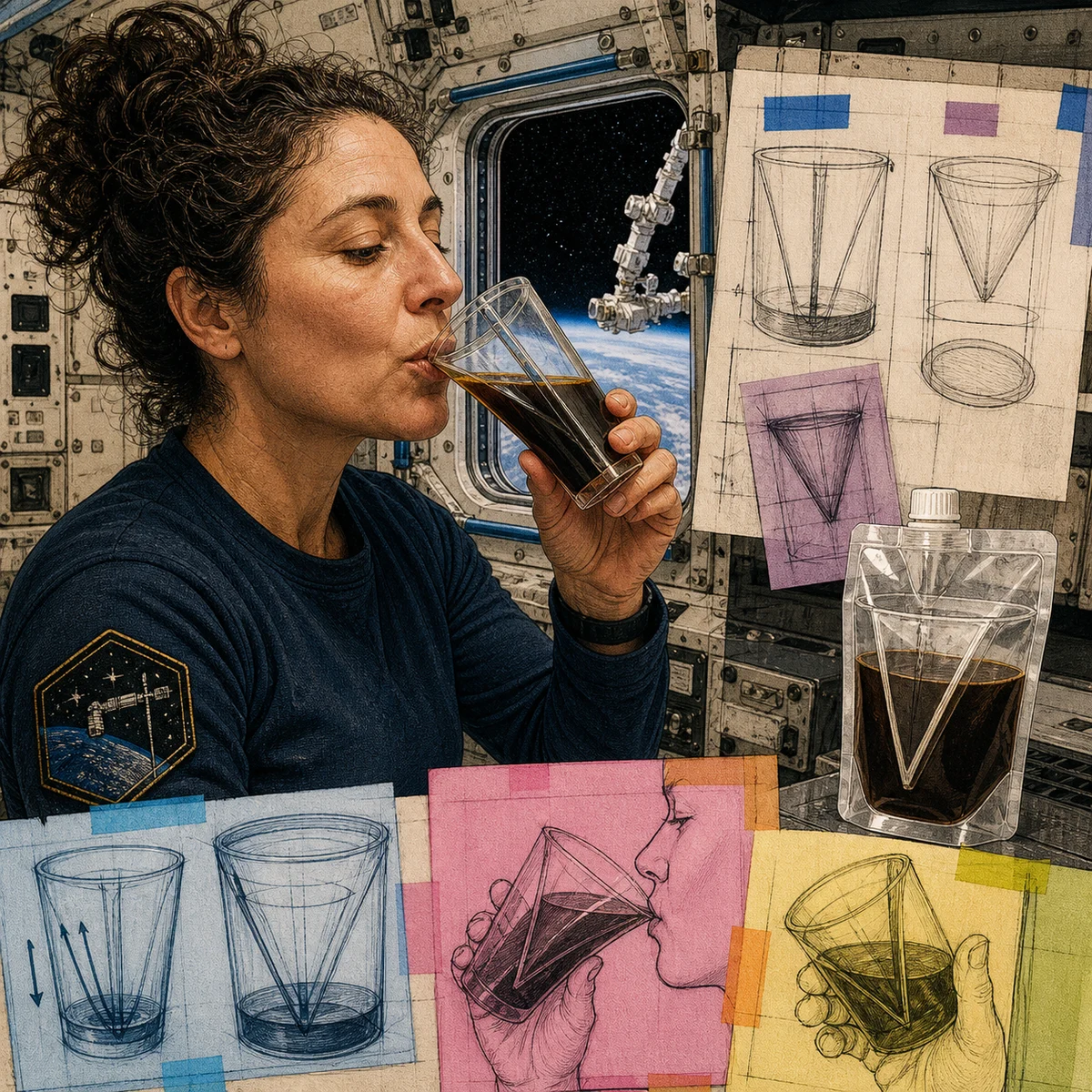
Astronauts usually drink from sealed pouches because an open cup loses the partnership that makes it ordinary on Earth: gravity holds the liquid low, and tilting brings it to the mouth. On the International Space Station, Don Pettit folded overhead-transparency film into an early Capillary Beverage prototype. The later Space Cup grew from that demonstration and collaborative capillary-flow work with researchers including Mark Weislogel, Paul Concus, and Robert Finn.
Its crucial feature is an angled, narrowing channel running from the reservoir to the lip. The channel has two adjoining walls rather than a closed tube. Wetting and surface-tension forces pull the beverage into that corner and along it until the liquid reaches an equilibrium at the rim. Touching the rim and taking a sip disturbs that balance, so more fluid advances from below to restore it.
No pump or squeeze is needed, and only a few residual drops remain when the cup is emptied—much like a ceramic cup on Earth. Container shape, liquid properties, and wetting still matter; the cup is not proof that any open mug can roam a cabin without consequences. Pettit’s improvised film prototype supplied the vivid beginning, while the finished design belongs to a longer program of capillary science. It lets a familiar gesture survive weightlessness by replacing “down” with a carefully built corner.
Sources