Share
Share







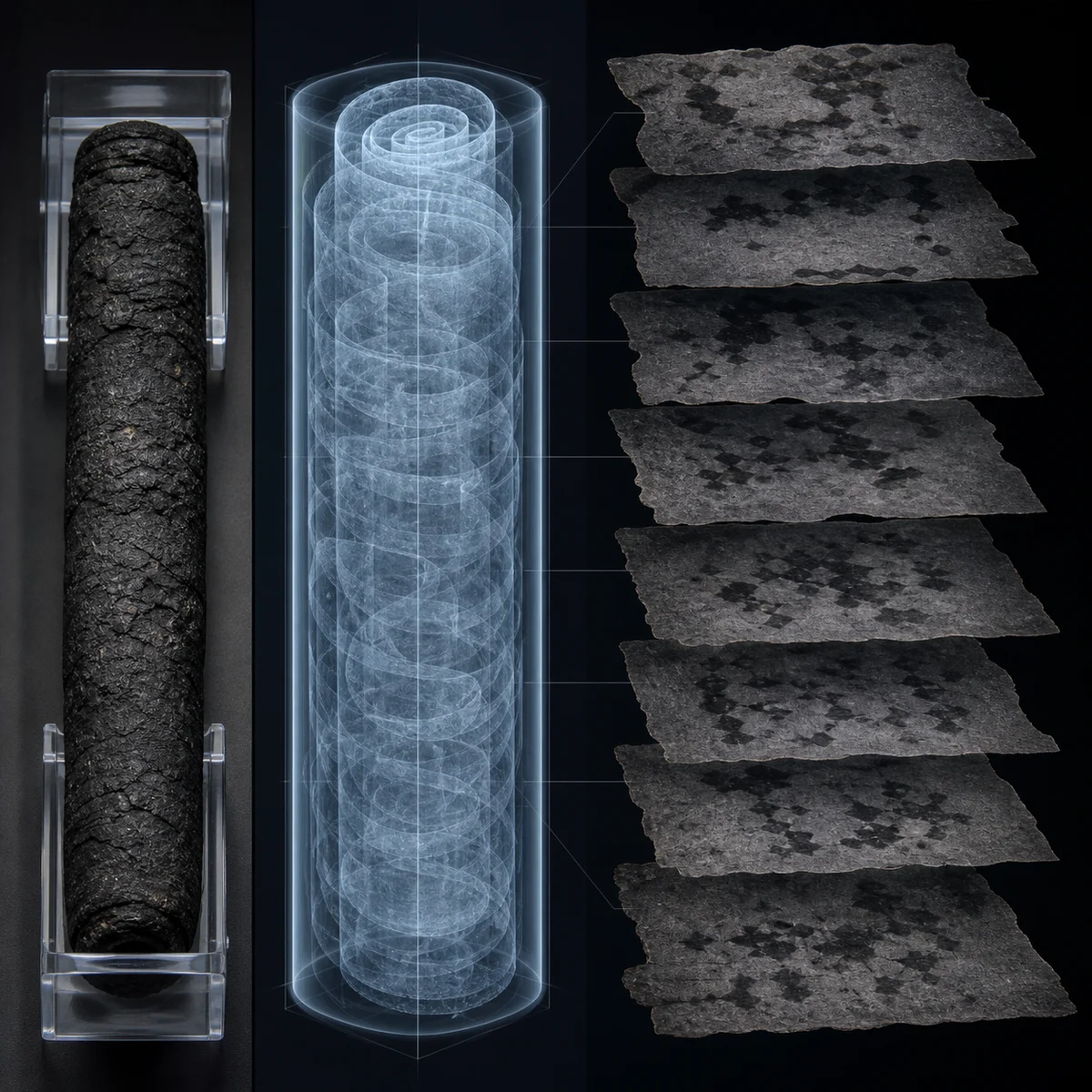
The Herculaneum papyri survived Vesuvius as blackened, compacted cylinders. Physical attempts to unroll such scrolls can make the brittle layers break apart, so researchers developed a noninvasive route: scan the interior in three dimensions, computationally separate the rolled surfaces, and use machine learning to distinguish carbon-based ink from carbonized papyrus.
That sequence is called virtual unwrapping, although no sheet physically opens. Software maps the geometry of hidden layers and presents them as flattened surfaces. Ink detection then reveals marks too subtle for an ordinary X-ray view. In the milestone described by the National Endowment for the Humanities, a student team recovered more than 2,000 characters across four passages, likely from a work concerning pleasure.
That was a breakthrough, not completion. The passages represented about five percent of one scroll, while the larger cache contains more than 1,800 papyri. The entire library had not been read. The advance was a working path from sealed artifact to legible text: preserve the fragile original, reconstruct its interior digitally, and let scholars read a small portion that had remained inaccessible for nearly two millennia.
Sources