Share
Share







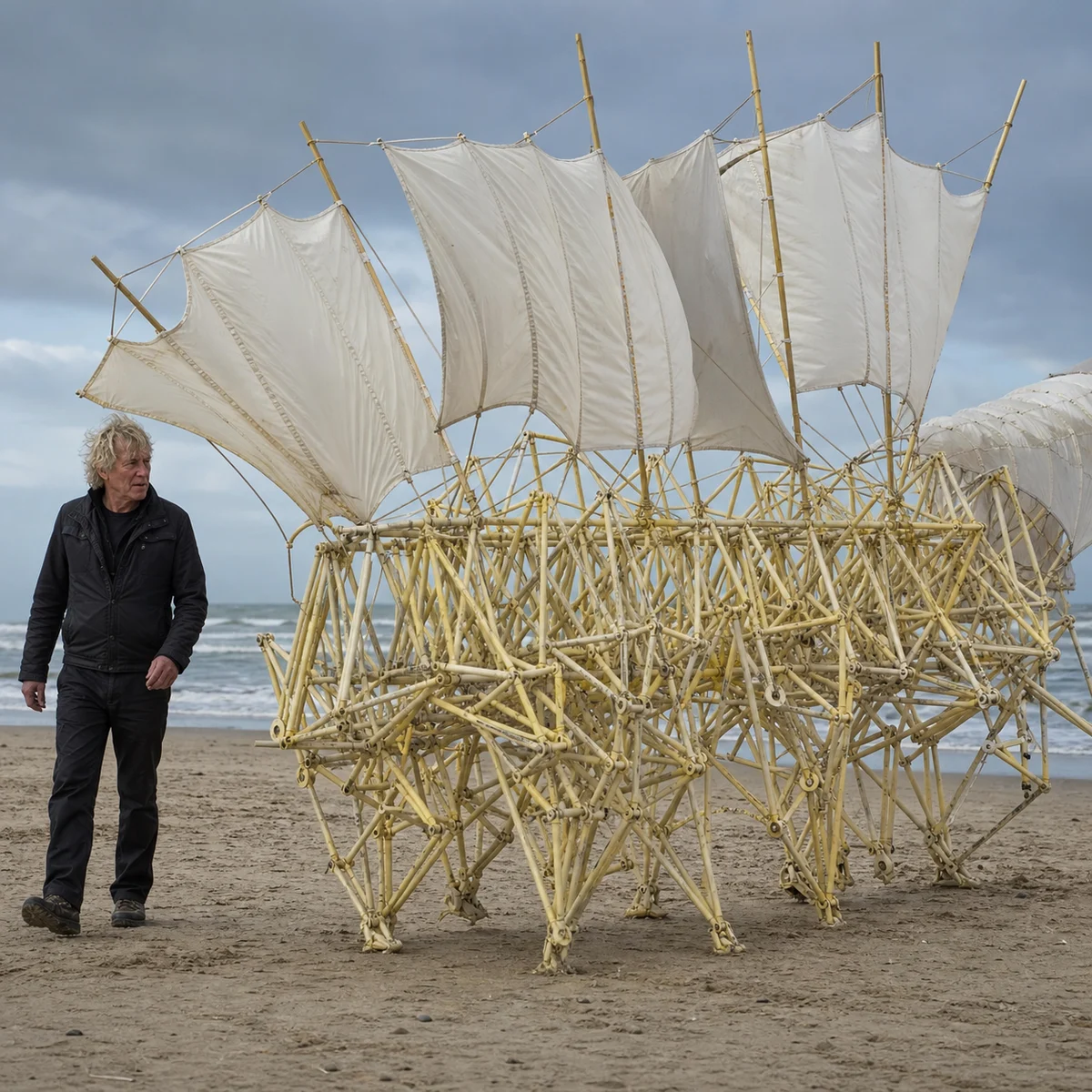
Dutch artist Theo Jansen builds Strandbeests—large kinetic creatures assembled from yellow plastic tubing, fabric sails, and carefully proportioned linkages. Wind pushes the sails or fills stored-air systems, and the mechanism converts that energy into a many-legged walk across the beach. The gait looks biological because each foot follows a controlled path, but the animal is entirely engineered.
Jansen develops the works in generations. New forms inherit useful linkage ideas from earlier ones and add mechanisms for coping with sand, gusts, water, or changing direction. Some designs use bottles as pressure reservoirs, storing compressed air from a gust and feeding it back into later movement; others include simple sensing or anchoring behaviors. Failure on the beach becomes information for the next build. The open shore exposes every mechanism to changing wind and sand, while abandoned generations remain part of the project's fossil record.
The artist describes species and evolution, but this is an artistic design framework rather than biological natural selection. Jansen selects, redesigns, and constructs the machines. That distinction does not make the metaphor empty. Strandbeests explore what an animal can seem to be when wind replaces metabolism, plastic tube replaces bone, and a beach becomes both habitat and test track.
Sources