Share
Share







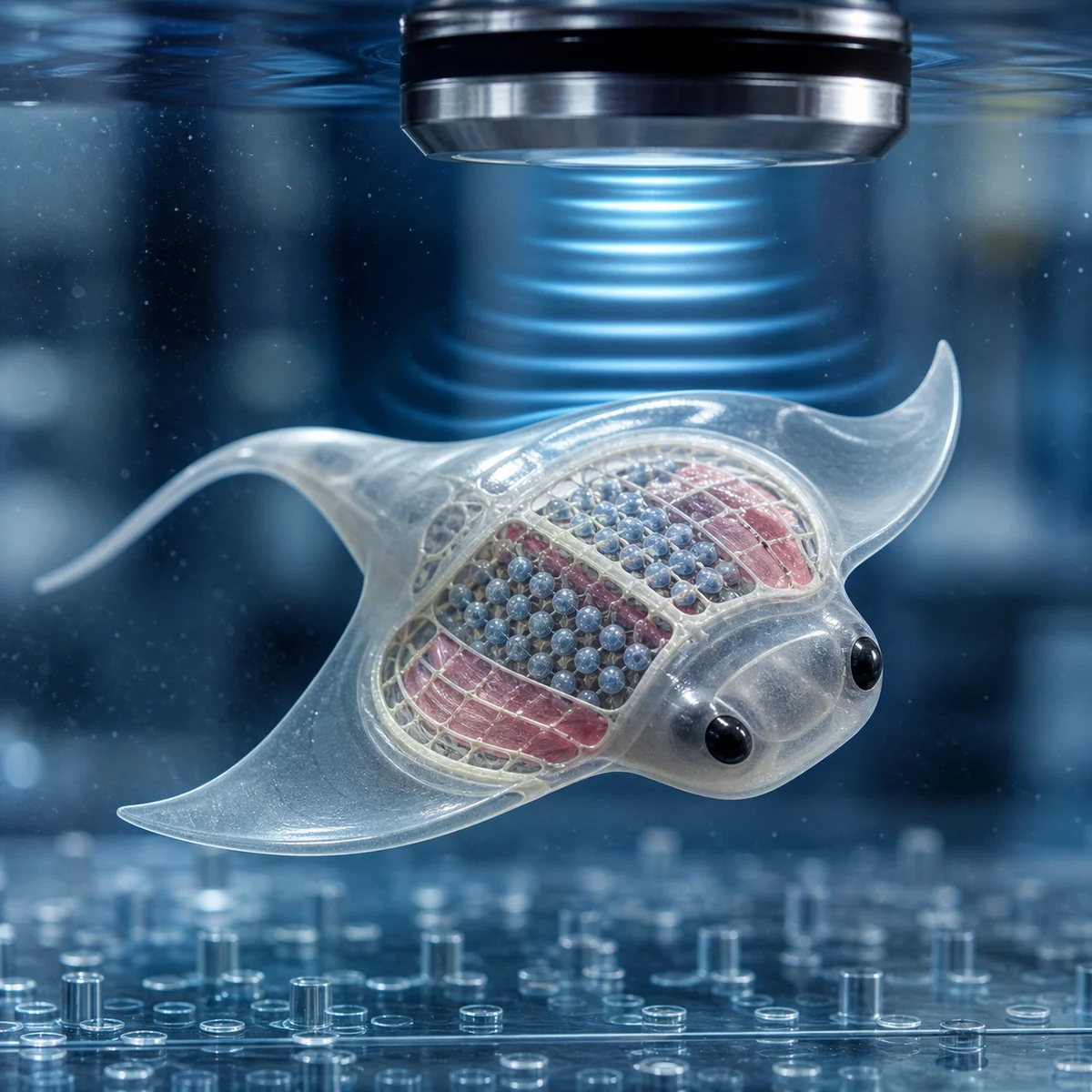
ETH Zurich engineers built soft actuators from silicone containing carefully arranged microbubbles. When ultrasound reached the material, the bubbles responded to the acoustic field and changed the shape of the surrounding structure. By choosing bubble sizes and arrangements, the team could make particular regions bend or move.
One demonstration was a stingray-like robot about four centimeters across. Ultrasound drove its soft fins without an electrical wire or conventional motor mounted on the animal-shaped body. Other devices showed that acoustic energy could address different artificial muscles, offering a way to power small soft systems through a surrounding medium.
The experiments remained laboratory demonstrations. Distance, control, efficiency, materials, and safety all matter before an ultrasound-powered device can take on a real medical or industrial task. The robot also did not swim by hearing a command; its embedded bubbles mechanically coupled external sound energy to motion. Still, the conversion is elegantly strange. A pressure wave entered soft silicone, tiny bubbles translated it, and an artificial stingray flapped.
Sources