




 Share








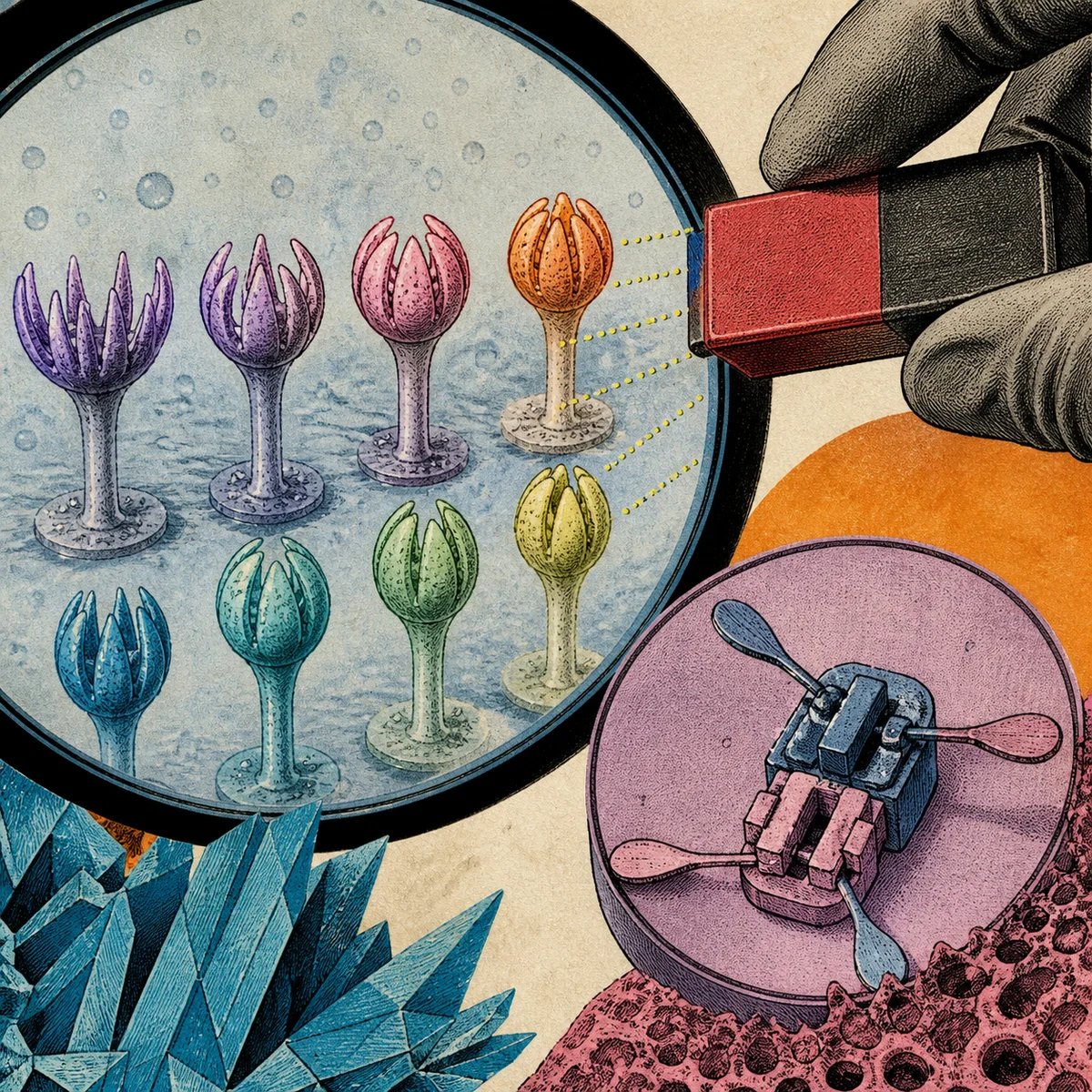
Magnetic particles are useful in tiny robots, but they interfere with the laser light used to print intricate resin structures. MIT and collaborators separated those steps. First, two-photon lithography built soft polymer-gel forms smaller than a millimeter with no metal inside. The finished pieces were dipped in iron ions and then hydroxide, causing magnetic iron-oxide nanoparticles to form within the gel.
Laser power controlled how tightly each feature was cross-linked. Looser regions absorbed more ions and became more magnetic, letting different parts of one object respond by different amounts. In one demonstration, balls smaller than grains of sand sat atop stalks like microscopic lollipops. Passing an ordinary magnet over them pulled the balls together like gripping fingers. Another structure used red-blood-cell-scale magnetic oars to flip and lock a millimeter-long switch in either direction.
The “magno-bots” are externally actuated laboratory structures, not autonomous machines roaming inside people. A gripper taking a biopsy or a valve controlling microfluidic flow remains a possible application, not a completed medical device. The demonstrated advance is manufacturing: print fragile complexity first, add spatially tunable magnetism afterward, and make separate features move without hiding a motor inside them.
Sources