Share
Share







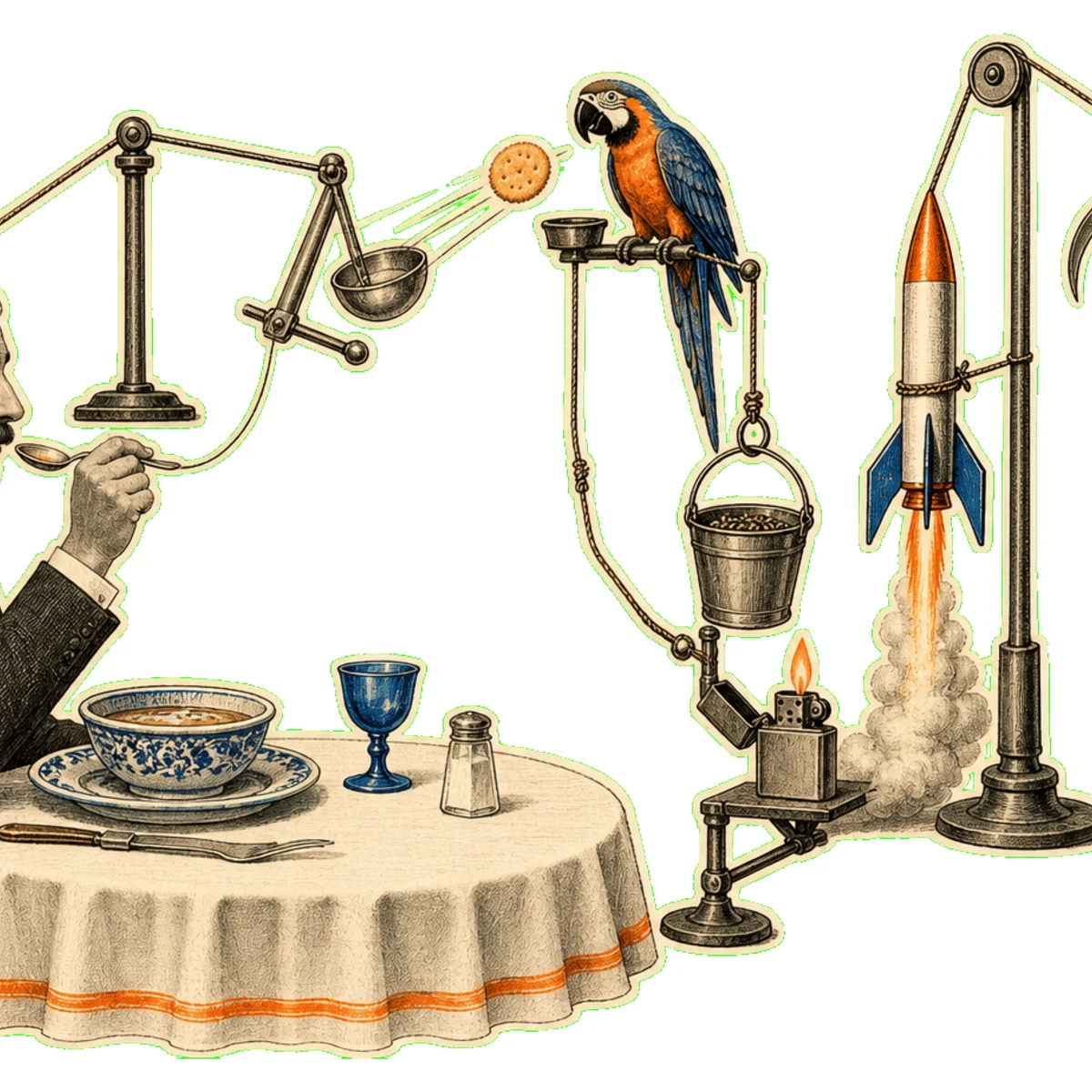
Rube Goldberg’s Self-Operating Napkin begins at the instant a diner raises a soup spoon. That modest motion does not bring a napkin to his chin. It recruits a string, a ladle, a cracker, a parrot, a container of seed, a pail, a cord, a lighter, a skyrocket, a sickle, and finally a pendulum. The drawing turns one useful gesture into a small administrative state, with every component waiting for permission from the component before it.
The cartoon appeared in Collier’s on September 26, 1931, as one of Goldberg’s Professor Butts inventions. Its mechanism exists on paper, where causality can be perfectly obedient and the danger of eating soup beside a rocket can remain part of the joke. Goldberg drew a diagram, not a prototype. The labeled sequence borrows the visual authority of an engineering explanation while spending that authority on an outcome a hand could accomplish immediately.
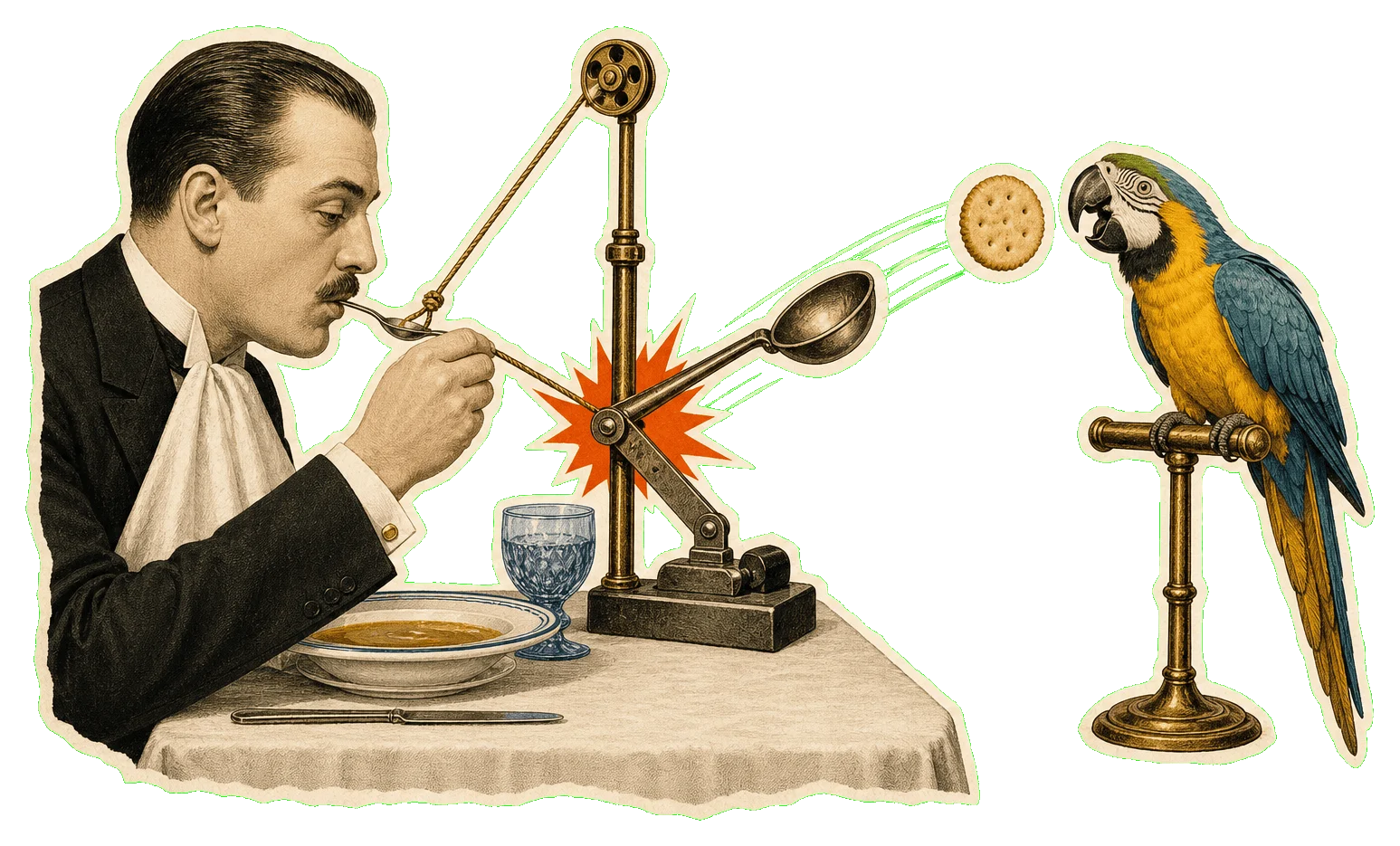
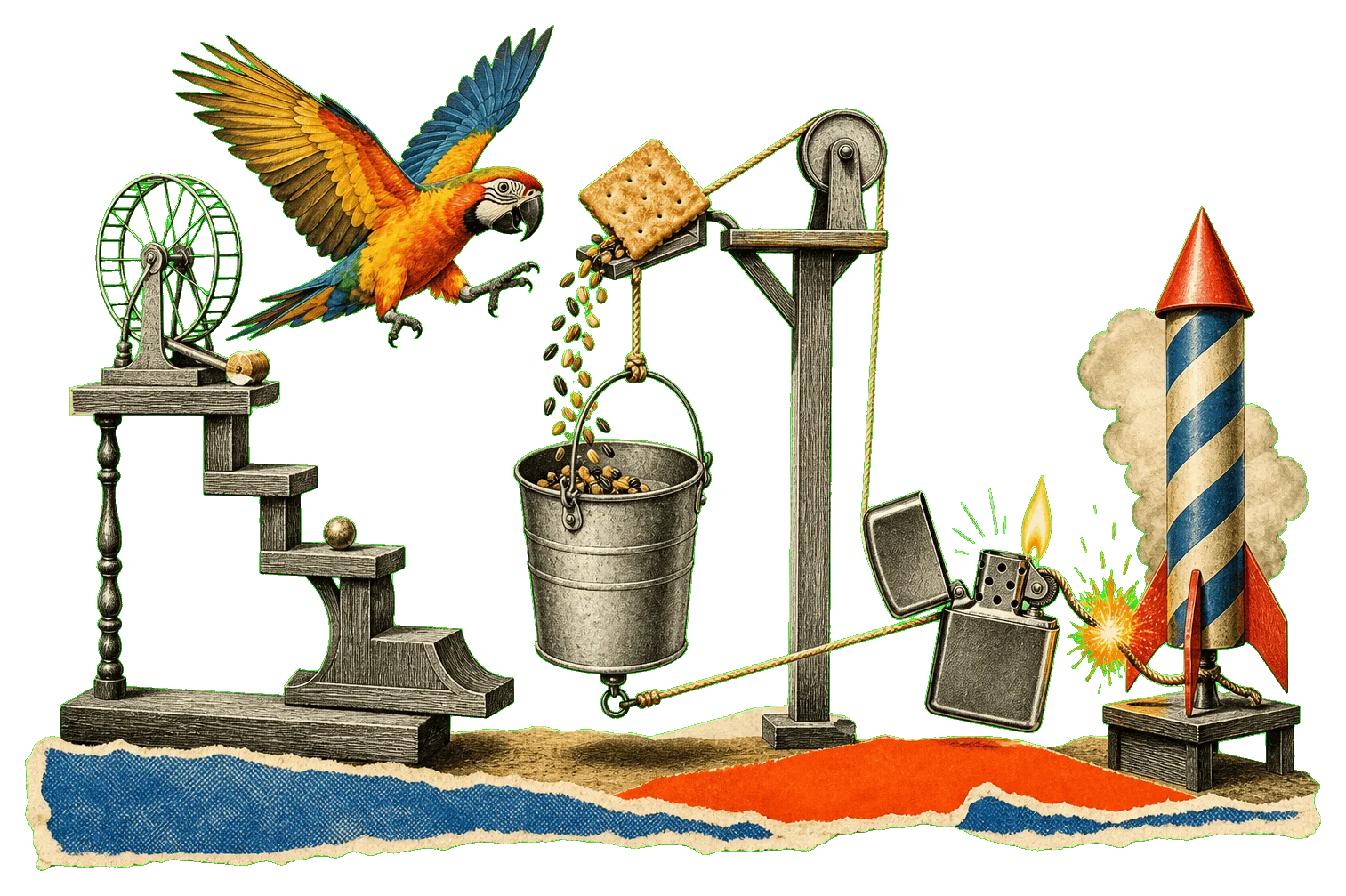
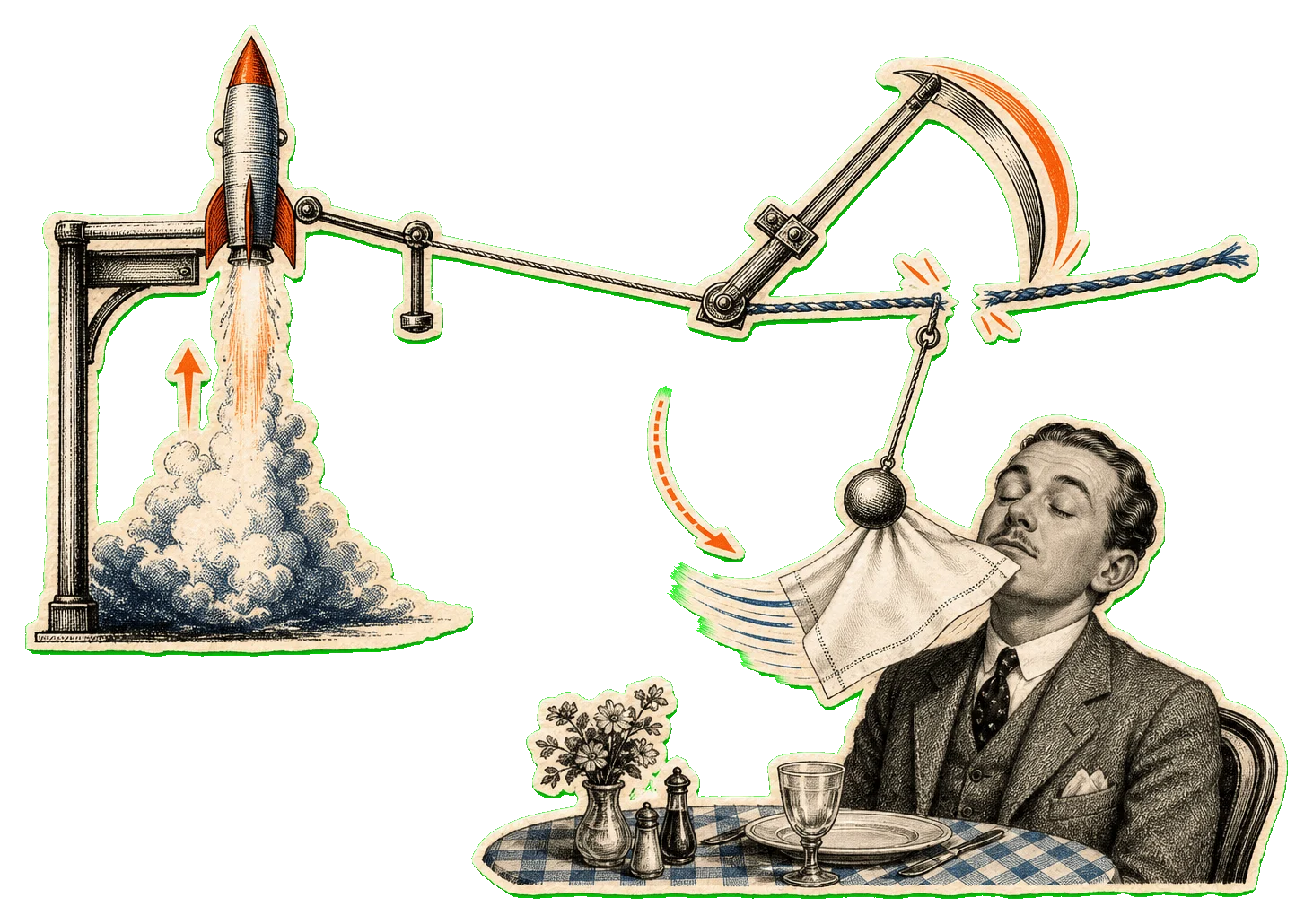
First, the diner lifts the spoon. A string attached to his arm pulls a ladle. The ladle flings a cracker past a parrot. The bird jumps toward the food and tips seed into a pail. As the seed accumulates, the extra weight pulls a cord connected to a lighter. The lighter ignites a skyrocket. The rising rocket makes a sickle cut another string, releasing a pendulum with a napkin attached. Only then does the cloth swing across the diner’s chin.
The order is crucial. Remove the parrot and the seed never reaches the pail. Remove the pail and the cord does not move. Remove the skyrocket and the sickle has no reason to cut. Each stage converts one kind of action into another: lifting becomes pulling, pulling becomes throwing, appetite becomes weight, weight becomes ignition, ignition becomes flight, and flight becomes a cut. The final wiping motion has traveled through a chain of increasingly inappropriate intermediaries.
Goldberg’s comedy lives in the mismatch between precision and judgment. The drawing is precise about what pulls what. It is wildly unconcerned with whether any of those relationships are sensible. The labels invite the reader to audit the apparatus like a patent diagram, but the apparent rigor keeps revealing new liabilities. A bird must cooperate. Loose seed must land where expected. An open flame must behave. A rocket must rise along the correct path. A blade must swing at exactly the useful instant.
The machine also converts a diner into part of his own appliance. His arm is the trigger, yet he has no direct control over the napkin after the spoon begins moving. He must trust a chain that detours through an animal and an explosive before returning to his face. A tool supposedly designed to serve its user instead gives the user one initial input and asks him to wait while the room completes an elaborate ritual around him.
That reversal was central to Goldberg’s broader satire. The Smithsonian’s account of his contraptions describes them as a comic response to industrialization and to the promise that technology would simplify life. The drawings ask what happens when the solution becomes more demanding than the problem. Their answer is not a rejection of invention. Goldberg had trained as an engineer. It is a warning about confusing technical elaboration with improvement.
The Self-Operating Napkin became one of his most recognizable examples. Rube Goldberg, Inc. identifies it as perhaps the most famous Professor Butts cartoon and notes that it was selected for a United States postage stamp in 1995. By then, the artist’s name had long escaped the signature box. “Rube Goldberg” had become a way to describe achieving a simple result through extravagantly complex means. The napkin supplied a perfect miniature of that definition.
Its endurance comes partly from the fact that the parts look almost plausible one at a time. Strings pull. Weight tips containers. Lighters ignite fuses. Blades cut cords. Pendulums swing. The joke does not require a magical component; it requires ordinary components assembled without restraint. Every local step can be understood while the global plan grows more ridiculous. The reader is carried forward by a sequence that is mechanically legible and strategically deranged.
Later builders have turned Goldberg’s paper logic into physical chain-reaction machines, but the original drawing retains an advantage over any demonstration. On paper, the parrot always wants the cracker and the seed always falls into the pail. The image freezes the apparatus at the edge of action, allowing the eye to run the experiment repeatedly without smoke, cleanup, or an uncooperative bird. Its real moving part is the reader’s attention.
The diner could stop the entire production by reaching for the cloth. That obvious shortcut is what gives every labeled letter its purpose. The Self-Operating Napkin does not celebrate a machine that works; it celebrates the comic distance between working and making sense. A spoon rises, a parrot lunges, a rocket fires, and a napkin finally swings—maximum effort, perfectly diagrammed, arriving at the smallest possible result.