Share
Share







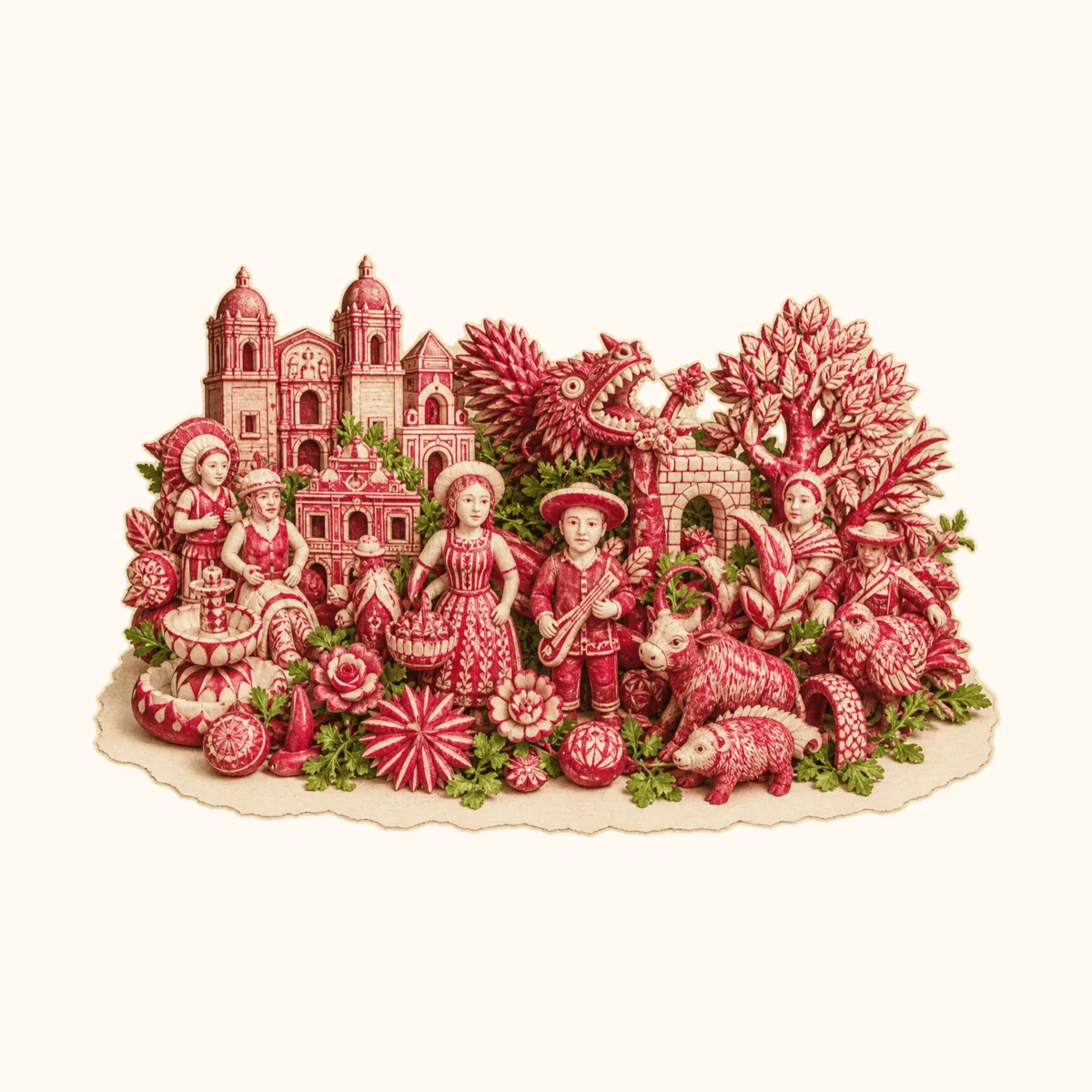
Every December 23, the historic center of Oaxaca de Juárez becomes a gallery with a very short shelf life. Participants in Noche de Rábanos carve oversized radishes into elaborate figures and scenes drawn from local culture, traditions, and everyday imagination. The competition has been held since 1897, turning one winter night into a civic exhibition of vegetables used as sculpture.
These are not ordinary salad radishes. Mexican agricultural sources describe specially grown specimens around fifty centimeters long and weighing as much as three kilograms. Their stretched roots, branches, folds, and bulbous forms give carvers raw material that already suggests bodies, animals, buildings, and landscapes before the first cut is made. The vegetable’s irregularity becomes the design brief.
The finished work is necessarily temporary. Cut radish flesh begins changing soon after exposure, so the gallery cannot settle into a museum collection or a long touring exhibition. It appears, is judged and viewed in the city center, then passes. For a few hours, roots grown for this purpose become architecture, characters, and complete public scenes before returning to ordinary organic matter. Noche de Rábanos makes impermanence part of the event: a tradition more than a century old, rebuilt every year from material that cannot last the night unchanged.