




 Share








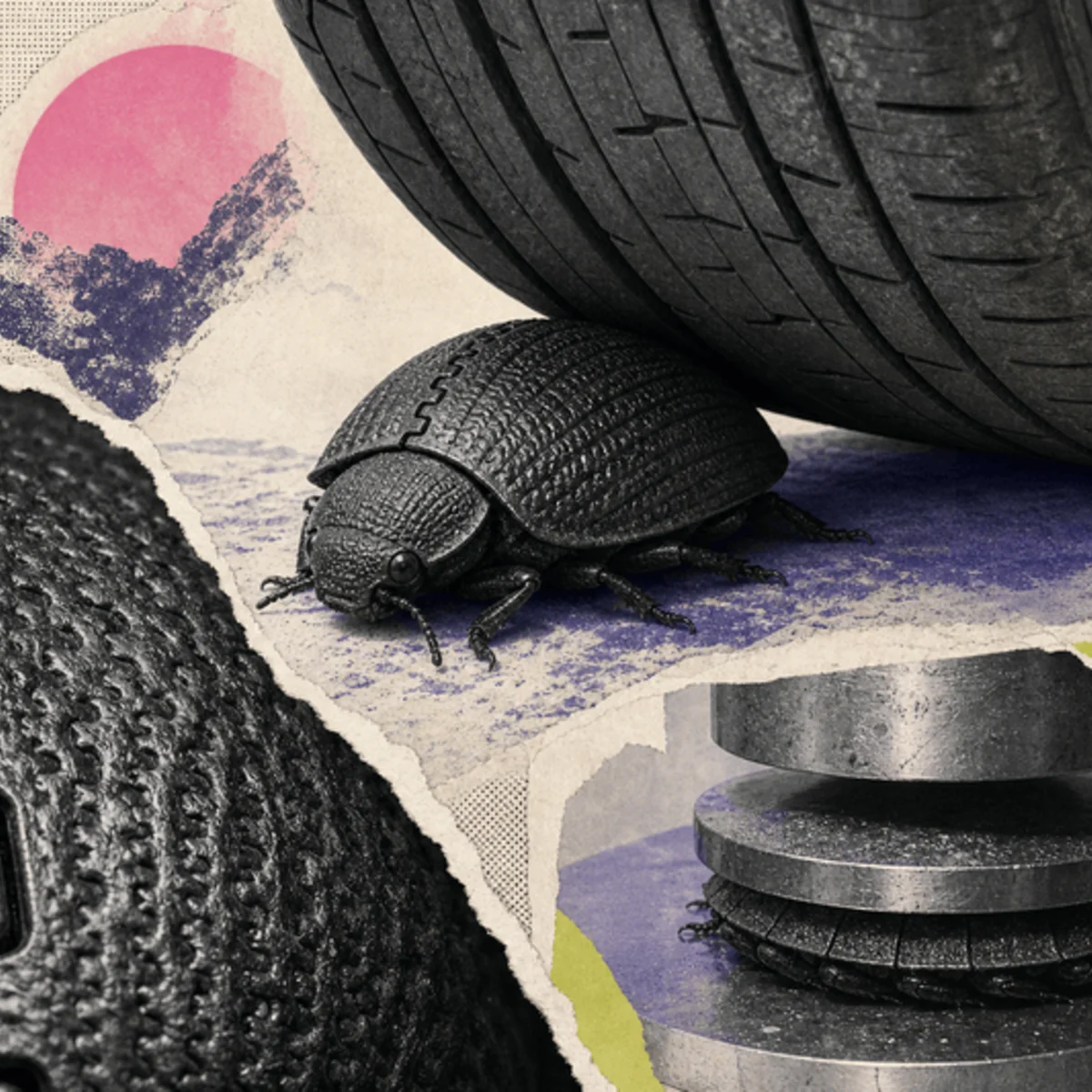
The diabolical ironclad beetle has a problem most beetles solve by leaving. It cannot fly. When a bird, lizard, rodent, or curious shoe applies pressure, Phloeodes diabolicus does not open its wing cases and escape. It stays put, plays dead, and turns the hardware that once covered flight wings into a sealed piece of biological armor.
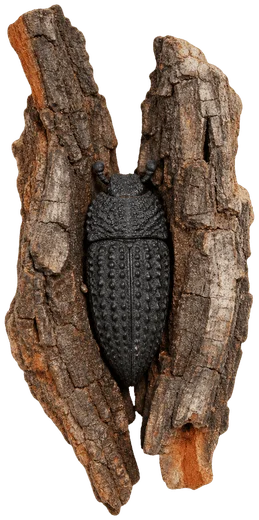
The beetle lives in dry parts of the American Southwest, including Southern California. It is often found beneath rocks or squeezed into the narrow space between bark and a tree trunk. That habitat rewards a body able to tolerate compression, and flightlessness changes the normal beetle blueprint. In flying beetles, the hardened forewings, called elytra, open and close over the delicate wings beneath. In the ironclad beetle, the elytra have fused into a solid protective shield.
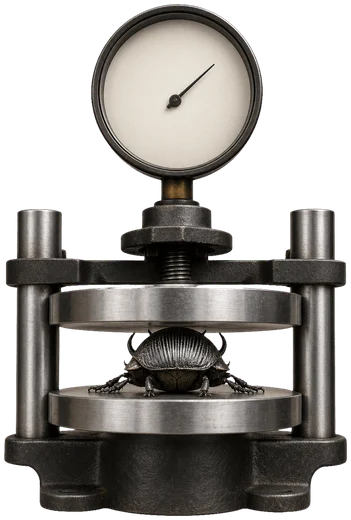
That shield has inspired plenty of spectacular descriptions, including reports that the beetle can survive being run over by a car. A research team led by scientists at the University of California, Irvine wanted numbers and mechanisms rather than reputation. They placed beetles between parallel steel plates, compressed them, mapped their internal structures with microscopy and X-ray imaging, and compared their armor with the shells of other beetles.
The result was a peak load of about 149 newtons—roughly 39,000 times the insect's body weight. Scaling animal feats directly to humans is imperfect, but UC Irvine offered a useful sense of the mismatch: a 200-pound person would need to endure about 7.8 million pounds to equal the same body-weight ratio. The important discovery was not merely that the shell held. It was how the shell avoided a sudden, fatal break.
The elytra are a composite, built from layers of chitin fibers in a protein matrix. The team found that the ironclad beetle's outer layer contained about ten percent more protein by weight than that of a lighter flying beetle, a difference the researchers suggest contributes to toughness. Internal supports connect the armored roof to the lower body, spreading loads through several regions instead of asking one thin wall to absorb everything. Tiny surface structures also add friction where parts meet and help resist slipping.
The most remarkable joint runs down the middle of the back, where the two fused halves meet. Under a microscope, this medial suture resembles a row of interlocking jigsaw pieces. Each piece has an ellipsoidal neck and a layered blade. A rigid interlock could be strong right up to the moment it snapped at its narrowest point. The beetle's version behaves differently. As force rises, layers within the blades begin to separate, or delaminate, in a controlled way.
Delamination sounds like damage because it is. Here, damage is part of the defense. Peeling layers consume energy and prevent one crack from racing across the entire seam. The joint gives locally while the shell remains functional as a whole. Researchers described this as avoiding catastrophic failure: instead of one clean break ending the structure, many small separations slow the failure down. The beetle survives by allowing the right parts to lose a little integrity in the right sequence.
That principle caught the engineers' attention because joining unlike materials is notoriously difficult. Aircraft and other lightweight structures often need to connect fiber-reinforced composites to metals. Bolts, rivets, welds, and adhesives can create concentrated stress, add weight, or degrade at the interface. A connection that distributes load and fails gradually could remain useful longer and provide warning before complete separation.
The team reproduced the beetle's ideas at human scale. They 3D-printed jigsaw-like test pieces with different blade shapes and layer arrangements, then watched how the models stretched and broke. They also created a carbon-fiber-reinforced composite interlock attached to an aluminum coupling. In mechanical tests, the beetle-inspired connection was both stronger and tougher than a conventional engineering fastener used for comparison. The research did not produce a beetle-shaped aircraft part ready for installation; it demonstrated a transferable architecture for joining dissimilar materials.
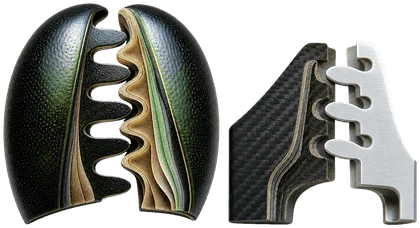
The study's strength lies in connecting those scales. Chemistry helps make the cuticle tough. Layering changes how a blade separates. The jigsaw seam directs where that separation occurs. Lateral supports distribute compression through the body. No single feature carries the entire defense, and copying only the beetle's outline would miss the point. The useful design is the relationship among the parts.
This is what makes the ironclad beetle more interesting than a tiny object that is simply hard. Hardness alone can make a material brittle. Thickness alone adds weight. The insect combines material chemistry, layered construction, friction, lateral supports, and puzzle-like geometry so that pressure travels through a system. Its armor manages damage rather than pretending damage will never occur.
A flightless beetle therefore offers an unusually elegant engineering lesson. When escape disappeared as an option, evolution did not merely thicken the shell. It transformed the seam—the place that looks most likely to fail—into a device for absorbing energy. The beetle refuses to flatten because its body knows how to bend, peel, grip, and share the load before anything important gives way.
Sources