




 Share







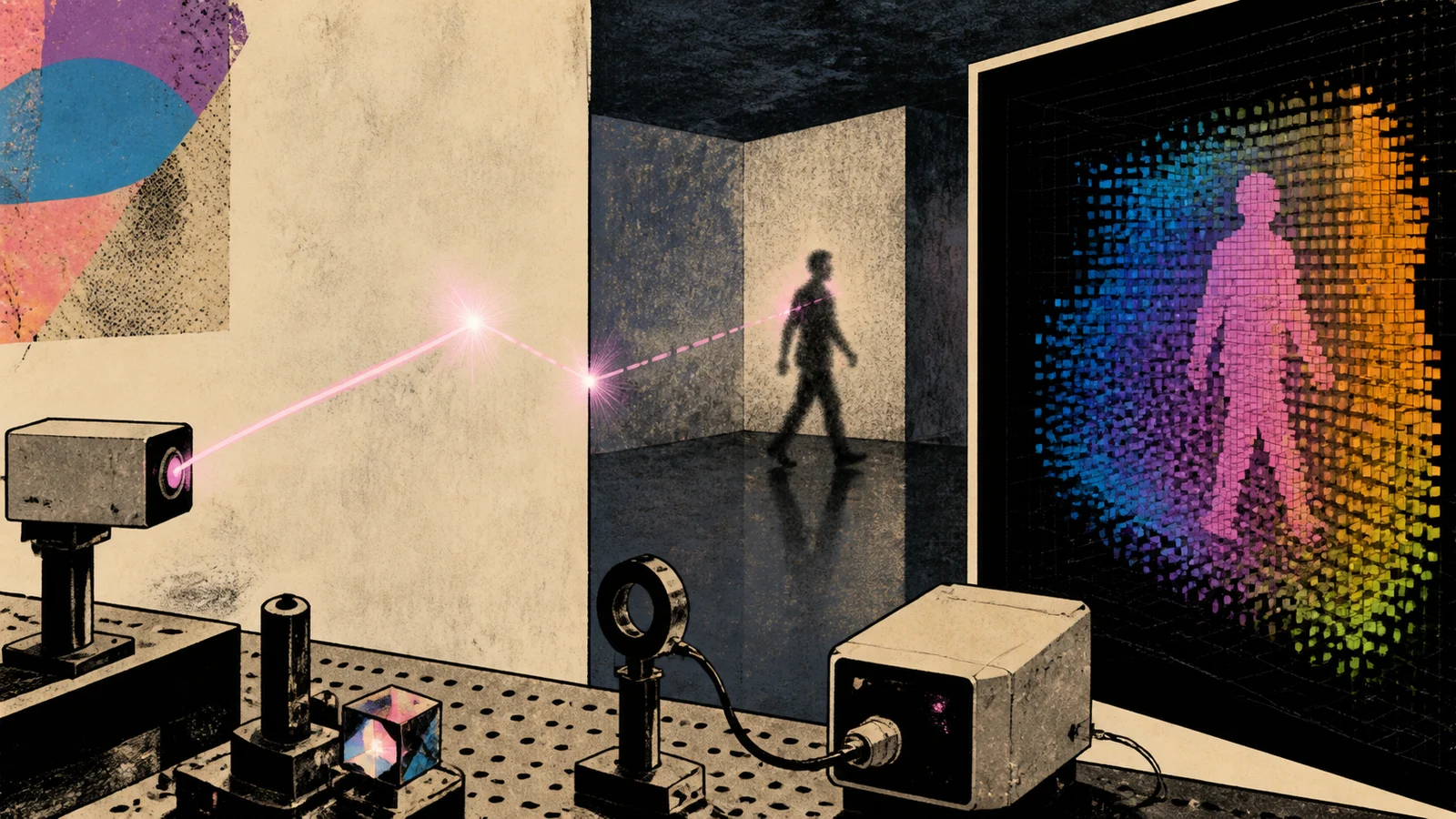
The camera does not point around the corner. It points at a wall. A laser scans that visible surface; light scatters into the hidden space, touches a moving person or object, returns to the wall, and finally reaches a sensitive detector. By then only a tiny fraction of the original photons remain, but their travel times contain the geometry of the route.
Stanford researchers built algorithms that untangle those echoes into low-resolution, room-size moving shapes. The system sampled hidden motion at four frames per second and could reconstruct at 60 frames per second on a graphics processor. Its wave-based mathematics borrowed ideas from seismology, where reflected sound helps infer structures underground.
This is not X-ray vision. It does not see through an opaque wall, produce ordinary photographs, or fit inside a consumer camera. It needs a visible relay surface, powerful pulsed illumination, sensitive timing, and heavy computation. The achievement is more exact: light that seems lost after several diffuse bounces can still preserve enough timing information to reveal motion beyond direct sight.
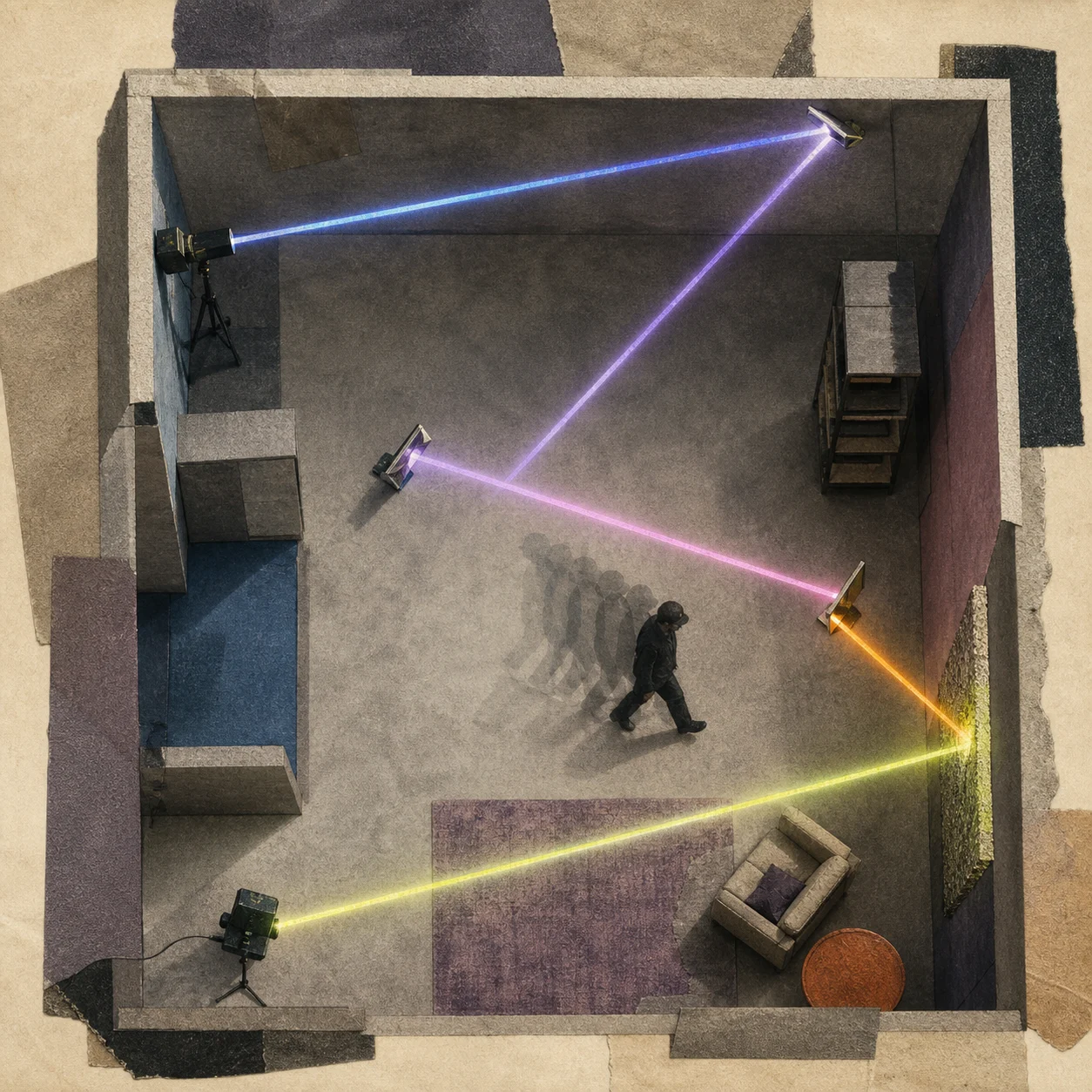
Ordinary vision assumes a nearly direct path. Light leaves a source, reflects from an object, and enters an eye or lens. A corner breaks that connection, but it does not stop light from moving. Walls scatter illumination in many directions. Some photons travel from the visible wall into the hidden space, reflect from a person, return to the wall, and scatter again toward the detector. The problem is not absence; it is extreme dilution and confusion.
The experimental system sends short laser pulses across points on the relay wall. A time-resolved sensor records the scarce returning photons and when each one arrives. A slightly longer path means a slightly later detection. Repeating that measurement across the wall produces a large set of travel-time constraints, each mixing information from many possible hidden positions.
Reconstruction software solves the inverse problem. Instead of tracing a clean ray from a visible object, it asks which hidden geometry could have produced the measured field of delayed light. The team treated the returning signal as waves spreading from unseen surfaces. That approach drew on seismic imaging, synthetic-aperture radar, and other fields that infer inaccessible structures from echoes rather than direct pictures.
The resulting image is not a conventional video. It resembles a coarse three-dimensional silhouette or moving volume. In the demonstration, a person in a reflective tracksuit stretched, walked, and hopped in a hidden room while the apparatus faced away from him. The recovered motion was recognizable enough to follow, even though fine facial or clothing detail never appeared.
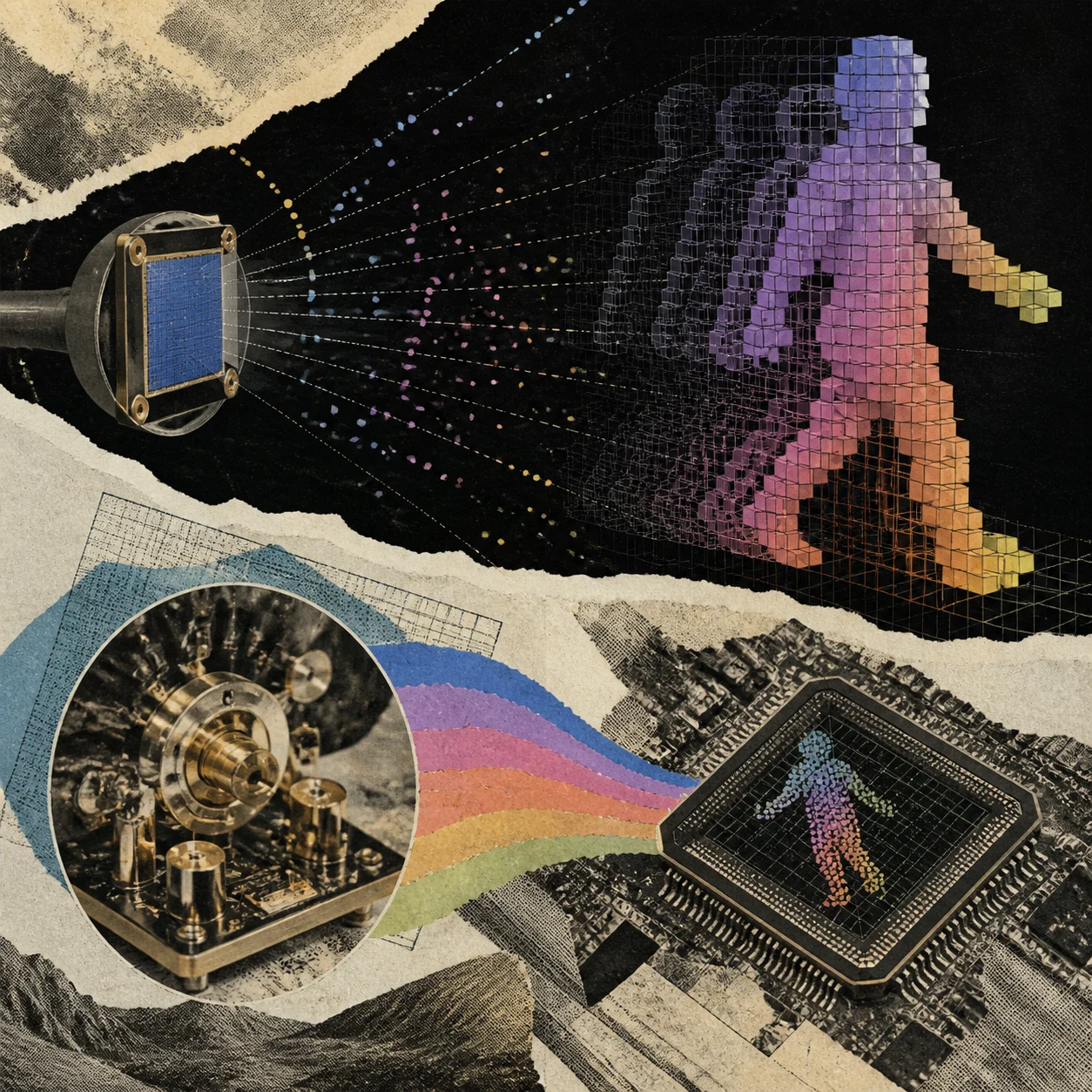
Speed marked the advance. The system acquired hidden movement at about four frames per second, then reconstructed the scene at up to 60 frames per second on a computer with a graphics processing unit. Acquisition and reconstruction are separate rates: faster computation cannot manufacture photons that were never measured, but it can keep the mathematical decoding from becoming the only bottleneck.
The team also tested varied surfaces. Earlier non-line-of-sight systems often worked best with objects that reflected light very evenly or very strongly. This version recovered signals from books, textured sculptures, and shiny objects such as a disco ball. Real scenes remain harder than a controlled room, but expanding the range of reflectance is essential if a future sensor is expected to encounter cars, fabric, paint, and weather rather than calibrated targets.
More powerful illumination helped collect enough returning light. The laser used in the reported setup was far stronger than the team's earlier one. That is one reason the result should not be imagined as a phone quietly peeking down a hallway. Eye safety, range, sunlight, fog, rain, snow, sensor cost, and processing all stand between a laboratory demonstration and a practical outdoor system.
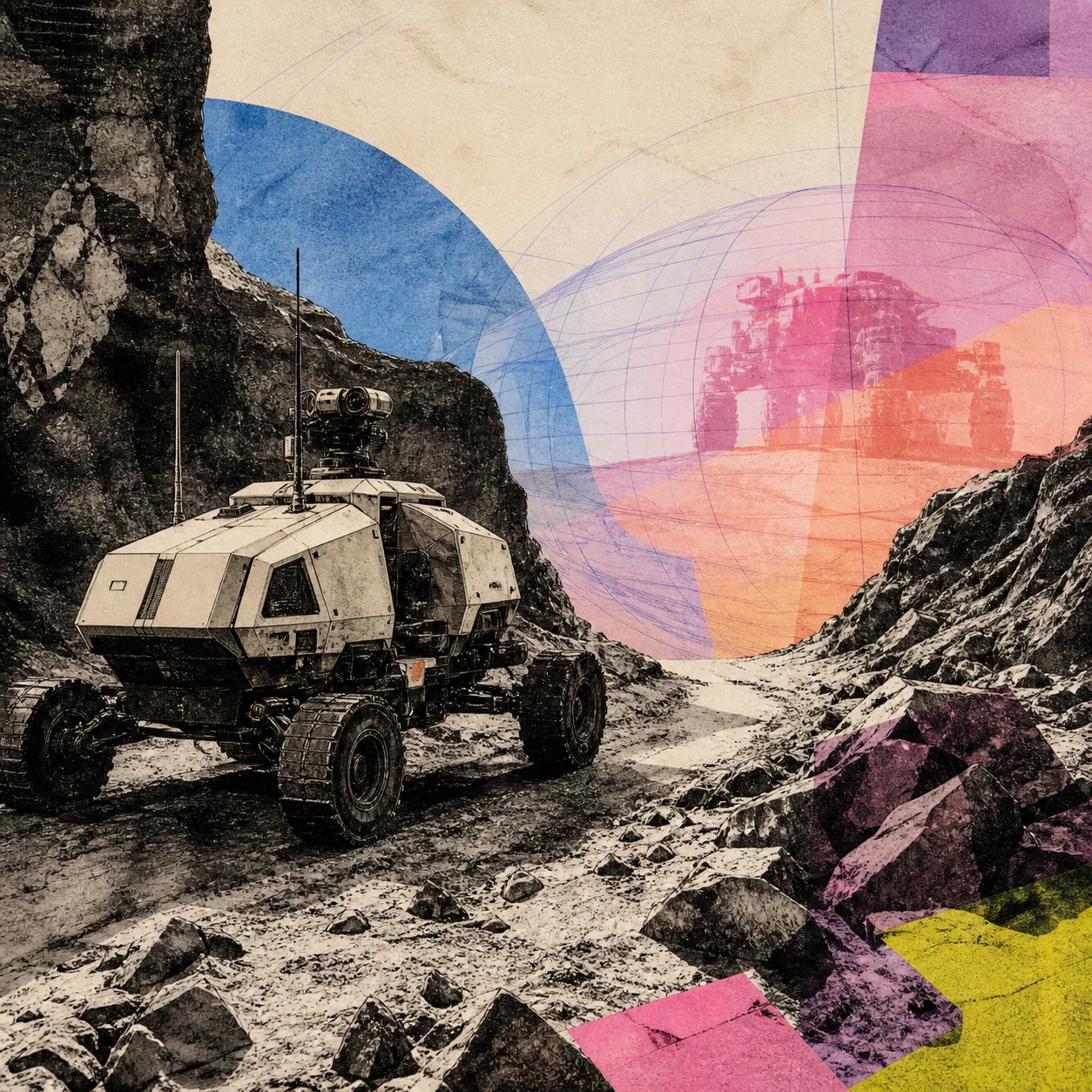
Potential applications include giving robots or autonomous vehicles warning about motion outside a direct field of view. A vehicle approaching a blind corner would not need a portrait of an unseen pedestrian; a coarse indication that something is moving could already be useful. Those benefits remain prospective. The work showed a method and its limits, not a deployed safety guarantee.
The phrase “around-corner camera” is accurate if the corner is understood as a light path, not a lens position. The wall becomes an improvised mirror that scrambles rather than preserves an image. Timing measurements and computation then perform the astonishing recovery. The system does not defeat opacity. It listens to the photon echoes that ordinary cameras discard.
The trick works because scattered does not mean information-free. Each photon carries only a tiny clue, and most never return, but millions of constrained paths can overlap into a recoverable shape. The hidden figure emerges from statistics and geometry, not from a secret beam slipping straight through the wall.
Resolution is the price of the indirect route. Every diffuse bounce spreads light and mixes paths, so the reconstruction preserves broad motion better than fine surface detail. That tradeoff still leaves a useful research target: detecting where a hidden object is moving can matter even when the system cannot tell what expression is on its face.
Sources