




 Share








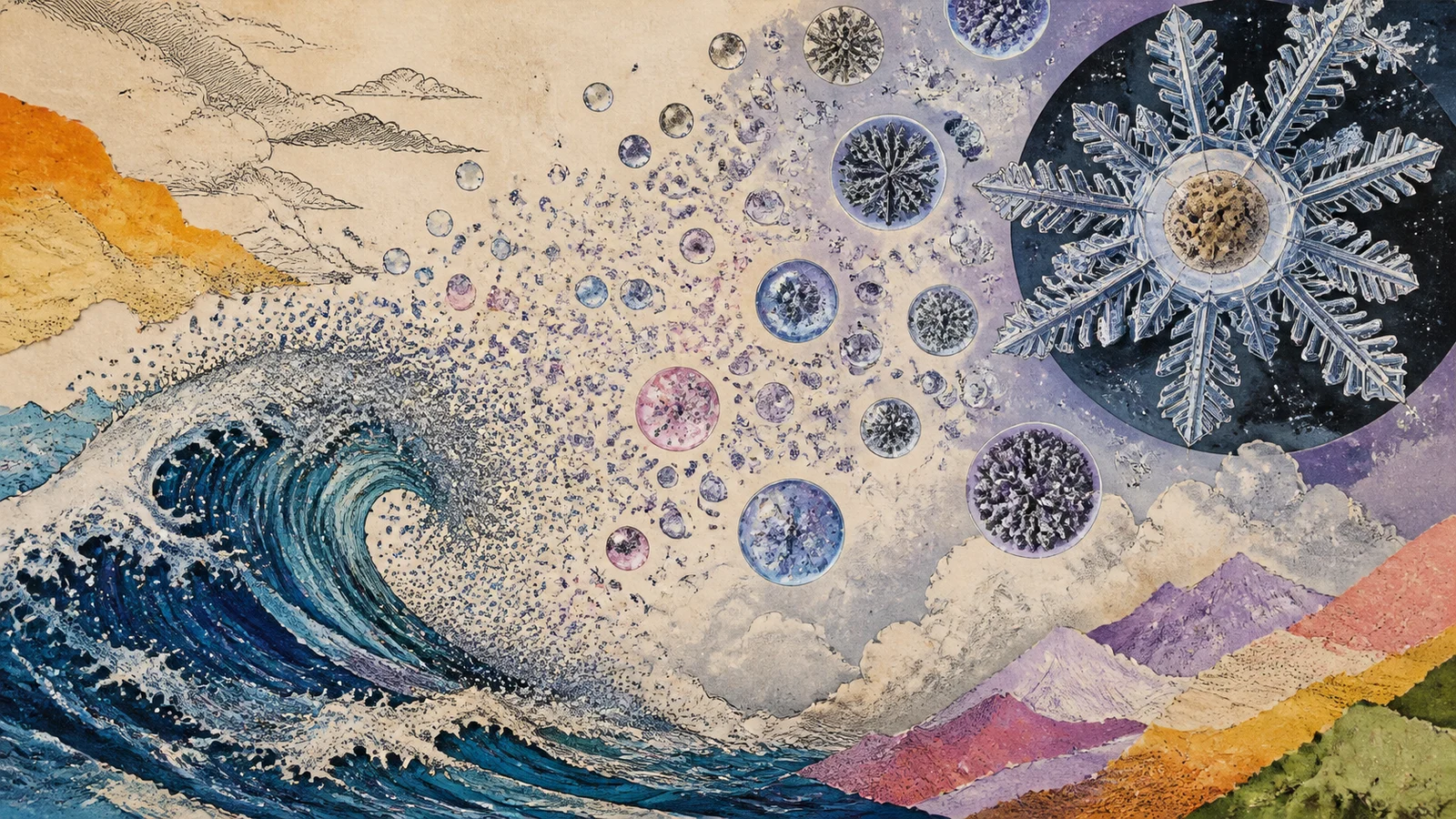
Every breaking wave is also an aerosol machine. Bubbles rise through seawater, burst, and fling microscopic droplets into the air. As the water evaporates, those sea-spray particles carry salt and organic material gathered near the ocean surface. Winds can lift them far above the waves and, in some cases, into the cold regions where cloud droplets begin freezing around particles.
Researchers recreated sea spray in laboratory tanks designed to mirror ocean conditions, then traced which components acted as ice-nucleating particles. The work linked some of the activity to metabolic products released by marine microorganisms—especially particular polysaccharides and proteins carried on the spray. The microbe itself does not need to fly intact or become a raindrop; its chemistry can travel on a salt particle.
Ice nucleation is one step in cloud microphysics, not a tiny switch that makes rain on command. Dust, soot, wildfire ash, and other particles can also start cloud ice, and the lab measured controlled particle populations rather than every ocean spray event. The useful discovery is a route connecting surface life, breaking bubbles, high cold air, and the ice crystals that climate models must represent.
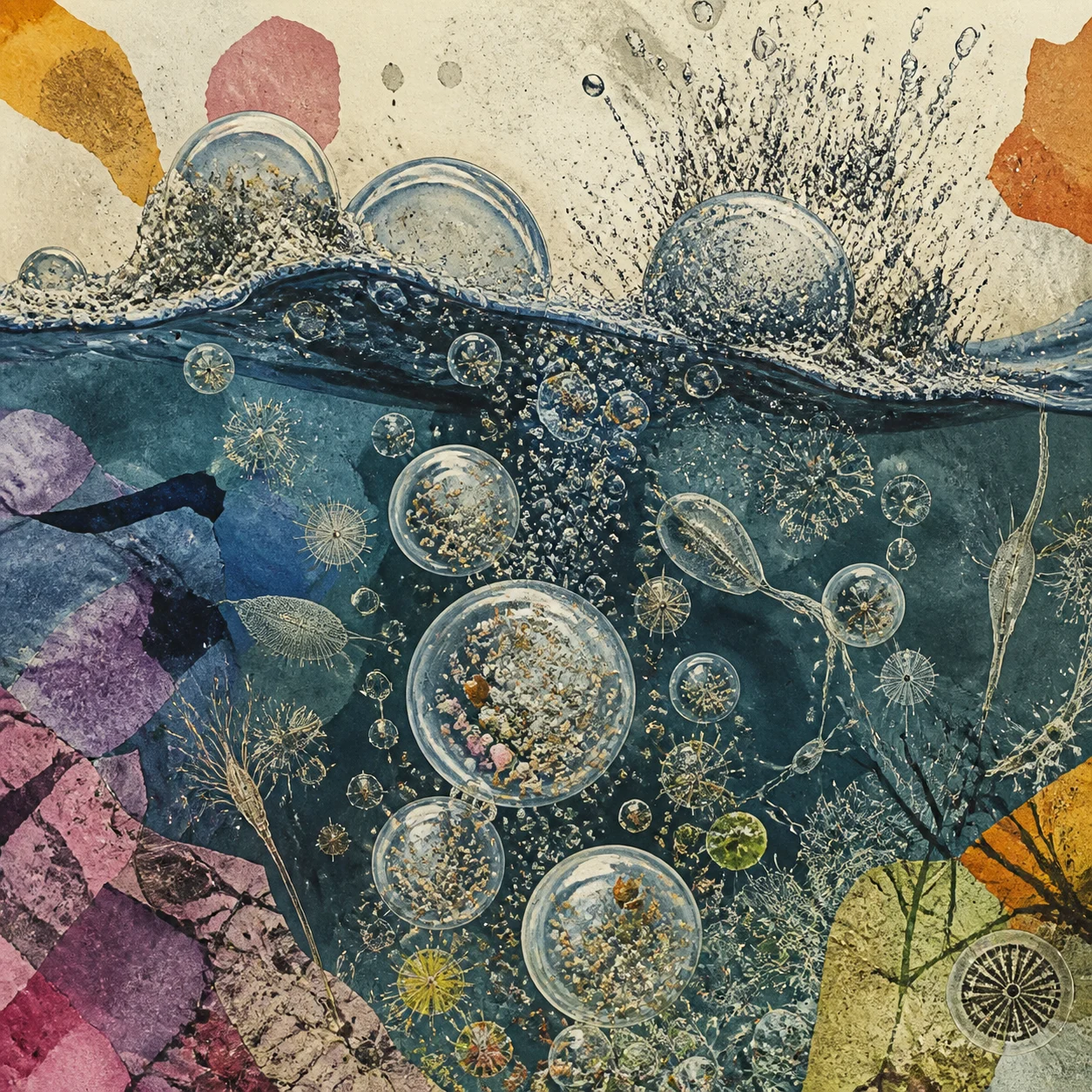
Cloud water can remain liquid below the ordinary freezing point unless it encounters a surface that helps molecules organize into ice. Particles capable of providing that beginning are called ice-nucleating particles. Their abundance and chemistry influence when supercooled droplets freeze, which in turn affects a cloud's structure, lifetime, and precipitation processes. The atmosphere receives such particles from land, fire, industry, and the sea.
The ocean contribution starts with bubbles. Wind roughens the surface and breaking waves trap air beneath it. As bubbles rise, they collect dissolved and suspended material from the water around them. At the surface, their thin caps rupture and launch fine droplets. Water can evaporate from those droplets, leaving a concentrated mixture of sea salt and organic compounds small enough to remain airborne.
That mixture is difficult to study in the open atmosphere because each particle has a history. It can age, mix with pollution, absorb water, or travel far from the place it formed. The laboratory approach therefore built controlled tanks that generated spray from seawater under ocean-like conditions. Researchers could then connect the composition of the source water with the chemistry and freezing behavior of the particles produced above it.
The experiments identified metabolic products from microorganisms near the sea surface in ice-active aerosol. Polysaccharides—long chains of sugars—and proteins were among the organic materials associated with nucleation. These compounds can become coatings or inclusions on salt-rich particles. The result provides a molecular link between biological activity in surface water and the physical threshold at which cloud droplets can freeze.
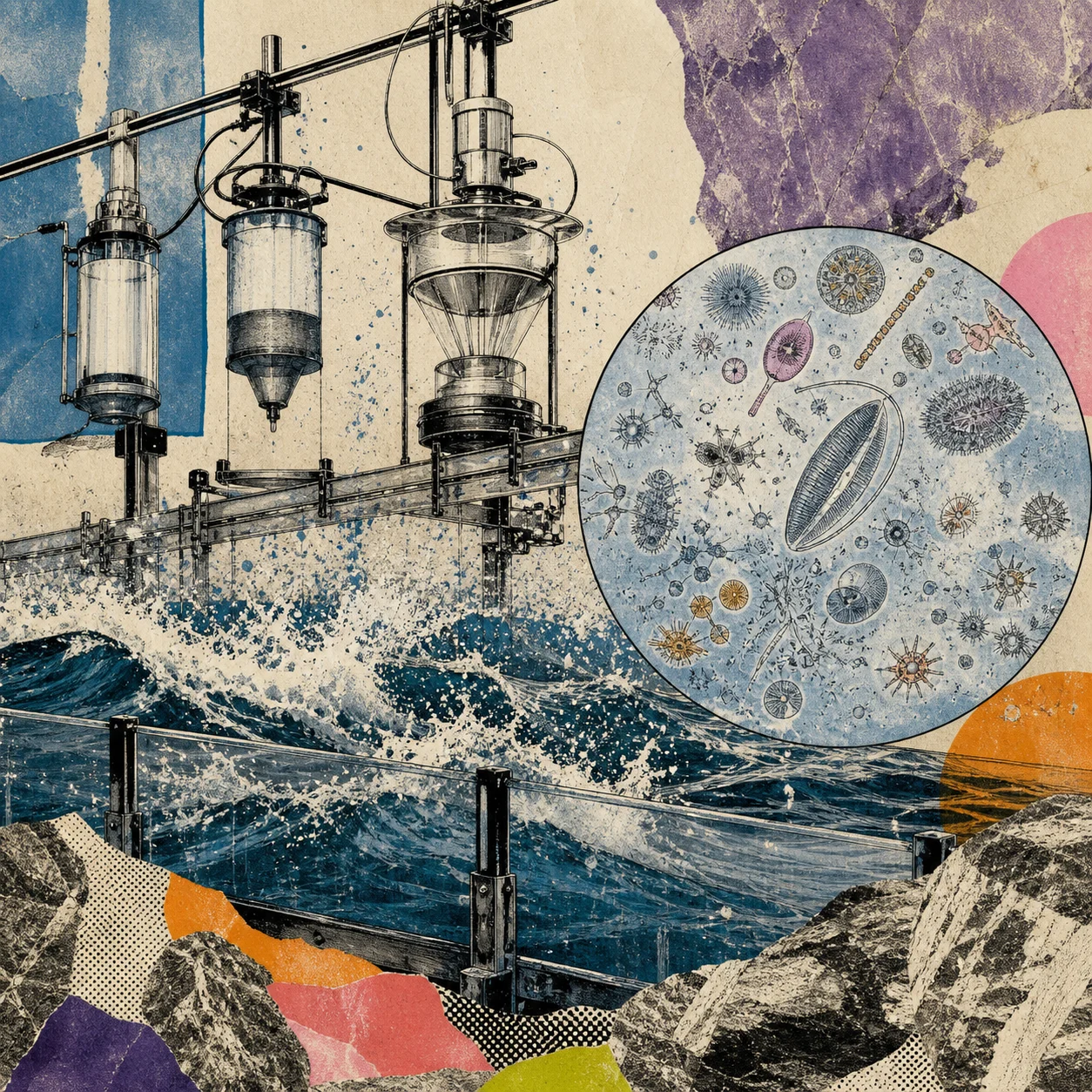
The wording needs restraint. A microorganism releasing an ice-active compound is not personally building a cloud, and one particle does not guarantee rain. Nucleation occurs under particular temperatures and concentrations inside a larger atmospheric system. Winds, humidity, vertical motion, other aerosols, and the cloud's own evolution all matter. The lab isolates a step so models can represent it; it does not recreate every sky above every sea.
Sea spray matters geographically because oceans cover most of the planet and many clouds form far from continents. Over remote water, mineral dust and industrial particles can be less abundant than they are downwind of land. A realistic inventory of marine ice-nucleating particles therefore helps scientists understand cloud formation where the atmosphere is most directly connected to the ocean surface below.
Different particle sources can produce different freezing behavior. Dust, soot, and ash offer mineral or carbon surfaces; marine aerosol combines salts with biological organic matter. Calling all of them “cloud seeds” is useful shorthand, but the comparison should not flatten their chemistry. Researchers need temperature-dependent measurements and molecular identification because two particles of the same size can interact with water very differently.
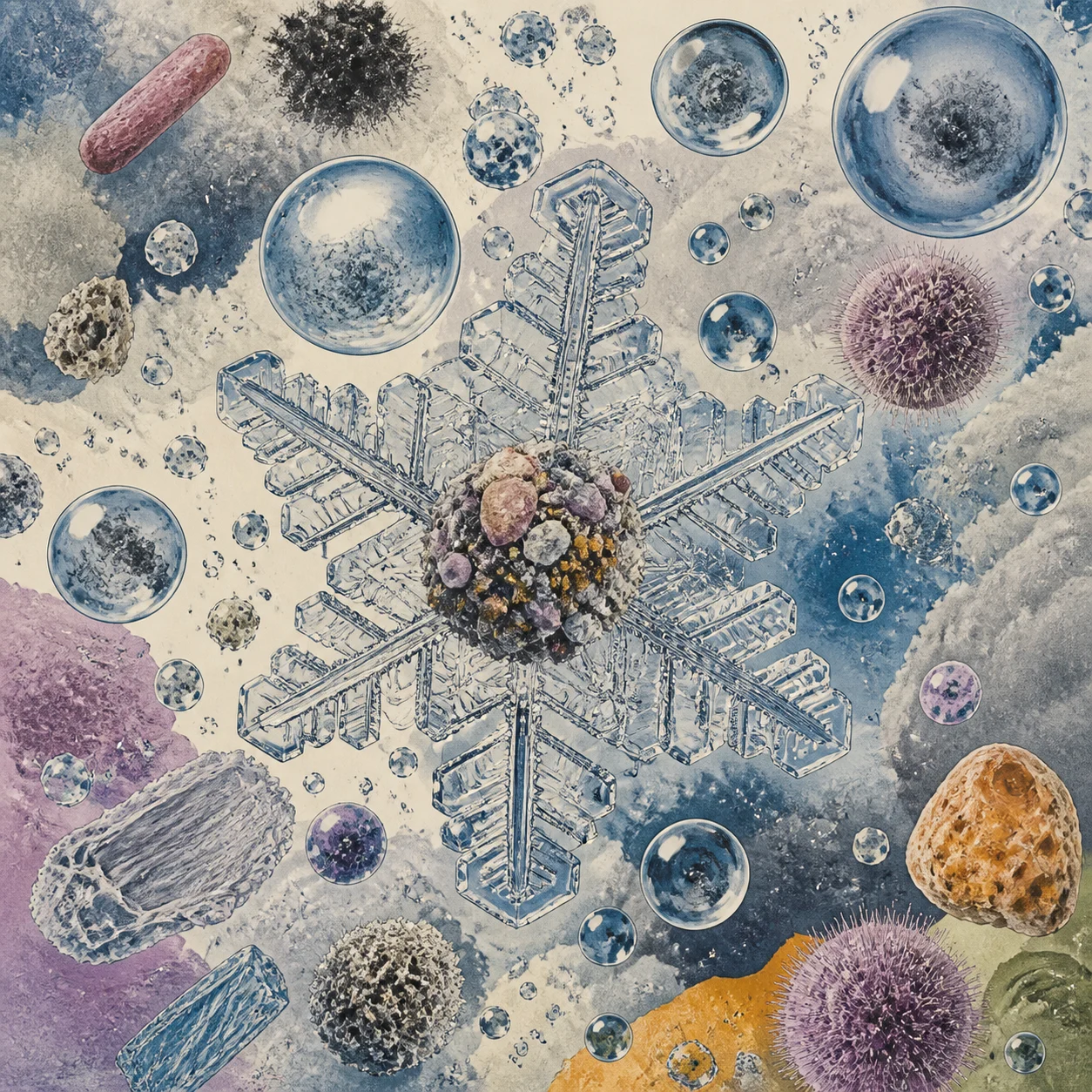
This is where an almost invisible chain becomes climatically important. Microbes transform material in surface water. Bubbles collect some of those products. Bursting films create spray. Winds transport the particles. Cold cloud droplets encounter them and, under suitable conditions, organize into ice. Each link can be measured separately, then connected in models that ask how clouds reflect sunlight, move water, and respond to a changing ocean.
The research does not turn the sea into a simple weather lever. Its achievement is specificity. Instead of saying vaguely that ocean biology affects clouds, scientists identified classes of compounds in generated spray and measured their ice-nucleating role. A wave can therefore carry information about microscopic life into the sky—not as a message, but as chemistry with a physical consequence.
At the human scale, the ocean surface looks like a boundary. At aerosol scale, it is an exchange zone crossed constantly by gases, droplets, salt, and organic material. Breaking waves make that exchange visible for a second as foam and mist; the laboratory follows the same traffic after it becomes too small to see.
The tanks also give atmospheric researchers a reproducible particle source. Instead of waiting beneath a passing marine cloud, they can vary the source water, generate spray, collect aerosol, and test freezing at controlled temperatures. That sequence connects microbiology and cloud physics without pretending the laboratory contains an entire weather system.
Sources