





 Share









For years, nonstop flight invited a tempting assumption: a bird aloft for days must be sleeping somewhere in the journey. Researchers finally tested that idea on great frigatebirds by attaching small recorders that tracked brain activity, head movement, position, and altitude during ocean foraging flights. The birds did sleep in the air—but in a pattern far stranger and stingier than anyone could infer from flight alone.
At night, slow-wave sleep appeared for stretches of minutes while the birds soared. Sometimes one cerebral hemisphere slept and the other remained awake. During circling flight, the awake side was usually connected to the eye facing into the turn, as if the bird were keeping watch on its path and nearby traffic. The recorders also captured both hemispheres sleeping together and, rarely, brief episodes of REM sleep without a change in flight path.
The startling number was not how much sleep they managed, but how little: about 42 minutes a day on average in flight, compared with more than 12 hours a day after returning to land. The study measured a small tracked group of nesting females on flights lasting up to ten days and 3,000 kilometers; it did not prove that every long-distance bird sleeps this way. Frigatebirds turned the sky into a bedroom, then barely used it.

Continuous flight is not the same evidence as sleep. Before this work, researchers could track a bird remaining aloft, but a flight path cannot reveal whether the brain is awake, in slow-wave sleep, or briefly in rapid eye movement sleep. The distinction matters because birds might have navigated with one sleeping hemisphere, slept with both, or simply postponed most sleep. Only direct brain measurements could separate those possibilities.
The team worked with great frigatebirds nesting in the Galápagos. Small data recorders measured electrical activity from both cerebral hemispheres and movements of the head, while a separate GPS unit tracked position and altitude. The devices traveled with females on nonstop foraging trips that lasted as long as ten days and covered up to 3,000 kilometers. When the birds returned, researchers recovered the instruments and the hidden sleep record inside them.
During daylight the birds remained awake while searching for feeding opportunities. After sunset, the electrical pattern sometimes shifted into slow-wave sleep as a bird soared. A bout could involve one hemisphere or both at once. Sleeping with both halves showed that one awake half was not always required to maintain aerodynamic control, at least during the stable flight conditions in which the behavior appeared.
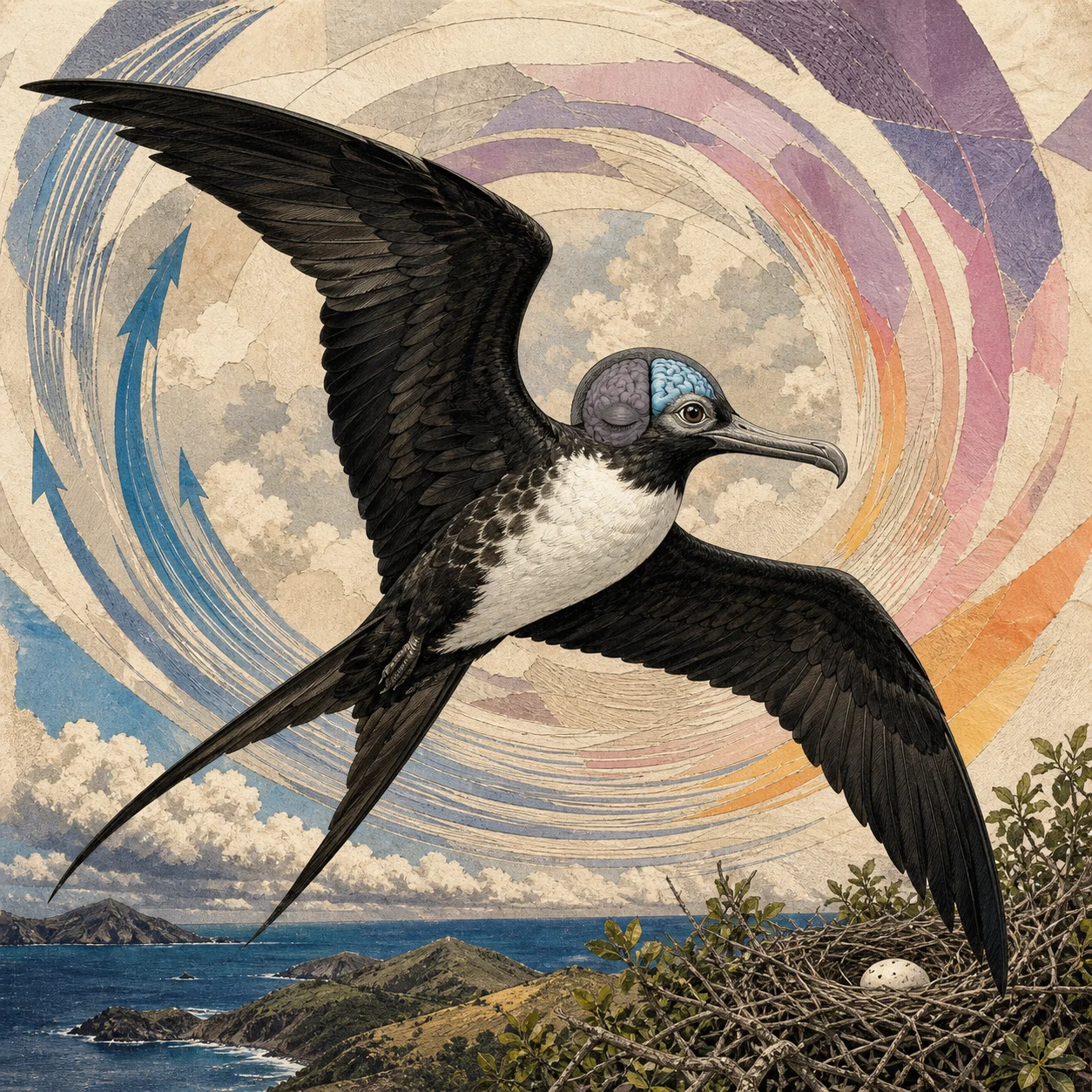
The one-sided sleep still carried a striking directional pattern. When a frigatebird circled on rising air, the hemisphere linked to the eye looking into the turn tended to remain awake while the other slept. That finding supports a practical interpretation: the open eye may help monitor the direction of travel or other birds while the sleeping half takes a short turn offline. It is vigilance paired with rest, not an unconscious autopilot proven to solve every hazard.
The recorders also caught rare interruptions of slow-wave sleep by REM sleep. Bird REM episodes are much shorter than the long episodes familiar from mammals. A frigatebird's head could dip briefly while the tracked flight path continued unchanged. The result is visually irresistible, but the measured fact is precise: brief REM-like brain activity and head movement occurred during flight, not a long dream sequence that the study could somehow read.
The daily total reframed the entire discovery. Aloft, the birds averaged only 42 minutes of sleep in a day. Back on land, they slept for more than 12 hours, with longer and deeper bouts. The ability to sleep in the sky therefore did not let them reproduce a normal night overhead. It provided scattered fragments of rest while the ecological demands of life at sea kept most of the brain's schedule unusually alert.
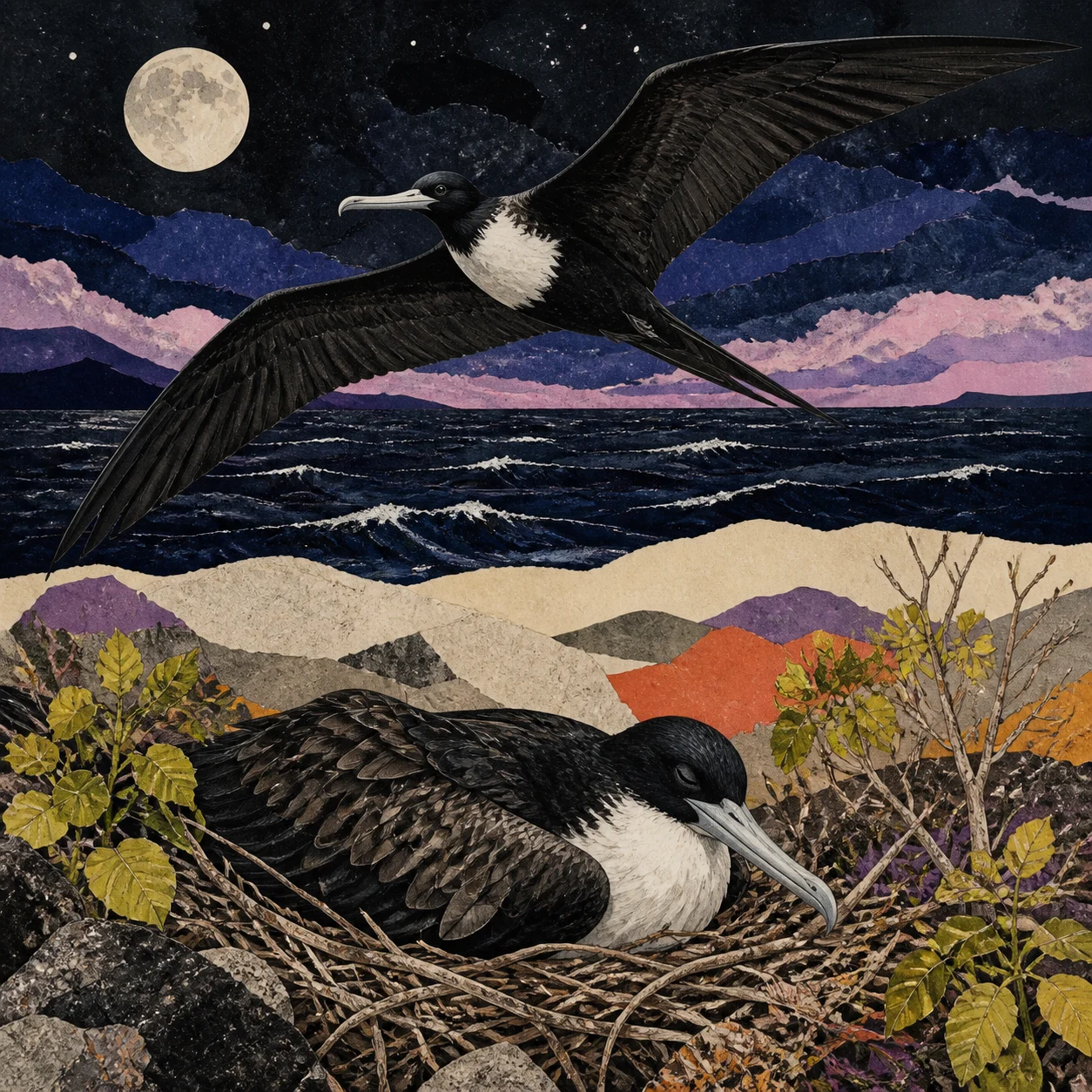
Why such little sleep is enough during a journey remains unresolved. Frigatebirds follow conditions associated with feeding opportunities, and attention may be valuable around the clock, but the experiment did not deliver a complete explanation for their apparent resilience. That unanswered question is part of the result. The birds demonstrate that sleep can be divided and compressed under extreme conditions; they do not make sleep optional for birds in general, much less for people.
The broader lesson is methodological as much as biological. A tracker can tell us where an animal goes. An EEG can tell us when its brain changes state. Combining the two transformed an elegant guess into measured behavior and then complicated the guess: yes, great frigatebirds sleep while flying, sometimes with half a brain and sometimes with both, but they do so for remarkably little time. The ocean crossing contains a bedroom measured in minutes.
The finding also protects a useful distinction between capability and routine. Demonstrating that an animal can enter a sleep state during flight does not show that it does so continuously, safely in every maneuver, or in the same pattern across species. Here the strongest claim is also the most interesting one: direct recordings captured several sleep states in wild great frigatebirds aloft.
Sources