Share
Share







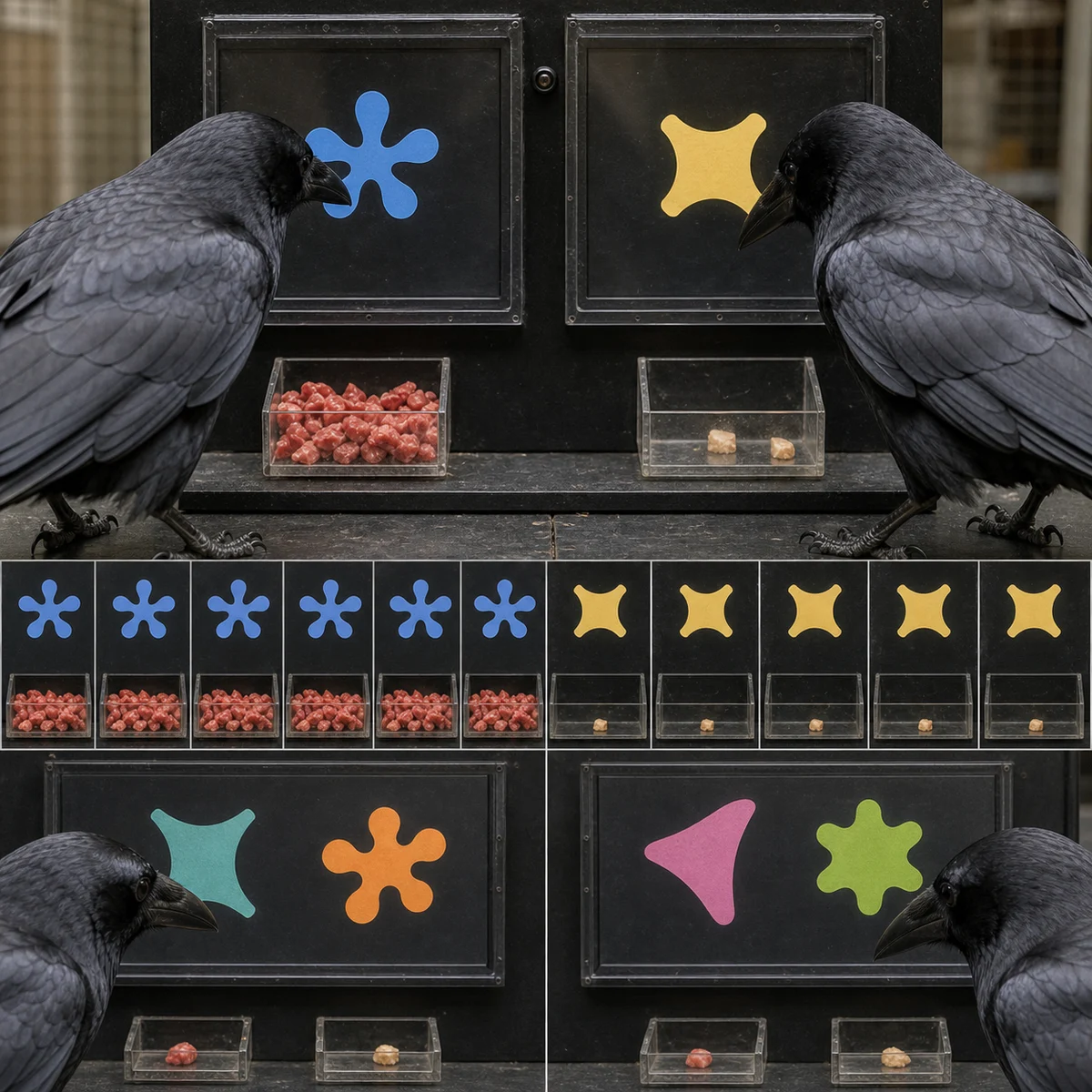
Two carrion crows learned a visual economy of uncertainty. Arbitrary symbols predicted reward probabilities ranging from 10 to 90 percent. After training, the birds faced pairs of symbols, including combinations they had not previously chosen between, and selected the option associated with the better relative chance of reward.
Novel pairings mattered because they tested flexibility. A bird that memorized only one fixed response for each practiced pair would have no ready answer when the comparison changed. The crows' choices instead tracked the relation between the two displayed probabilities. Researchers also used a control designed to separate that pattern from simply favoring whichever symbol had delivered rewards most often in absolute terms during training.
The experiment involved two animals in a laboratory. It does not establish that crows consciously represent written percentages, perform verbal arithmetic, or experience probability as humans describe it. “Statistical inference” names the behavior: the birds used learned reward distributions flexibly when choosing between alternatives. Their evidence was not a printed number. It was a history attached to an arbitrary symbol—and the choice revealed that they could compare those uncertain histories in a new pairing.