Share
Share







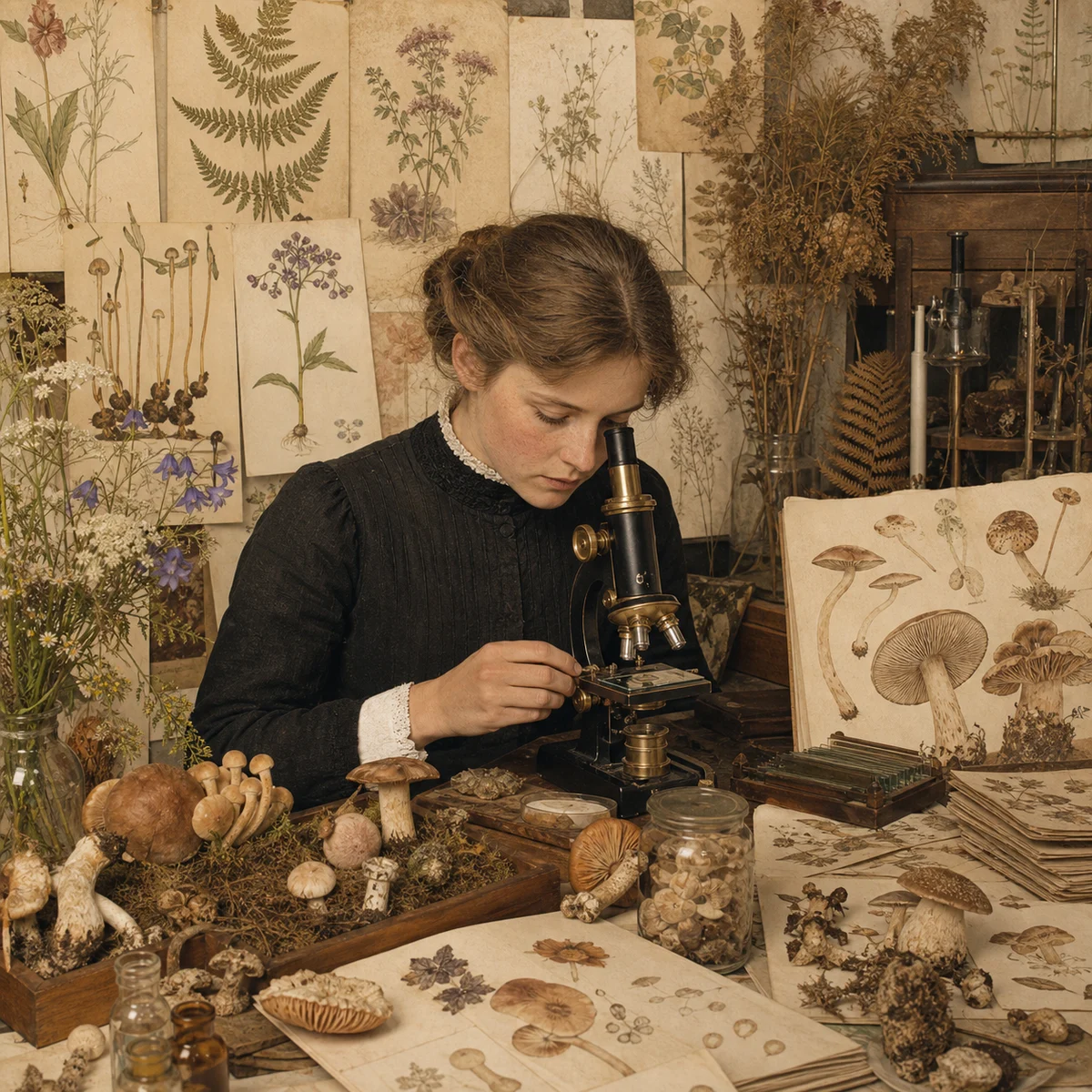
Before Beatrix Potter published the stories that made her famous, she pursued fungi with the tools of a serious naturalist. She visited Kew's Herbarium, examined specimens through microscopes, experimented with spore germination, and produced hundreds of precise drawings of fungi, spores, and mosses. Her art was not decoration added after the science; it was a way to record structures carefully enough to study them.
Potter tried to bring that work into scientific institutions that largely excluded women. She sought access to collections and specialists, and George Massee submitted her paper on fungal spore germination to the Linnean Society in 1897 because women could not present papers or become members. The society has since apologized for the sexism she encountered. Her paper itself was lost and never published, so its conclusions cannot be recovered or verified. Later stories of scientific vindication outrun the surviving evidence.
The surviving record is still rich: visits, letters, journals, experiments, and remarkably accurate images. Potter eventually turned toward children's books, where close observation of the natural world remained visible in every plant and animal. Calling her merely a secret scientist makes the work sound like a hobby hidden behind Peter Rabbit. She was an active mycological researcher whose route into formal publication was blocked—and whose best evidence now lives in the drawings and archives that outlasted the missing paper.
Sources