Share
Share







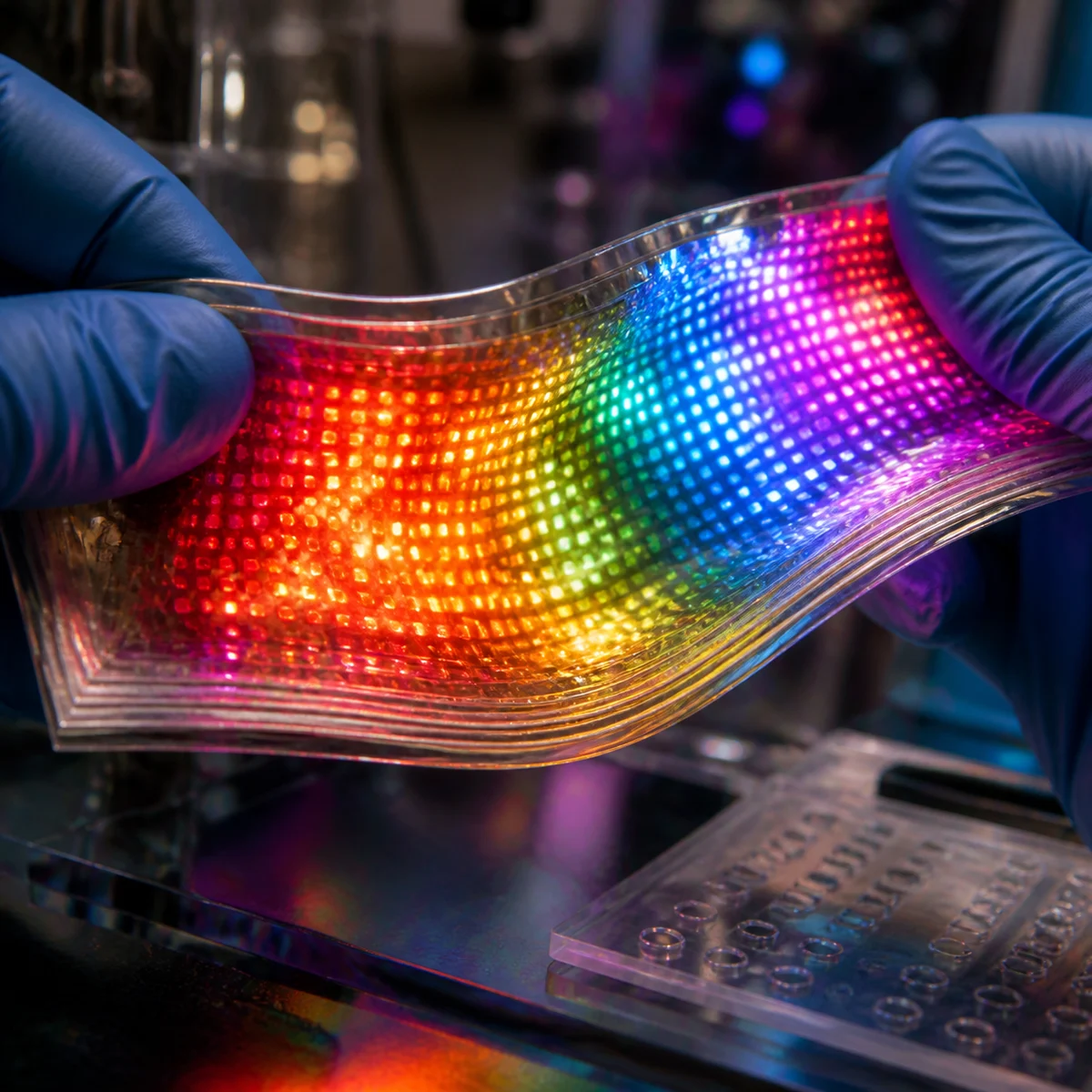
Ordinary displays tolerate a little flex only until brittle layers crack or separate. A Stanford team developed a bright elastic light-emitting polymer and assembled it into a proof-of-principle color display that could bend and stretch. The light-producing material moved with the substrate instead of demanding that the whole device remain rigid and flat.
Stretchability changes the geometry available to electronics. A soft display might conform to a curved surface, move with skin, or integrate with other flexible systems rather than sitting as a hard rectangle above them. The engineering challenge is not just making a rubber sheet. Conductive, insulating, and emissive layers must continue working together while their dimensions change. The demonstrated polymer addressed the luminous part of that stack.
The prototype was not a finished stretchable phone or a product ready for a wrist. It established that a bright color-emitting material and display architecture could operate under mechanical deformation. Many steps remain between a laboratory demonstration and durable consumer hardware. The result is best understood as a material possibility: pixels do not have to choose between illumination and elasticity, provided the layers around them are designed to move as one system.
Sources