Share
Share







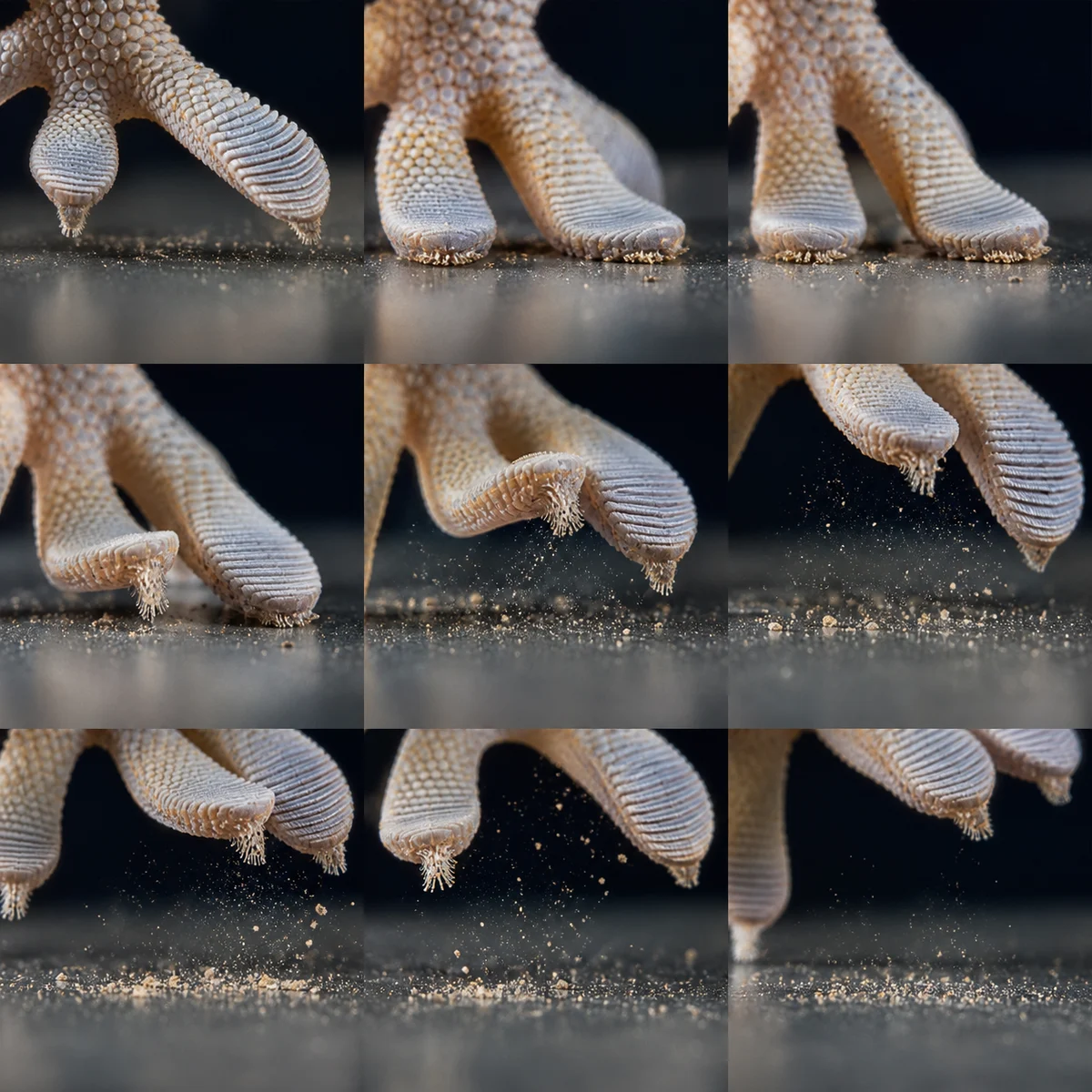
A gecko foot grips without wet glue. Dense microscopic structures on the toes make intimate contact with a surface, producing powerful dry adhesion. Dust should ruin that system by blocking contact—and at first it does. Experiments show that contaminated toes lose grip, then recover much of it as the animal takes only a few steps.
The cleaning action comes from motion. A gecko does not press each toe down and pull it straight back like a piece of tape. It peels the toe away during a step. That changing contact favors particles leaving the adhesive structures and remaining on the surface, so locomotion becomes maintenance. Each lift helps reset the very machinery needed for the next placement.
“Self-cleaning” does not mean impossible to foul. Recovery depends on what contaminant researchers use, the surface, and the walking conditions; some dirt and situations reduce adhesion more stubbornly than others. The measured result is narrower and more useful: under tested conditions, the natural peeling cycle rapidly shed contamination and restored a substantial share of grip. A gecko foot is not permanently spotless. It is an adhesive whose ordinary use contains its own cleaning step.
Sources