Share
Share







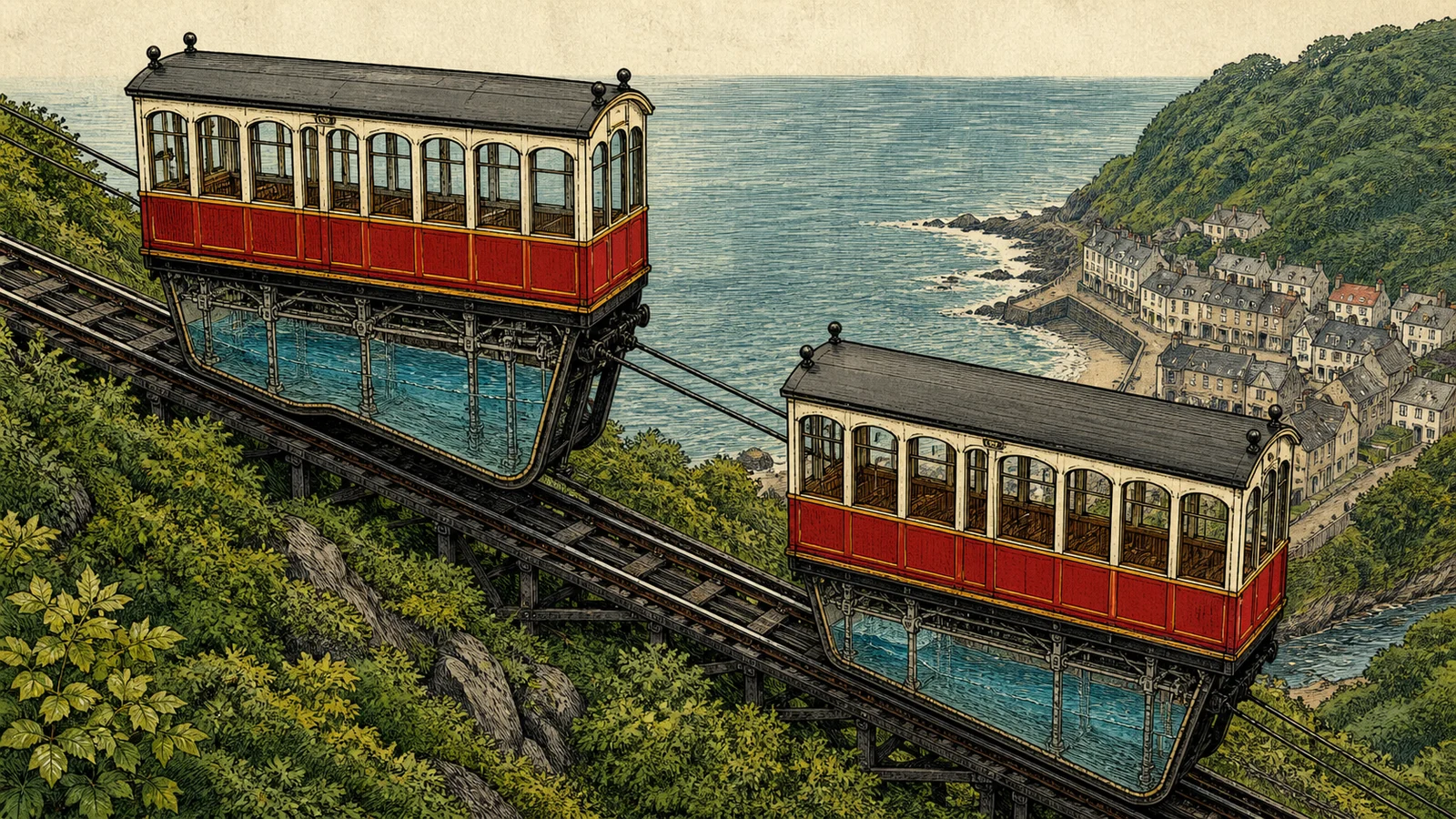
Lynton and Lynmouth sit close together on the North Devon coast but are divided by a high cliff. By the late nineteenth century, both places were drawing visitors, hotels were multiplying, and the steep trip between the upper town and the harbor below demanded a better answer. Construction of a funicular began in 1887. The Lynton and Lynmouth Cliff Railway opened on Easter Monday in 1890.
The railway works as a pair rather than as two independent vehicles. Its cars are permanently connected by cables that run around pulley wheels at the top and bottom of the track. The operator calls the cables ropes. Two hauling ropes carry the cars' weight, while two tail-balancing ropes counteract the changing weight of the hauling ropes. Each main pulley wheel is five feet six inches across.
Water supplies the adjustable ballast. The railway has rights, established through an 1888 act of Parliament, to take water from the West Lyn River. It travels more than a mile through five-inch pipes to holding tanks at the upper station. From there, it can fill a tank beneath each car. A full tank holds 700 gallons, turning an ordinary-looking passenger car into a movable reservoir.
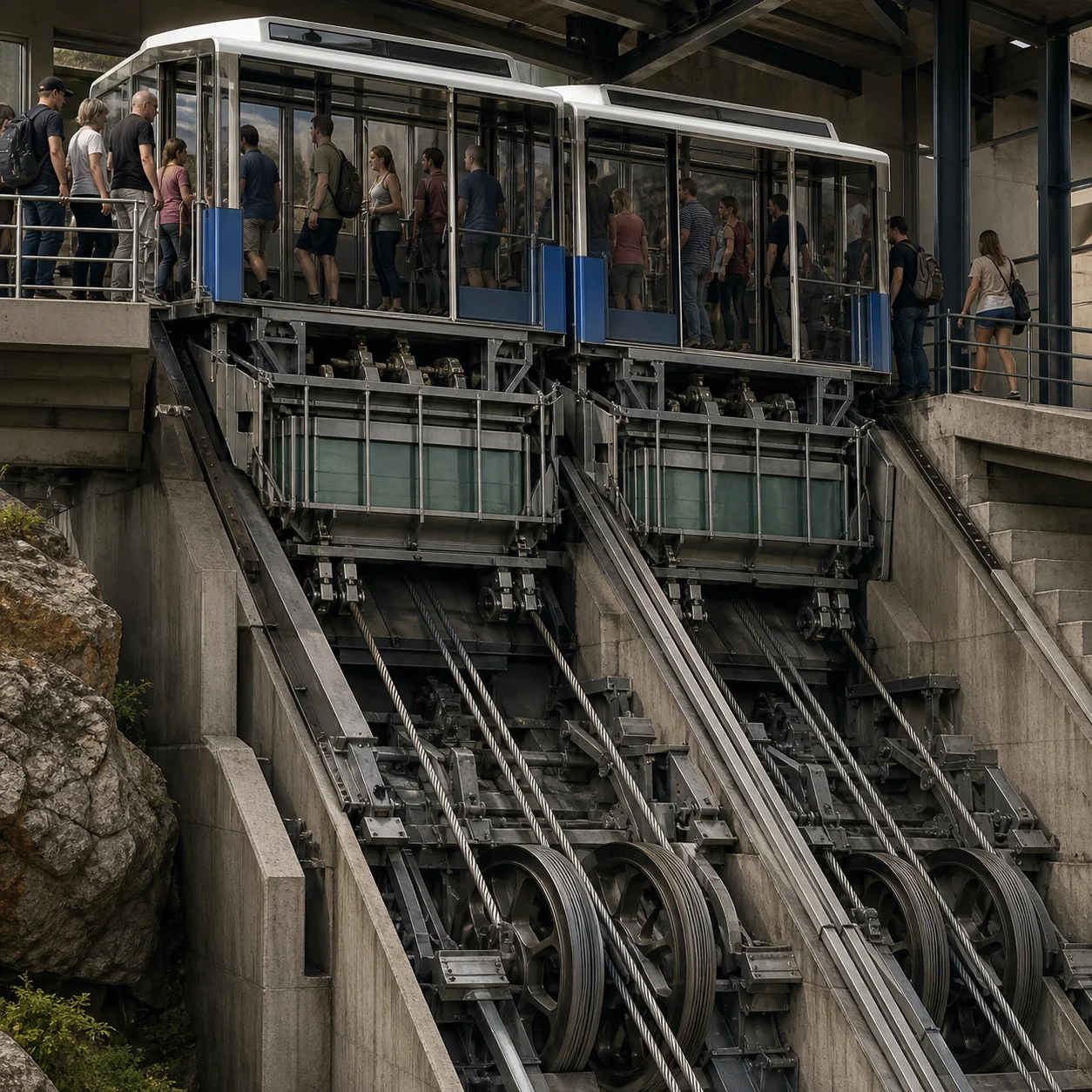
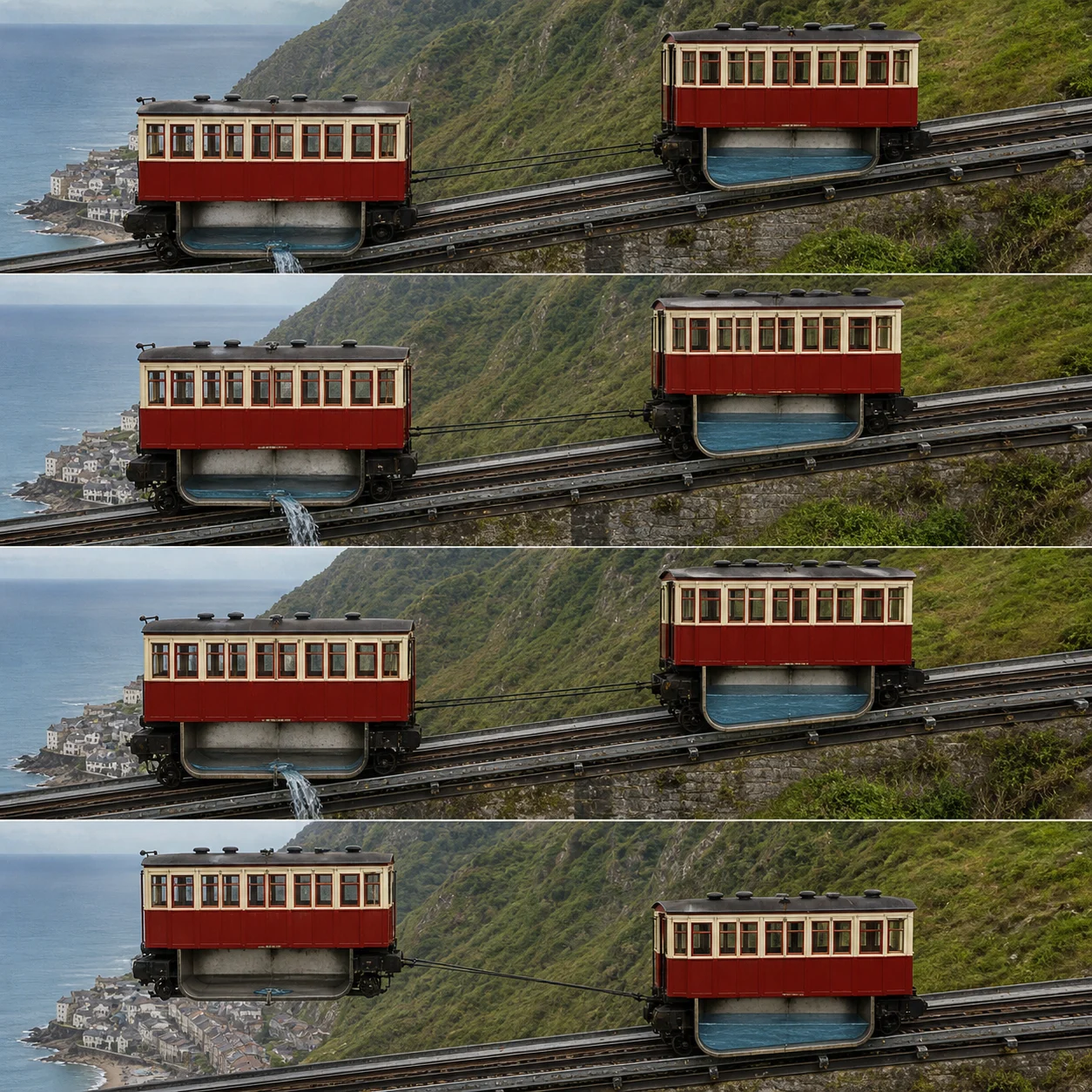
At the start of a cycle, both cars can be docked with full tanks and held in balance. Passengers then board at the top and bottom. Their unequal numbers and weight disturb that neat equality, so the cars remain secured by brakes while the drivers assess the load. The goal is not to fill one magical upper tank. It is to establish a controlled weight difference between the two linked cars.
When the drivers are ready, they communicate with arranged bell signals, release the safety lock, and manage the brakes. The driver in the lower car discharges water until the upper car is heavier. In some trips, passenger weight alone creates enough difference and no water needs to be released. Once the balance tips, gravity sends the upper car downhill, and the connecting ropes pull the lower car upward.
This is why the most accurate description is a water-ballast railway driven by gravity. The water is not running a pressure engine, turning a turbine, or pushing the cars along the rails. It changes mass. A heavier descending car gives up gravitational potential energy and does the work of lifting the lighter one. Water makes that useful imbalance adjustable from one passenger load to the next.
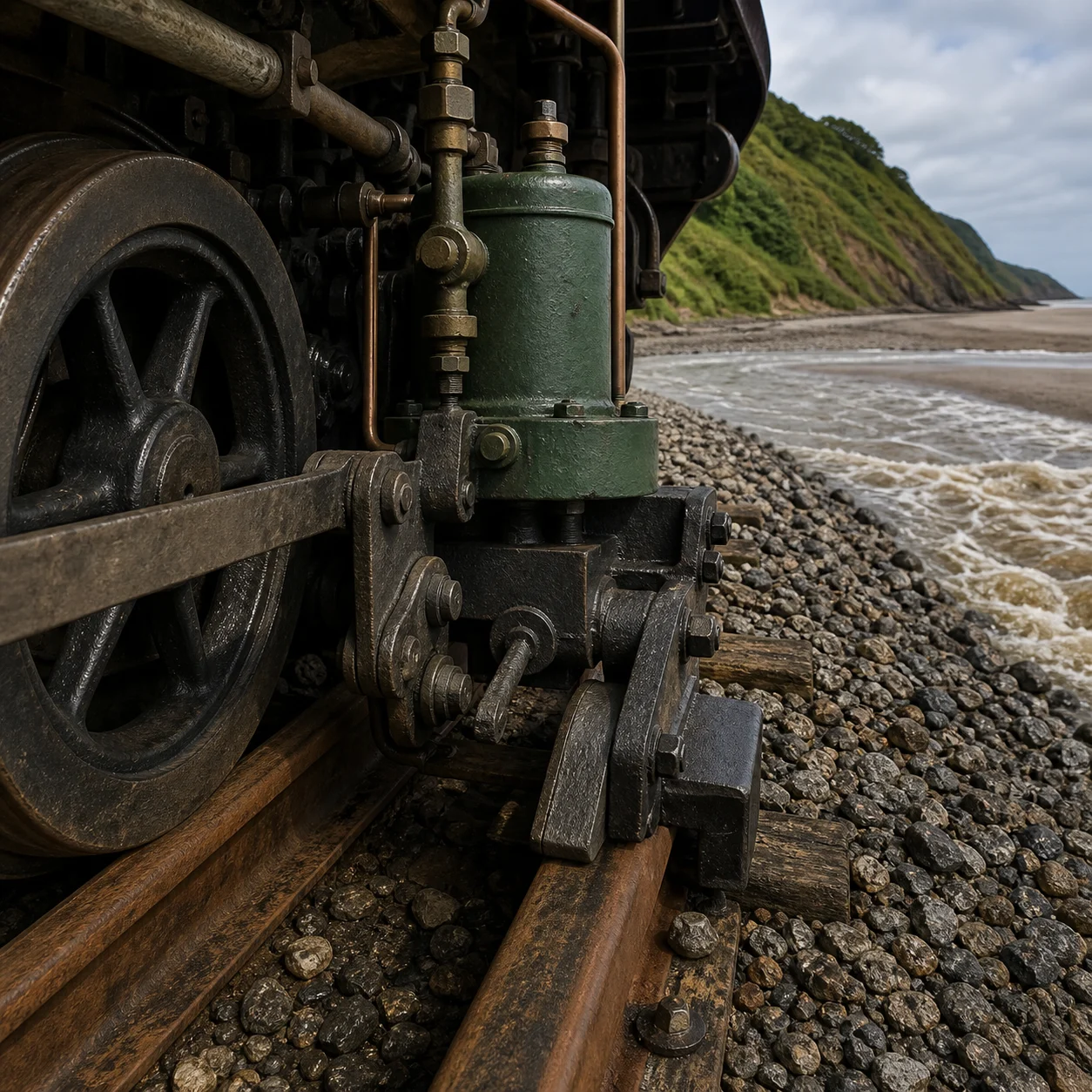
A system powered by imbalance also needs firm control. Each car has two sets of water-operated brakes. A governor driven by the main wheels operates one set. Its shoes press onto the top of the rail so forcefully that they lift the car by about two millimeters, using the car's own weight to create friction between brake shoe and rail. The tiny lift is part of a very large restraint.
The second brake system reverses the usual expectation. Its brakes are normally on, applied through a large water accumulator. The driver uses a hand wheel known as the deadman's handle to hold them off during the journey. If a car is unattended, the brakes clamp it to the rails. At the bottom station, the lower car also has a water-operated locking device that secures it while the pair is docked.
Once used as ballast, the river water is not pumped back to the top. The railway says it is discharged unchanged onto the beach at Lynmouth, about one hundred meters from the river mouth. Avoiding a return pump is crucial to the mechanism's claim: gravity and naturally supplied river water move the cars, while even the operating brakes use water rather than an external electrical drive.
The first traffic was meant to include both freight and passengers. Tourism soon became dominant, and a Historic England photograph from 1907 shows people waiting at the bottom station. The railway has continued operating since its opening. The operator describes it as the highest and steepest totally water-powered railway, a promotional superlative best kept attached to its source rather than treated as an unqualified engineering category.
Its more demonstrable distinction is the mechanism itself. The operator says it is the United Kingdom's only fully water-powered railway and one of three remaining worldwide that do not use electricity to pump ballast water back uphill. Other water-ballast lifts may still need a powered return system. At Lynton and Lynmouth, the river's elevation supplies the next charge before a car begins to move.
Nothing in the ride happens because water mysteriously flows downhill beside a train. Pipes, tanks, ropes, pulleys, governors, locks, brakes, passenger loads, and two drivers all take part. The spectacle is a carefully managed exchange: drain just enough mass below, release a secured pair, let the heavier car descend, and collect its partner above. More than a century of travel fits inside that repeated act of balancing and unbalancing two tanks.