Share
Share








A cycad can look like a palm or fern, though it is closely related to neither. Its stout trunk supports a crown of stiff leaves, and its reproductive organs gather into cones. There are separate male and female plants. To move pollen between them, some cycads rely on beetles—and new research shows that those insects receive a signal written in heat.
Across seventeen studied cycad species, male cones warmed near the end of the day and then cooled. Female cones heated about three hours later. The sequence was not merely a thermal curiosity happening beside pollination. Beetles tracked it. Marked insects in field observations moved toward the warm male cones first and later toward warm female cones, carrying pollen between the separate plants.
Plants can heat tissue by increasing metabolism. In the best-studied cycad, Zamia furfuracea, thermal images showed that heat production centered on the reproductive cone. The sporophylls bearing reproductive structures contained high concentrations of mitochondria, the cellular machinery supplying energy. The cone could rise dramatically above ambient temperature. Other species in the comparison produced their own heating patterns, but the shared timing—male first, female later—stood out.

Heat had often been treated as a way for plants to release more scent. Warm volatile compounds spread readily, and smell is known to guide cycad pollinators. The study adds a second role: infrared radiation itself can carry information. A warm cone is not only perfuming the air. Its temperature creates a signal detectable by an insect equipped to receive it.
The receiving equipment sits on the beetles' antennae. Using electron microscopy, electrical measurements, and gene-expression evidence, researchers identified specialized thermosensitive organs near the antenna tips. These structures contain heat-sensing neurons and include molecular machinery responsive to warmth. Tests of different beetles suggested that sensitivity could be tuned to the heating range of each insect's own cycad host.
That match supports a timed pollination route. Beetles enter male cones to feed on pollen. Cycads use a combination of odor, humidity, and heat in a push-pull relationship: moderate signals attract, while an overwhelming phase helps drive insects away. When the male cone's invitation becomes too intense and the female cone begins its later warming, the beetles move. Their bodies bring male pollen to female reproductive structures.
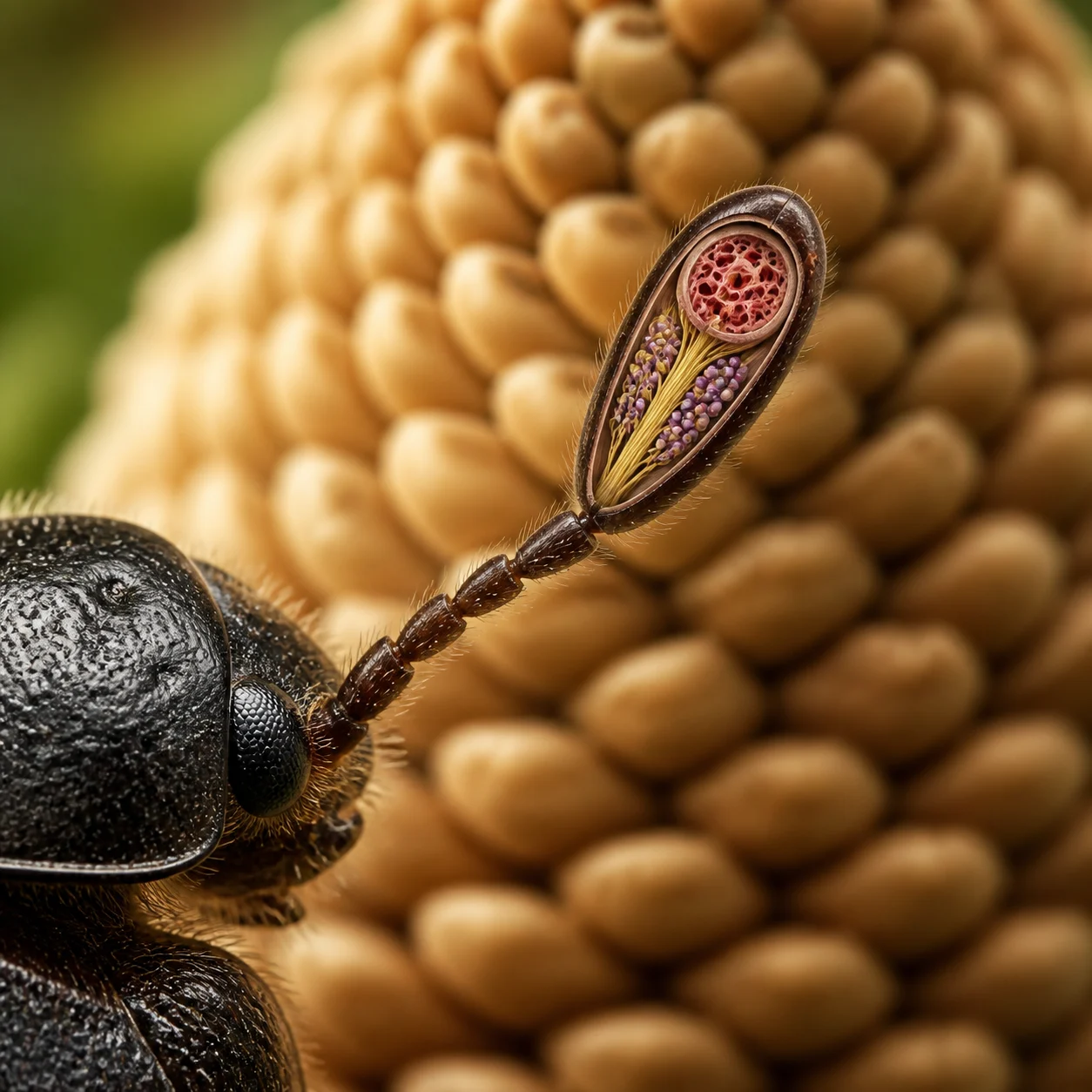
The three-hour separation makes the landscape behave like a relay. If male and female cones peaked together, beetles would receive competing destinations. Sequential heating gives the first stop and second stop different thermal moments. The plants do not communicate by intention, and the beetles do not read a clock. Circadian control, metabolism, and sensory neurons make the order emerge.
Cycads belong to an ancient seed-plant lineage that appeared long before flowering plants dominated land. Modern cycads maintain highly specific relationships with insect pollinators. That history makes infrared especially intriguing as a possible old channel of plant-animal interaction. Colorful petals are obvious to human eyes; a timed heat signal remained easy for us to overlook precisely because our senses are not tuned like a beetle's antenna.
The evolutionary story should remain measured. The controlled evidence covered seventeen cycad species, with detailed physiological and sensory work in particular plant-beetle pairs. It does not establish that every living cycad uses the same thermal sequence, that every pollinating insect has identical sensors, or that the full ancient origin of the system is directly observed. Fossil age and modern mechanisms are different kinds of evidence.

The field tracking made the timing visible at insect scale. Researchers marked beetles with ultraviolet-fluorescent dye and watched their nighttime movement between plants. Thermal imaging identified the warm cone regions the insects approached. The convergence of temperature maps and beetle routes mattered: a warm cone and a visiting beetle could otherwise be parallel events rather than parts of one signal system. Here, the movement aligned with the staggered heating.
The sensory work supplied a second line of evidence. Microscopy revealed specialized antennal structures, electrophysiology tested their response, and gene-expression analysis identified heat-sensing machinery including TRPA1. A corresponding beetle species responded in a range matched to its host cycad's temperature. That pairing does not make every beetle a thermal specialist, but it helps explain how these pollinators can distinguish a biological heat signal from the general warmth of a tropical evening.
Within the studied systems, the conclusion is still wonderfully concrete. A cone produces heat in reproductive tissue. A beetle detects infrared with specialized organs. Male and female plants peak at different times, and insect movement aligns with the sequence. Pollination is usually illustrated with a bright flower and a bee. Here the invitation is a warm cone after dusk, followed by another cone warming three hours later. The staggered warmth gives a receiver a changing route through dusk rather than one simultaneous field of equal signals. The signal is not visible to us. The cone warms for antennae that can feel it.
Sources