Share
Share








Out at sea, a tugboat pulled what looked like a 355-foot white pipe with rooms attached to one end. The object had no engine, no conventional bow, and no ambition to travel under its own power. It was FLIP—the FLoating Instrument Platform—and the horizontal pose was only for commuting. Once it reached the research site, the crew would turn the entire laboratory upright.
The idea grew from an acoustic problem. In the late 1950s, Scripps researchers wanted to measure how long-range sound moved through deep water. A normal ship was an awkward reference point: waves made it roll, pitch, and heave while its engines and hull added their own noise. Oceanographer Fred Spiess and engineer Fred Fisher explored the idea of a manned spar buoy, drawing on Allyn Vine's observation that a long, narrow object could float with remarkable stability when most of its length sat below the disturbed surface. Rather than upend a submarine, the team designed a purpose-built platform. FLIP entered service in 1962.
Getting it into working position was an act of controlled surrender. FLIP was towed horizontally to the chosen patch of ocean. The crew then opened valves that admitted seawater into ballast tanks along its long, narrow end. As that end grew heavier, it sank. The broad end rose. Over roughly half an hour, the platform rotated through 90 degrees until it stood like a building dropped into the sea. About 300 feet of the structure was now underwater, leaving only the top 55 feet—and the occupied working platform—above the waves.
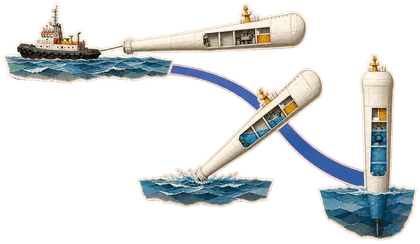
That extreme proportion was the point. In its vertical position, FLIP behaved as a spar buoy: tall, thin, deeply weighted, and resistant to ordinary wave motion. Most wave energy lives near the surface. FLIP reached far below that busy layer, so its great submerged mass did not follow every crest and trough. A ship nearby might rise and fall while the platform appeared almost indifferent. The ocean kept moving; the laboratory declined to imitate it.
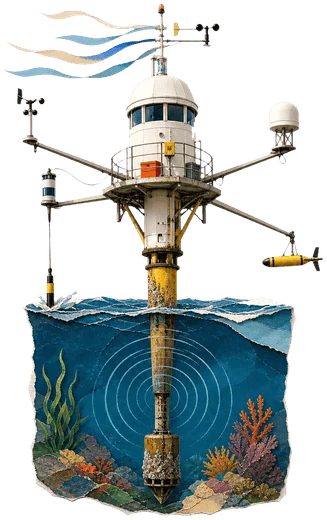
Stillness was only half the measurement problem. A research platform can disturb the very water and air it is trying to record, turning its own wake, heat, and structure into noise. FLIP's long instrument booms could hold sensors away from the occupied tower. Scripps researchers credited the combination of dynamic stability and reduced flow distortion with advancing measurements of the boundary where ocean and atmosphere meet. The platform was not merely refusing to bob; it was trying to make itself scientifically quiet.
The steadiness made unusually precise measurements possible. Instruments deployed from booms could sample wind, spray, currents, temperature, and sound with less interference from a moving hull. Scripps says FLIP supported research in geophysics, meteorology, physical oceanography, ocean acoustics, air-sea interaction, ocean mixing, marine mammals, and remote-sensing technology. Its original mission involved long-range sound propagation, a subject tied to submarine warfare, but its usefulness spread across the sciences of the upper ocean and lower atmosphere.
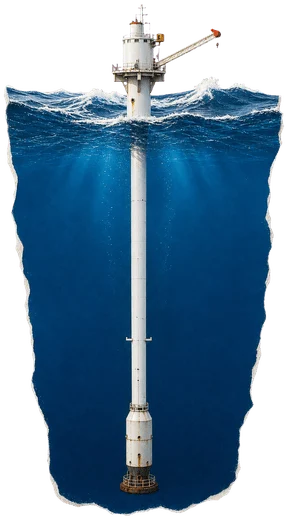
That range matters because the sea surface is not a clean dividing line. Wind transfers energy into waves. Breaking waves throw spray and bubbles upward and pull gases downward. Temperature differences drive exchanges between water and air. To study any one part, researchers often need to watch several systems at once. FLIP offered a fixed neighborhood for those observations, with ocean instruments below, atmospheric instruments above, and a stable frame connecting the two.
FLIP was stable, not invulnerable. In 1969, north of Oahu, swells exceeding 80 feet knocked out power and forced the crew to evacuate. The evacuation itself was made awkward by the very seas FLIP was built to study: the distance from the platform to the water changed wildly as the swells passed. The platform survived. The episode underlined an important distinction. Engineering can produce an exceptionally steady reference point without making the ocean tame.
Across six decades, FLIP completed hundreds of deployments. Scripps records a ceremonial flip in June 2013 as number 381 of its research career. Its shape became familiar enough for documentaries and school textbooks, yet the operating sequence never stopped looking improbable: tow a laboratory sideways, flood its tail, stand it on end, then work in a small inhabited cap above three hundred submerged feet. It was less like anchoring a ship than changing the rules of what counted as a vessel.
The platform's final research voyage took place in 2017. After reviewers determined that renovation costs could not be justified, Scripps retired FLIP in August 2023 and sent it toward a dismantling and recycling facility. That seemed like the final orientation change. It was not.
In October 2024, Scripps added an unexpected postscript: subsea design company DEEP had salvaged FLIP with plans to restore and modernize it. The rescued platform traveled from Mexico through the Panama Canal and across the Atlantic to the Mediterranean for an extensive refit. Scripps says the intended relaunch will add new instruments, sensors, computing, and communication systems. The project belongs to DEEP now, not the former Scripps fleet, and the future schedule is theirs to determine.
FLIP's best trick was never the spectacle of a gigantic tube slowly tipping vertical. It was the reason for the trick. Researchers wanted to hear, measure, and understand a moving ocean, so they built a laboratory that put almost all of itself beneath the waves and held still. The strange silhouette was simply precision made visible.