




 Share








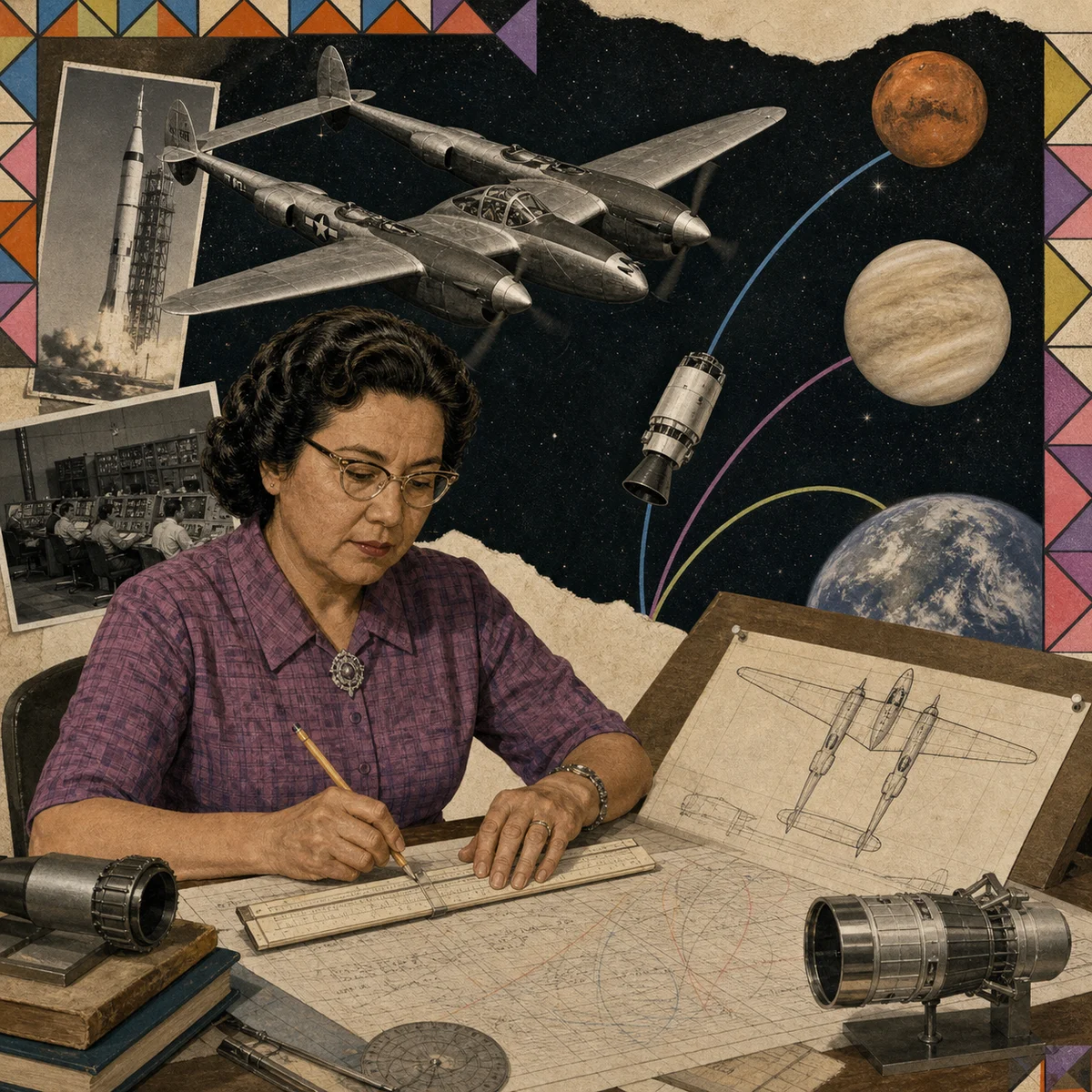
Mary Golda Ross was born in 1908 in Park Hill, Oklahoma, near the Cherokee Nation capital of Tahlequah. Mathematics first led her into teaching, one of the few technical careers readily open to women. World War II widened that path. In 1942 she joined Lockheed Aircraft in California as a mathematical research assistant and helped analyze how the P-38 Lightning and other aircraft responded to aerodynamic forces.
Ross completed advanced aeronautical-engineering coursework through UCLA and qualified as a registered professional engineer in 1949—the first known Native American woman to do so. At Lockheed’s Advanced Development Projects group and later its Missiles and Space Company, her documented work included the Polaris submarine-launched missile and the Agena vehicle used with military, scientific, and early planetary payloads.
She also contributed to NASA’s 1963 Interplanetary Flight Handbook, Volume 3, which detailed possible spacecraft trajectories to Mars and Venus. That public artifact supplies firmer evidence than later claims attaching her to every specific mission hidden behind classification. Much of her Cold War work remains unavailable, so its full scope cannot be responsibly reconstructed. Ross retired from Lockheed in 1973, then continued speaking, mentoring, funding scholarships, and advocating for women and Native students in engineering. Her flight paths extended in two directions: outward through the solar system and forward toward people the profession had previously excluded.
Sources