Share
Share







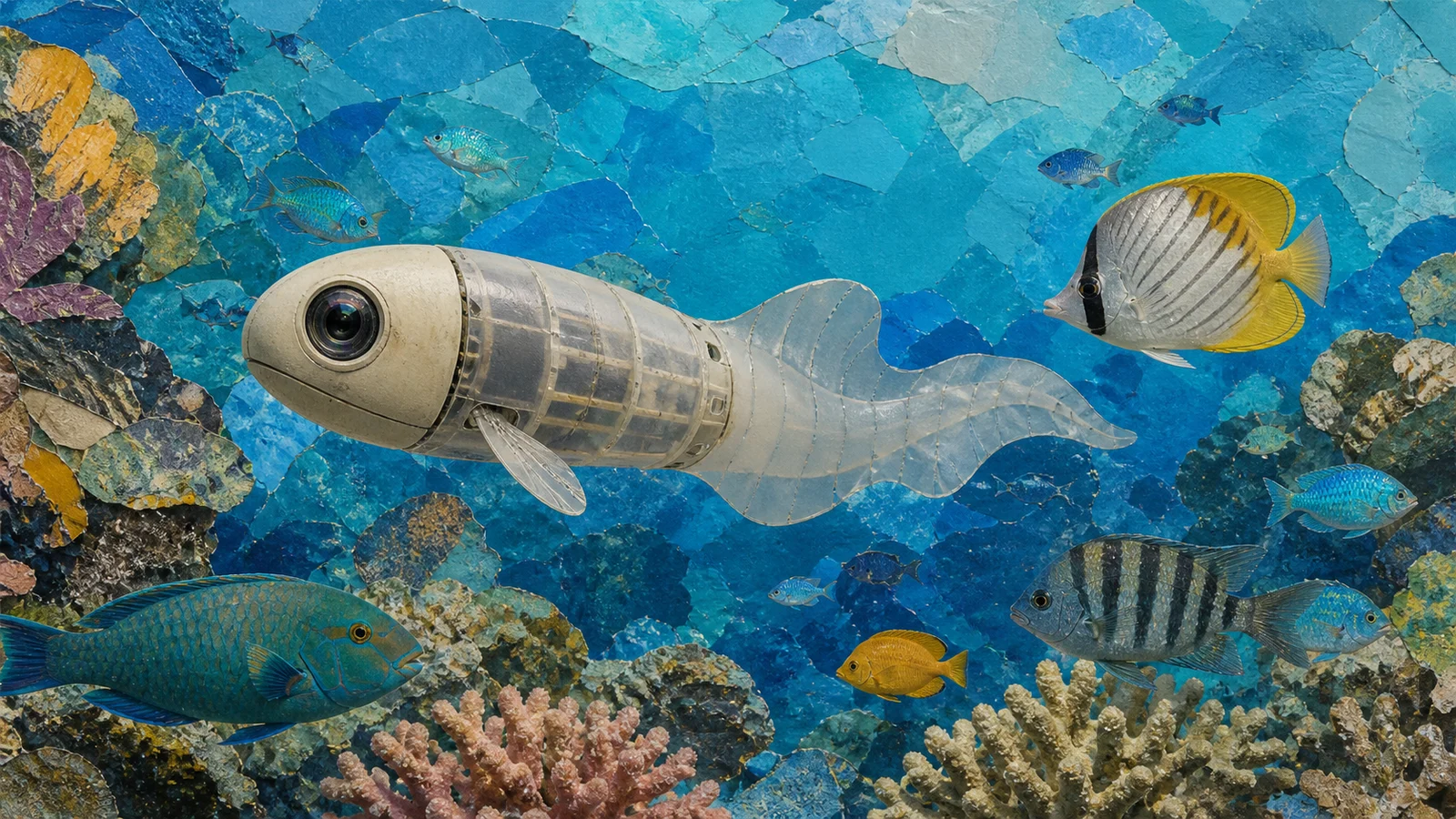
Underwater observation has a presence problem. A diver arrives with bubbles, limbs, lights, and limited air. A conventional vehicle may arrive with a cable, rigid frame, and propellers that churn the water. Any machine sent to watch marine life can change the behavior it hopes to record. MIT's soft robotic fish SoFi approached that problem by making the vehicle itself move more like an animal in the scene.
SoFi was built from a compact collection of parts: a single camera, a motor, a battery of the type used in consumer electronics, a rigid head protecting electronics, and a soft rear body. Its fisheye lens captured high-resolution photographs and video. The familiar shape was not only decorative. It organized a propulsion system around a flexible tail instead of an exposed propeller.
The tail worked hydraulically. A motor pumped water into two balloon-like chambers arranged on opposite sides. Filling one chamber bent the tail one way; moving water to the other bent it back. Alternating those actions produced a side-to-side undulation. By changing flow patterns, the system changed the tail's movement and the robot's speed. The pump turned internal fluid into a swimming stroke.
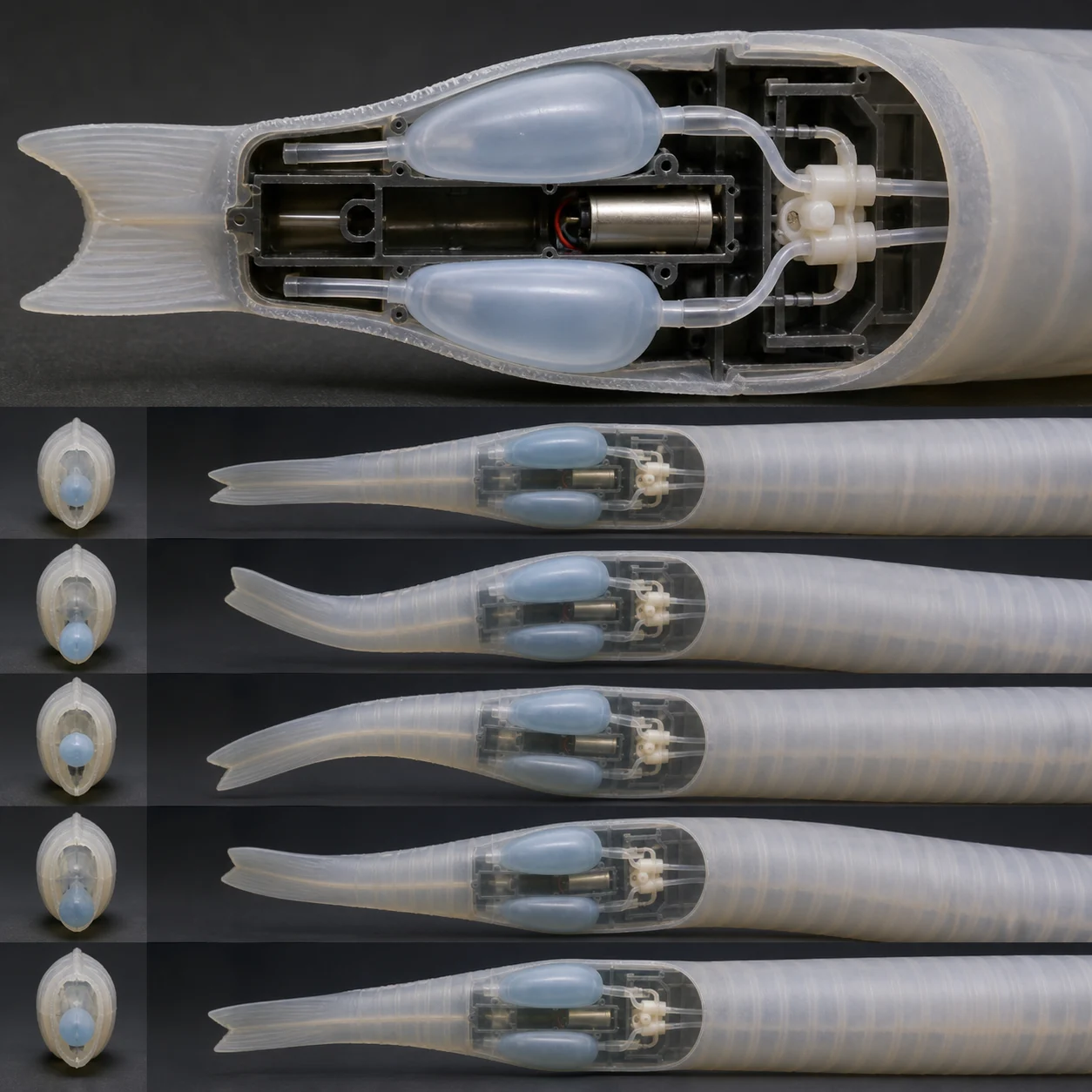
That softness changed how the machine occupied the reef. The back half, made with silicone rubber and flexible plastic, could flex rather than demanding that every nearby object be avoided by a hard hull and spinning blade. Soft robotics does not make collisions desirable, and SoFi was not designed to contact coral. It offers another mechanical vocabulary: deformation can absorb small interactions and generate animal-like motion.
Swimming forward was only one dimension of the problem. A reef observer must turn, rise, descend, and hold an appropriate depth. SoFi used side fins to adjust pitch and a buoyancy-control unit that changed density by compressing or decompressing air. An adjustable weight compartment helped set its position. Together, tail, fins, and buoyancy let the robot move in three dimensions without a tether.
Commands also had to cross water. Radio systems that feel effortless in air are poorly suited to ordinary underwater control, so the team developed an acoustic communications link. A diver used a waterproofed game controller to send sound-based instructions that changed speed and directed moves and turns. The controller looked playful; the important interface was the custom underwater acoustic system translating human input into motion at a distance.
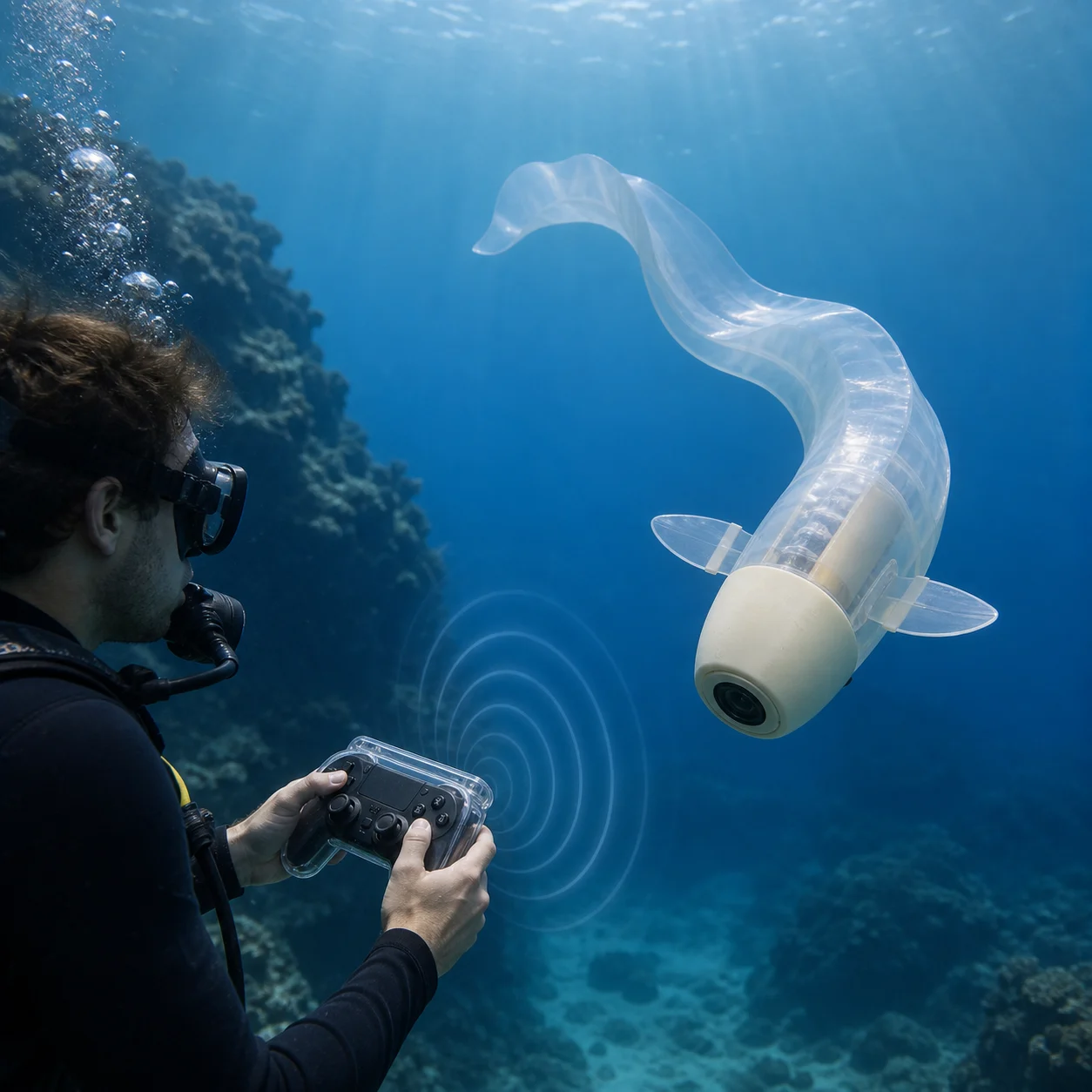
During test dives at Rainbow Reef in Fiji, SoFi operated at depths greater than 50 feet and for up to 40 minutes at a time. MIT reported that it could swim alongside real fish for several minutes while recording. Those demonstrations combined laboratory subsystems in the environment where they mattered: current, pressure, depth control, communication, imaging, and living animals all at once.
The head required its own pressure-aware design. Several components were 3-D-printed, and the electronics compartment contained a small amount of baby oil, a fluid that would not compress with changing dive pressure. That detail captures the mixed engineering inside the fish silhouette. SoFi's exterior imitated a biological form, while its interior solved water resistance and pressure with pumps, printed parts, battery chemistry, and carefully chosen fluid.
The machine's quietness was intentional. Researchers minimized motor noise and used ultrasonic communication. The project aimed to be as nondisruptive as possible so the camera could approach marine life more gently than some existing systems. Observers reported that the robot appeared not to disturb real fish during the dives. “Appeared” matters: a demonstration can show close operation without proving that every species in every setting treats the robot as invisible.
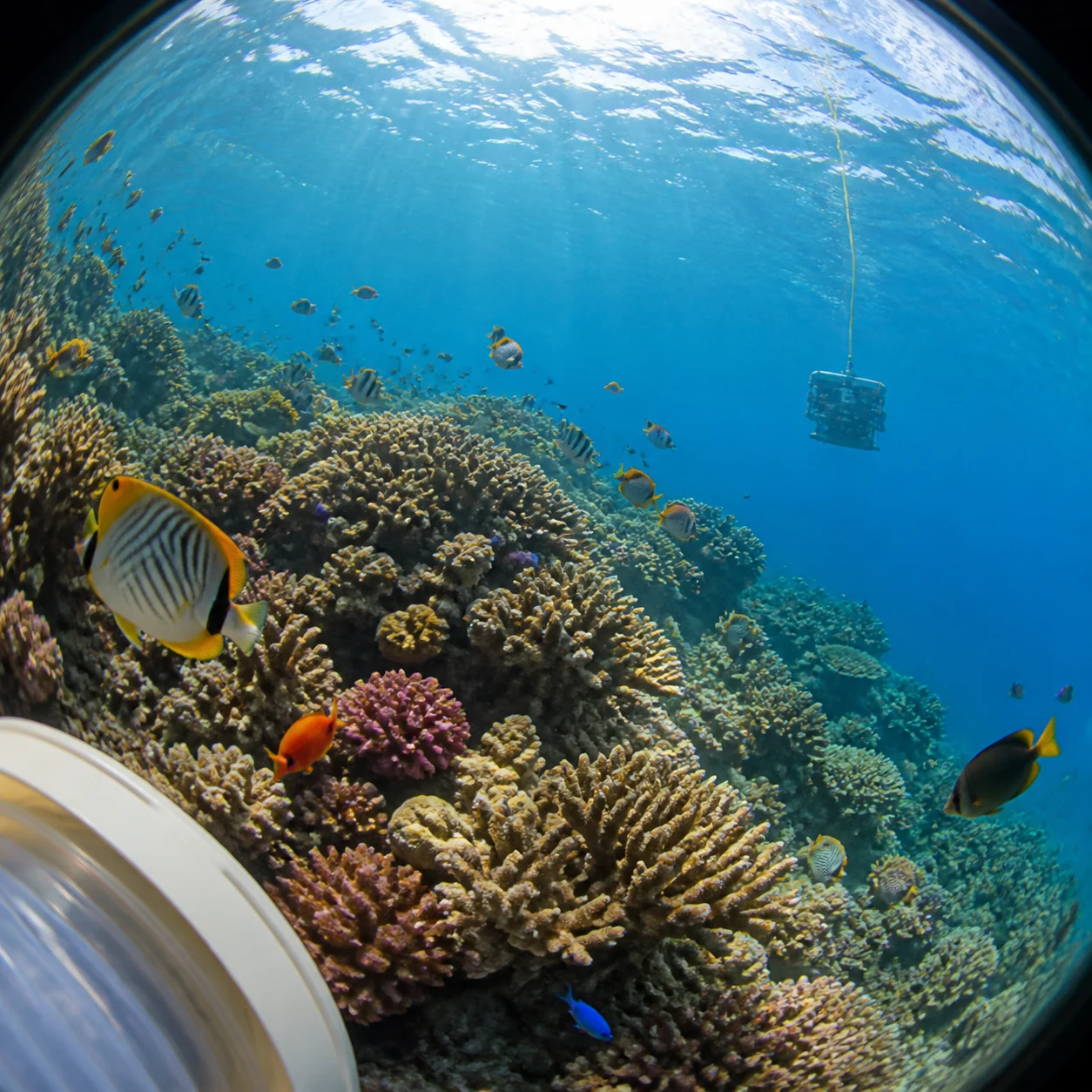
That is also why the title needs a boundary. SoFi swam alongside fish; the sources do not show that it became a social member of a school, fooled fish into accepting it as one of their own, or stayed on the reef permanently. The few minutes of proximity are an engineering result, not an animal-cognition experiment about robotic identity.
SoFi remained a research prototype. Future ideas included improving speed, using the camera for automatic following, and building additional units for biological studies. Those proposals should not be retroactively folded into the demonstrated machine. What entered the water in Fiji was human-controlled through acoustic commands, untethered, camera-equipped, soft-bodied, and capable of sustained three-dimensional swimming.
Its most useful inversion is that a robot designed to observe does not have to announce itself through conventional vehicle architecture. Propellers, cages, and cables are solutions, not requirements. By borrowing a fish's flexible propulsion and combining it with acoustic control, SoFi became a different kind of instrument: a camera whose platform undulated.
The reef fish did not enroll a new classmate. Researchers placed a machine close enough to share their water for a while. That distinction preserves the true achievement. SoFi carried a fisheye view into a living reef with no tether and no bulky external propulsion, turning soft motion into a practical observational tool. It “joined” the scene in the photographic sense—near enough to look from within—while remaining exactly what it was: an experimental robot built to watch with a lighter mechanical footprint.
Sources