




 Share







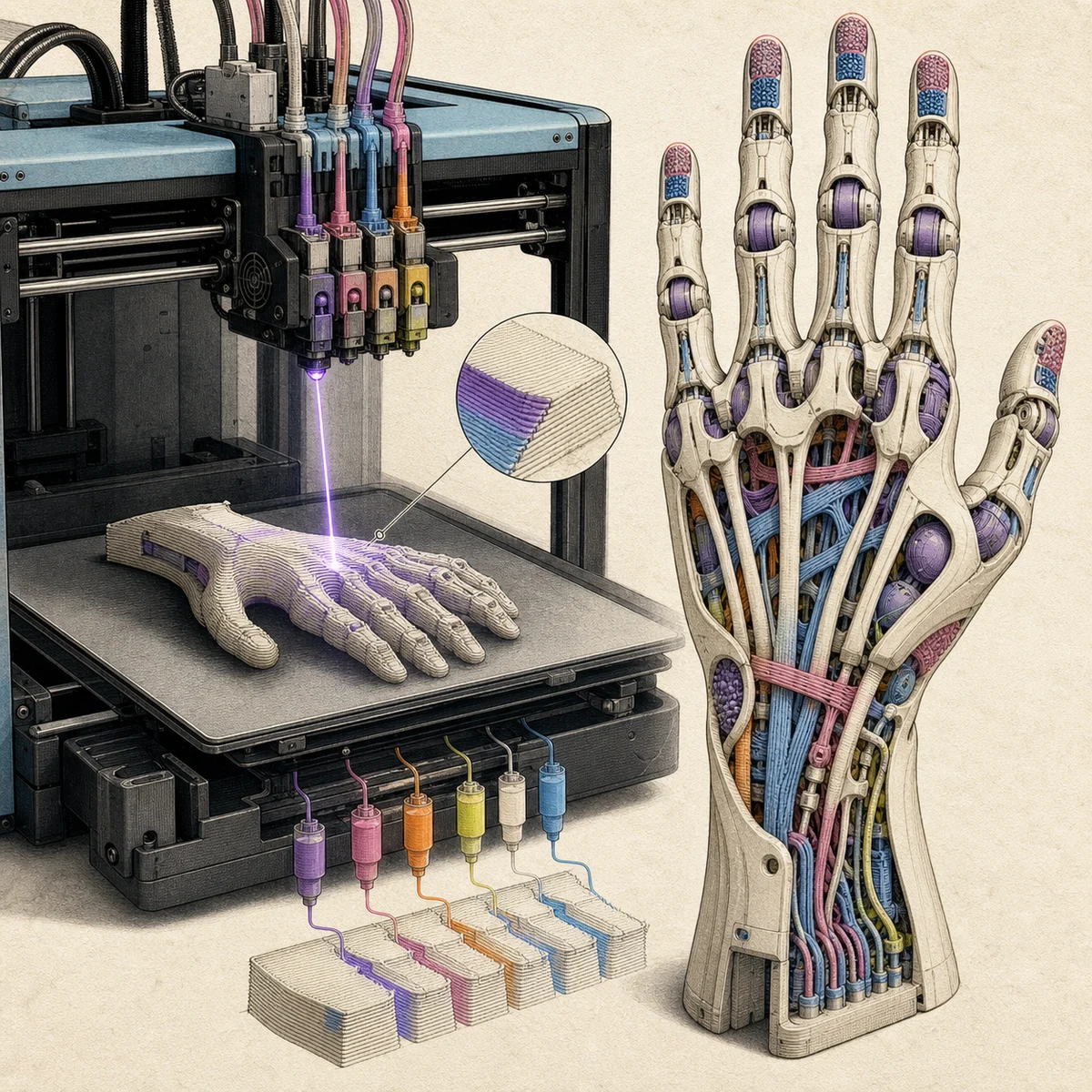
Conventional multimaterial printers cure each layer quickly, then scrape away surface irregularities before continuing. That approach struggles with slow-curing thiolene polymers: their soft surface can gum up the scraper. ETH Zurich researchers and the U.S. company Inkbit replaced physical leveling with vision-controlled jetting. A three-dimensional laser scan measures the uneven layer, and feedback software adjusts how much material the next layer receives at each point.
That correction made it possible to print slow-curing polymers with better elasticity and durability alongside rigid materials and hollow structures. The team produced a robotic hand in one continuous build. Stiff polymer components served as bone-like supports, softer joint capsules and elastic ligaments returned fingers toward their original position, and tendon-like elements transmitted forces for motion. The process also supported printed touch sensors and other delicate structures.
“Bones,” “ligaments,” and “tendons” describe mechanical roles and anatomical organization; every part here is manufactured polymer, not living tissue. The hand is a research robot, not a biological replacement or a mass-produced prosthesis. Its printing method is the larger result. By measuring rather than mechanically erasing each layer’s imperfection, one machine can combine soft, springy, and rigid behavior inside a finished moving object without assembling every interface afterward.
Sources