Share
Share







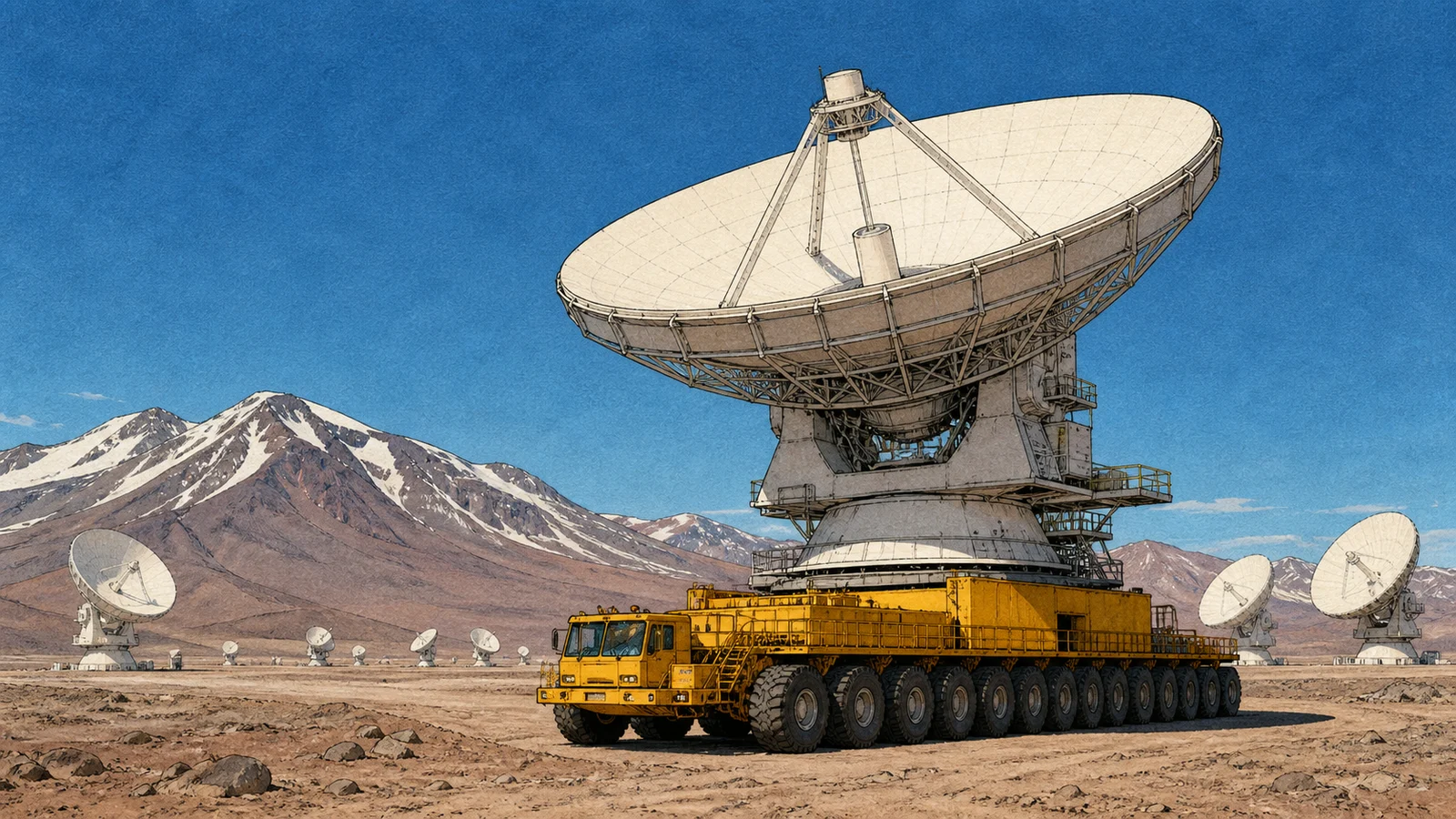
The Atacama Large Millimeter/submillimeter Array does not look through one tube. ALMA combines signals from many antennas on Chile's Chajnantor Plateau, using the separation between dishes as part of an interferometer. To change that separation, the observatory must move antennas that each weigh more than one hundred tons. It does so with two bright yellow machines named Otto and Lore.
Each transporter is twenty meters long, ten meters wide, and six meters high. Twenty-eight tires spread the load beneath a chassis that weighs 130 tons before an antenna is added. Two large diesel engines provide the power. The dimensions sound like a mining vehicle, but the assignment is closer to handling a precision laboratory instrument while driving it across a high desert.
Each transporter carries 1,500 liters of fuel. ESO designed the twins to move and position the fifty antennas of ALMA's main array in configurations ranging from about 150 meters to sixteen kilometers. Their scale is not decorative: it lets the same lifting platform protect a precision antenna while supplying the traction, braking, and controlled placement required across that operating network on the plateau. The machines make a distributed instrument physically reconfigurable.
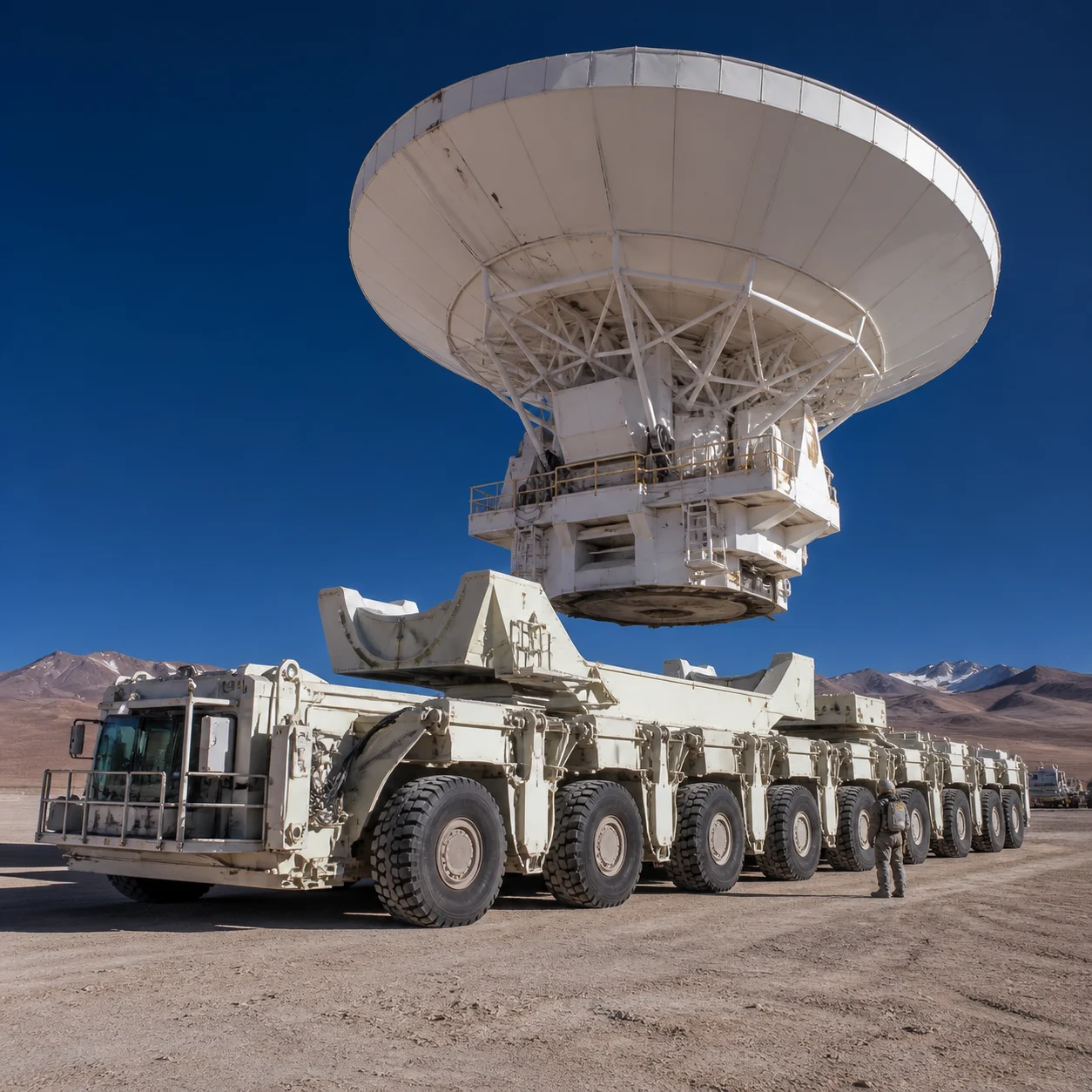
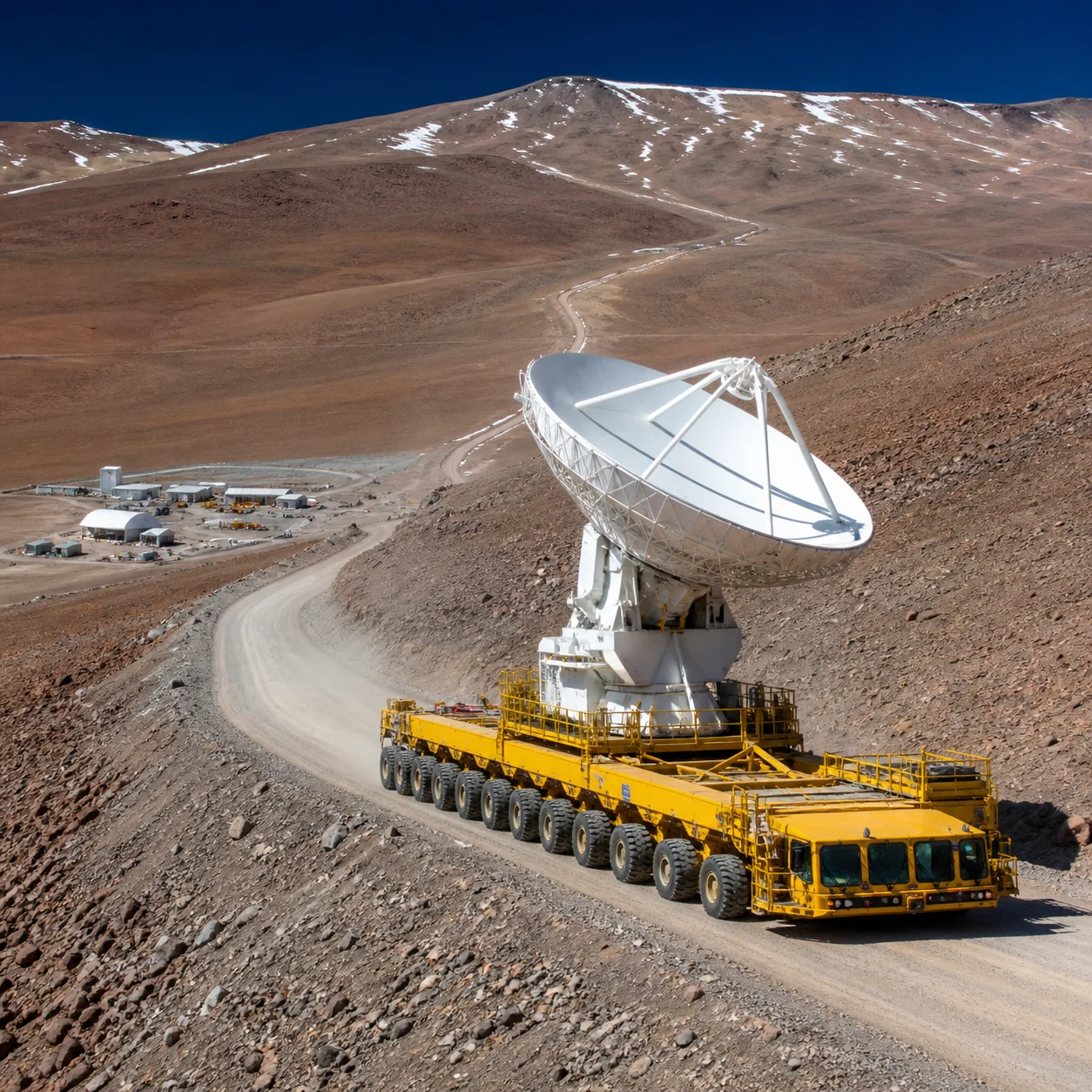
The transporters work along a twenty-eight-kilometer route from ALMA's Operations Support Facility at about 2,900 meters elevation to the Chajnantor Plateau at about 5,000 meters. They also move antennas between concrete foundation pads on the plateau itself. The altitude changes the machine and the human operating it. Driver seats accommodate oxygen tanks, and engines rated around 700 horsepower each produce substantially less in the thin air.
Speed is intentionally unexciting. Otto and Lore can reach about twenty kilometers per hour empty and twelve while carrying an antenna. Custom brakes and safety systems protect a load whose surface and internal components must retain exact alignment. During loading, unloading, and other critical maneuvers, the operator can use radio remote control while standing outside for a direct view.
At the destination, bulk gives way to finesse. A transporter lifts the antenna, carries it over a foundation, and positions it to within a few millimeters. The dish must settle onto a prepared pad so power, data, and other services can reconnect. Twenty-eight tires are therefore only the coarse beginning of the movement; final placement belongs to the same culture of precision as the telescope.
Why move an observatory at all? ALMA is an interferometer. Pairs of antennas sample incoming radio waves at different separations, or baselines. Astronomers combine those measurements computationally to reconstruct an image. Changing where the antennas stand changes the distribution of baselines and therefore the spatial scales the array measures most effectively. The physical map of dishes becomes part of the optical system.
A more extended configuration, with longer maximum baselines, can achieve finer angular resolution. A compact arrangement is better at sampling larger, more extended structures. ALMA's main twelve-meter array can range from configurations spread across roughly 150 meters to about sixteen kilometers. Moving a dish from one pad to another helps turn the same antennas into different versions of the array for different scientific targets.
One distinction prevents an easy but incorrect explanation. Reconfiguration does not change the primary-beam field of view of an individual antenna at a fixed observing frequency. That field is set chiefly by dish size and wavelength. What changes with baseline distribution is the synthesized angular resolution and the largest structure the interferometer can reliably recover. Larger regions can require mosaicking, and additional compact-array or single-dish data can supply spatial information the main array misses.
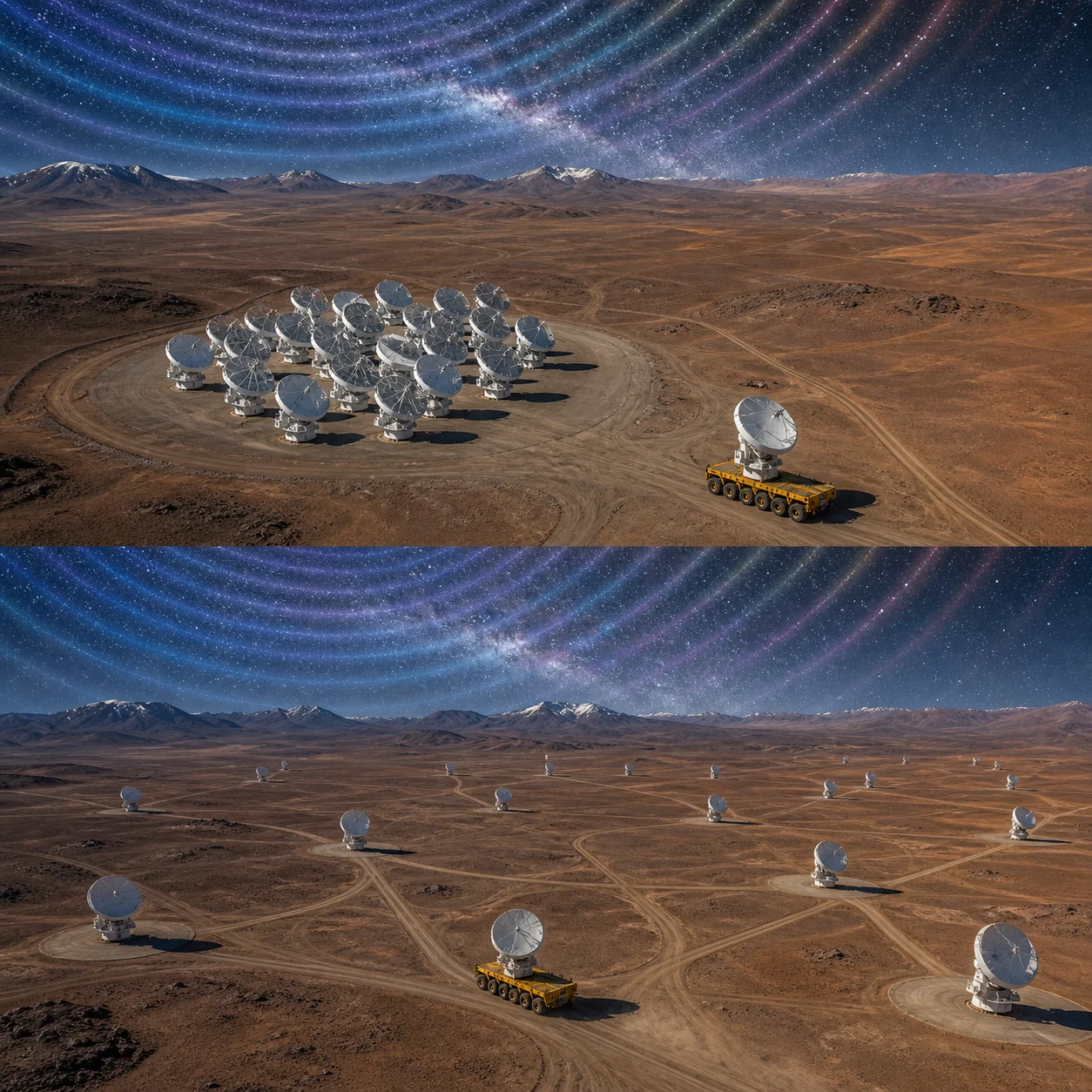
Reconfiguration is scheduled work, not an adjustment made halfway through every observation. Antennas move in coordinated campaigns so the array can cycle between compact and extended layouts. Each relocation takes the dish out of service while it is disconnected, lifted, transported, placed, and recommissioned. The foundation pads form a prepared network across the plateau; Otto and Lore make selected points in that network physically available to the same precision antenna.
The observatory's image still depends on more than maximum spacing. Weather, observing frequency, calibration, number of antennas, and the full distribution of short and long baselines all shape what the data can recover. The transporters control one foundational variable: where the dishes stand. Their work is therefore neither routine trucking nor a magic resolution switch. It is a carefully planned change to the sampling geometry astronomers later transform into an image.
Otto and Lore are not telescopes themselves. They do not collect the cosmic signal or replace the antennas' receivers. Their contribution is geometric and logistical. Without a way to carry enormous precision dishes safely between pads, ALMA could not cycle through its planned configurations. Observatory engineering includes every system required to make the desired measurement possible, even if that system spends its day driving slowly.
The names make the machines personable, but their real personality is caution. They are huge because the load is huge, slow because the load is delicate, and precise because a few millimeters matter at the end of a journey measured in kilometers. On Chajnantor, astronomy sometimes begins before an antenna points at the sky. It begins when twenty-eight tires lift a hundred-ton dish and rearrange the telescope on the ground.