Share
Share







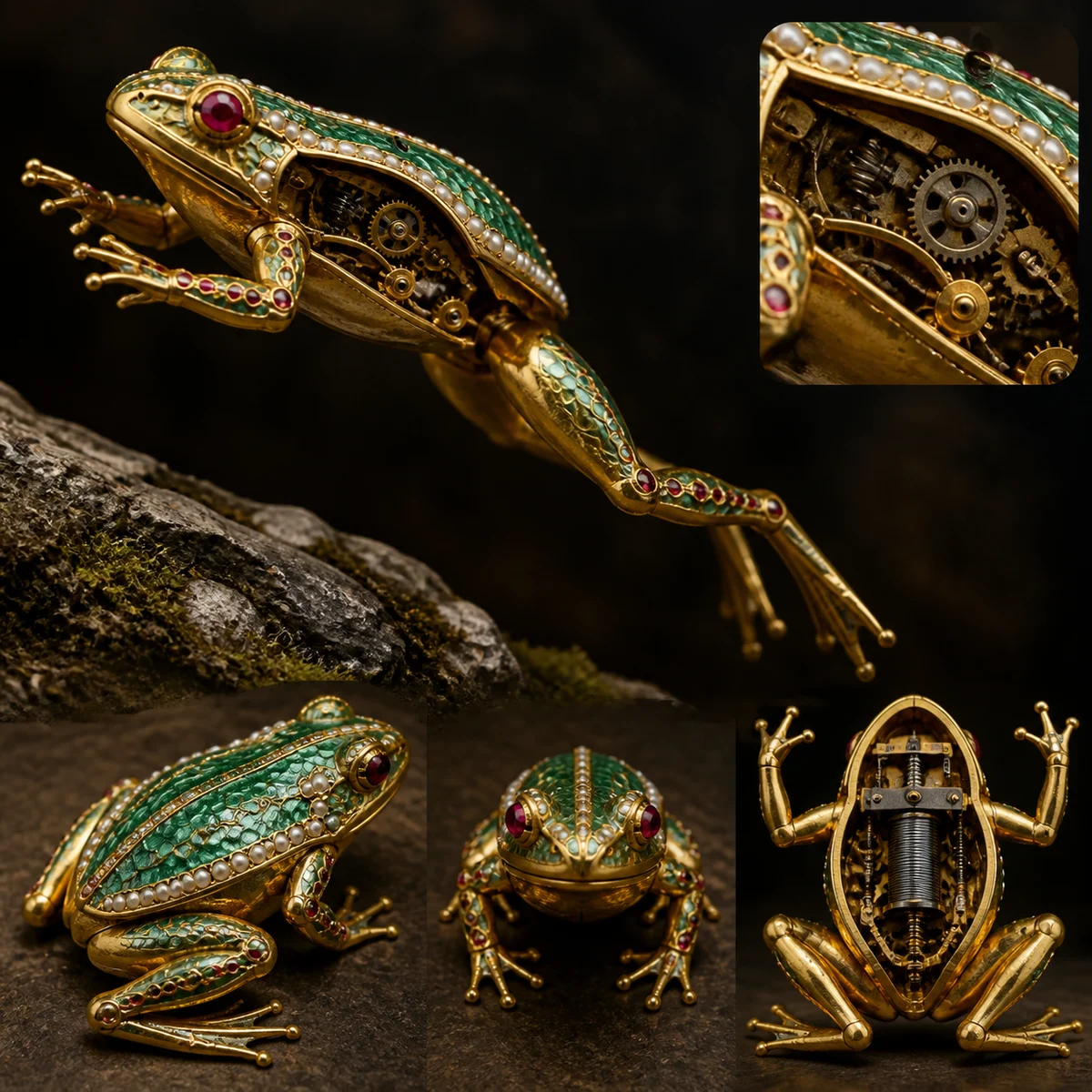
At rest, the Swiss automaton is already improbable: a frog formed from gold, translucent enamel, pearls, and rubies. Wind the hidden mechanism, and ornament becomes performance. Its legs move, the body jumps, and a croaking sound emerges from inside.
The object was made around 1820, when European automata joined clockmaking skill with spectacle. Miniature cams, springs, gears, and sound mechanisms could animate birds, figures, and animals inside luxury objects. The frog's natural form helps conceal the engineering. Bent hind legs promise stored motion, while the decorated body provides a shell large enough to hide the machinery that releases it.
It is not a realistic robotic frog in the modern sense. It does not navigate, respond to a pond, or decide when to leap. Its sequence is mechanically prescribed. That limitation is part of the charm: a jeweler and mechanism maker compressed a familiar living gesture into metal. For a moment, rubies and enamel stop being surface decoration and become the skin of a creature that can jump and croak.
Sources