




 Share








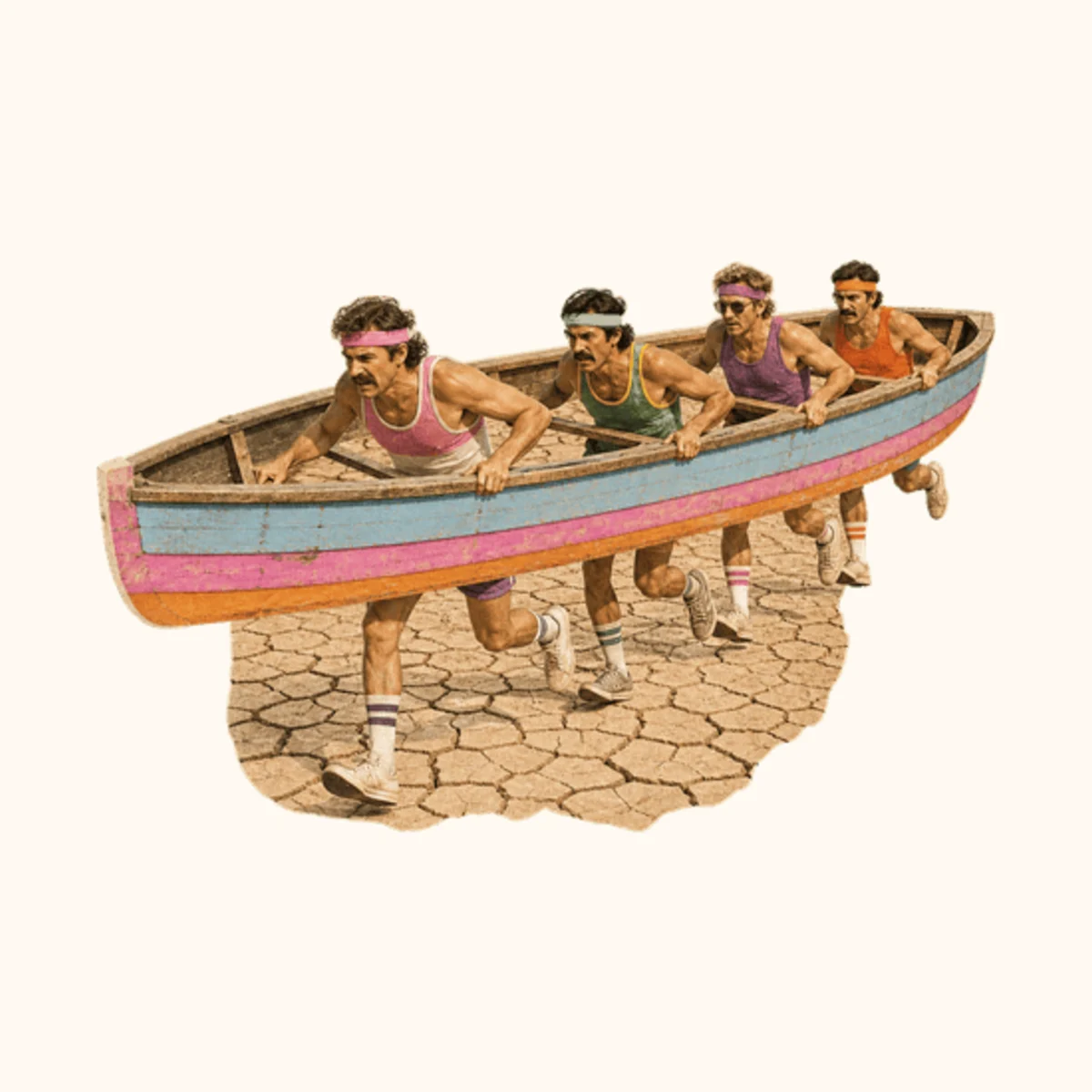
Most regattas require a navigable river. The Henley-on-Todd Regatta requires the opposite. On the usually dry bed of the Todd River in Alice Springs, Australia, competitors step inside bottomless boat-shaped frames, lift them around their waists, and run through the sand. The event calls itself the world's only dry-river boating regatta, an achievement protected by the complete absence of boating.
The joke began with a Rotary Club picnic in 1962. According to the event's official history, Reg Smith proposed a waterless regatta as a charity fundraiser. Someone asked whether the boats would be pushed or towed. Smith's answer established the engineering standard: cut the bottoms out and carry them. The inaugural race followed that December.
The modern program stretches the idea across bottomless kayaks, Oxford tubs, rowing eights, yachts, bring-your-own-boat races, and a climactic mock battle involving water cannons and flour bombs. Teams do the propulsion themselves, feet churning through rough sand while the hull supplies shape, decoration, and almost no conventional marine assistance. The regatta has also become a major fundraiser for Rotary clubs in Alice Springs; organizers say it has raised more than A$1.7 million across its history.
The Todd is not permanently dry. Heavy rain can send water through the channel, which creates the event's best inversion: a river can make the boat race impossible. In 1993, the regatta was cancelled when the Todd River ran and the dry course disappeared. Later cancellations had less poetic causes—pandemic restrictions in 2020 and organizational and funding problems in 2024—but the first remains the perfect summary.
Henley-on-Todd works because everyone agrees to preserve the language of serious boating while removing the water. There are crews, vessels, races, a river, and even naval combat. The boats simply have no bottoms, and the sailors provide the legs. It is a regatta built from every visible part of a regatta except the condition that normally makes one possible.
Sources