




 Share








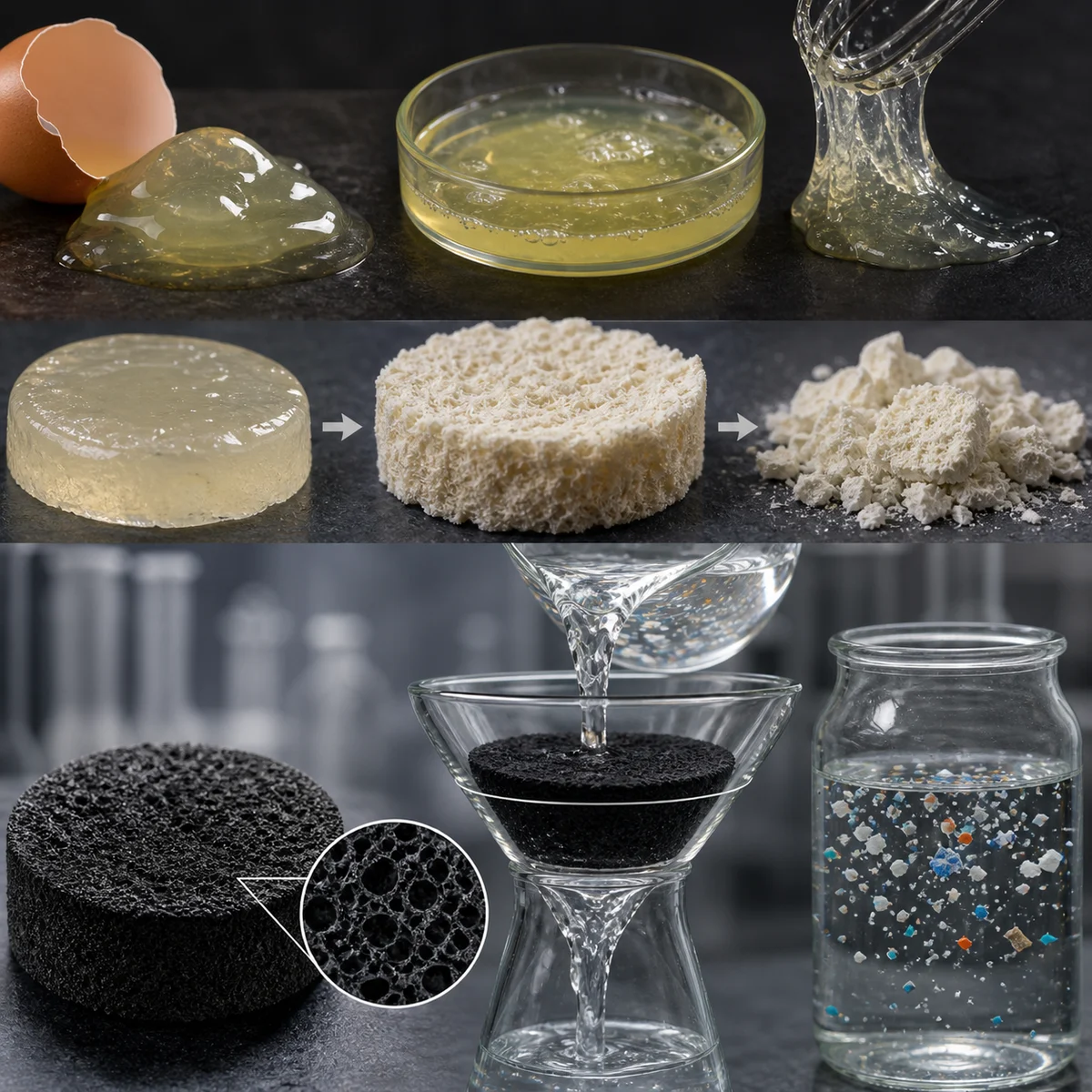
Egg white became useful to water treatment only after researchers made it thoroughly unlike egg white. A Princeton team freeze-dried the protein, then heated it at high temperature without oxygen. The process converted the delicate biological scaffold into a carbon aerogel, an extremely light solid filled with a connected network of pores.
Those pores supplied a large internal surface through which water could move. In laboratory tests, the material removed salt as well as microscopic plastic particles. The filtering behavior emerged from the processed carbon architecture, not from pouring raw albumen into contaminated water. Calling it an egg-white filter is accurate about the starting material but incomplete about the transformation.
The researchers also investigated whether other proteins could yield similar structures. That matters because an environmental material should not depend unnecessarily on a food source. The broader concept is protein-derived carbon: use molecular structures assembled by biology as templates, then convert them into stable porous solids.
A successful lab sample is not yet a household cartridge or desalination plant. Large-scale use would require answers about manufacturing energy, reuse, fouling, flow rates, cost, and performance in water containing many substances at once. The experiment establishes a promising materials route. Familiar protein passes through cold, vacuum, and intense heat, and the ghost of its structure remains as a black microscopic maze for separating what water carries.
Sources