Share
Share







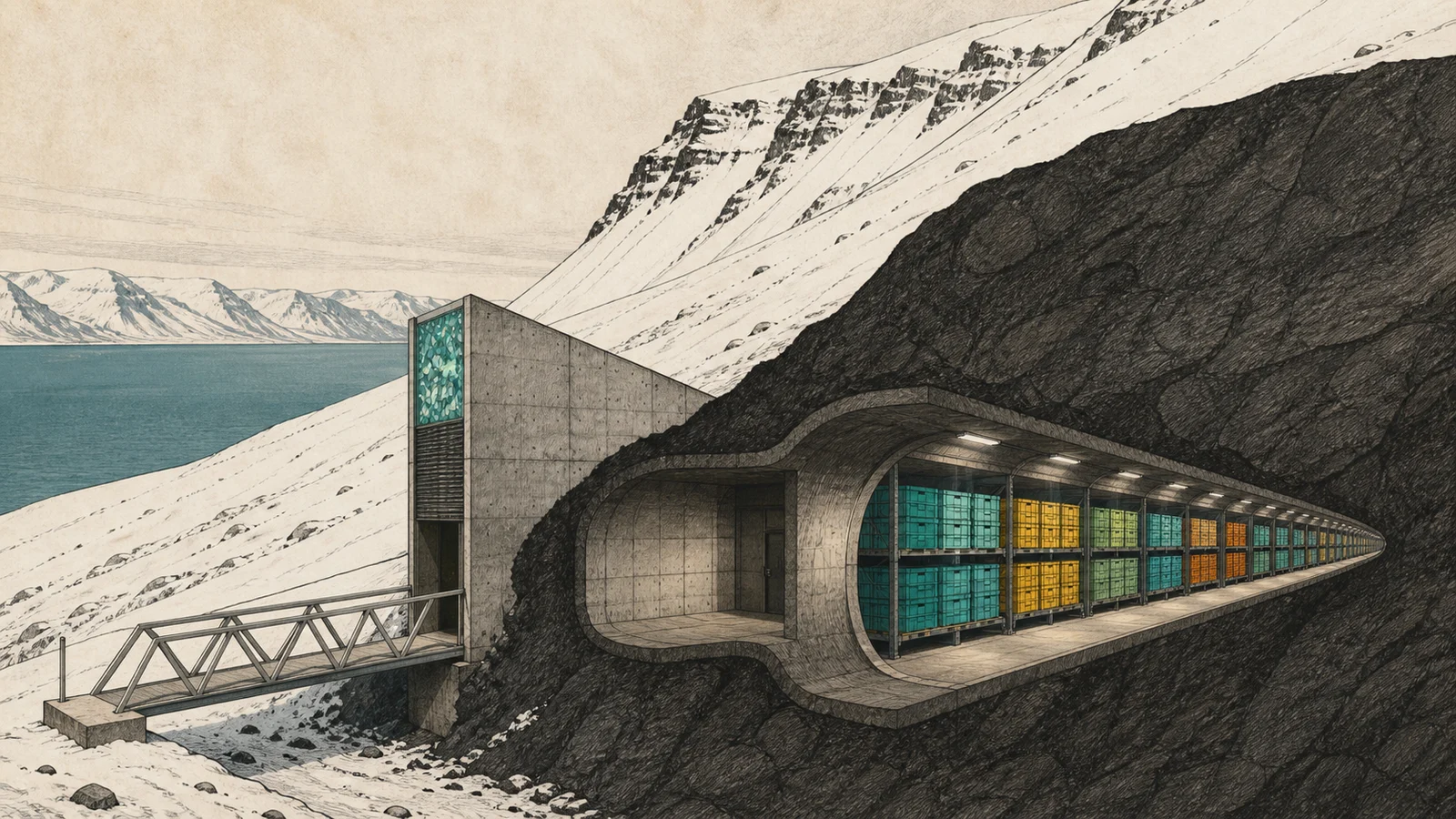
A concrete doorway emerges from Platåfjellet on Norway's Svalbard archipelago, but the visible entrance is only the front edge of the Global Seed Vault. The storage facility extends more than one hundred meters into the mountain; Norway's detailed description puts it about 130 meters into rock and 130 meters above sea level. Its mission is to keep backup seed samples from crop collections around the world.
The entrance is also the facility's public face. Dyveke Sanne's artwork, Perpetual Repercussion, covers the roof and upper façade with reflective stainless-steel triangles, mirrors, and prisms. It catches daylight and artificial light, making the threshold visible across the dark or snowy landscape while its appearance changes with season and time of day. That glittering wedge is not the storage room: it marks the start of the tunnel to a mostly hidden, utilitarian archive inside the rock.
The location is remote but reachable. The vault sits about a mile from Longyearbyen's airport in a geologically stable area with low humidity. Roughly one thousand square meters lie inside, while only the entrance lobby is visible outside. The surrounding permafrost stays several degrees below zero, and the thick mass of rock adds both physical protection and a natural cold reserve.
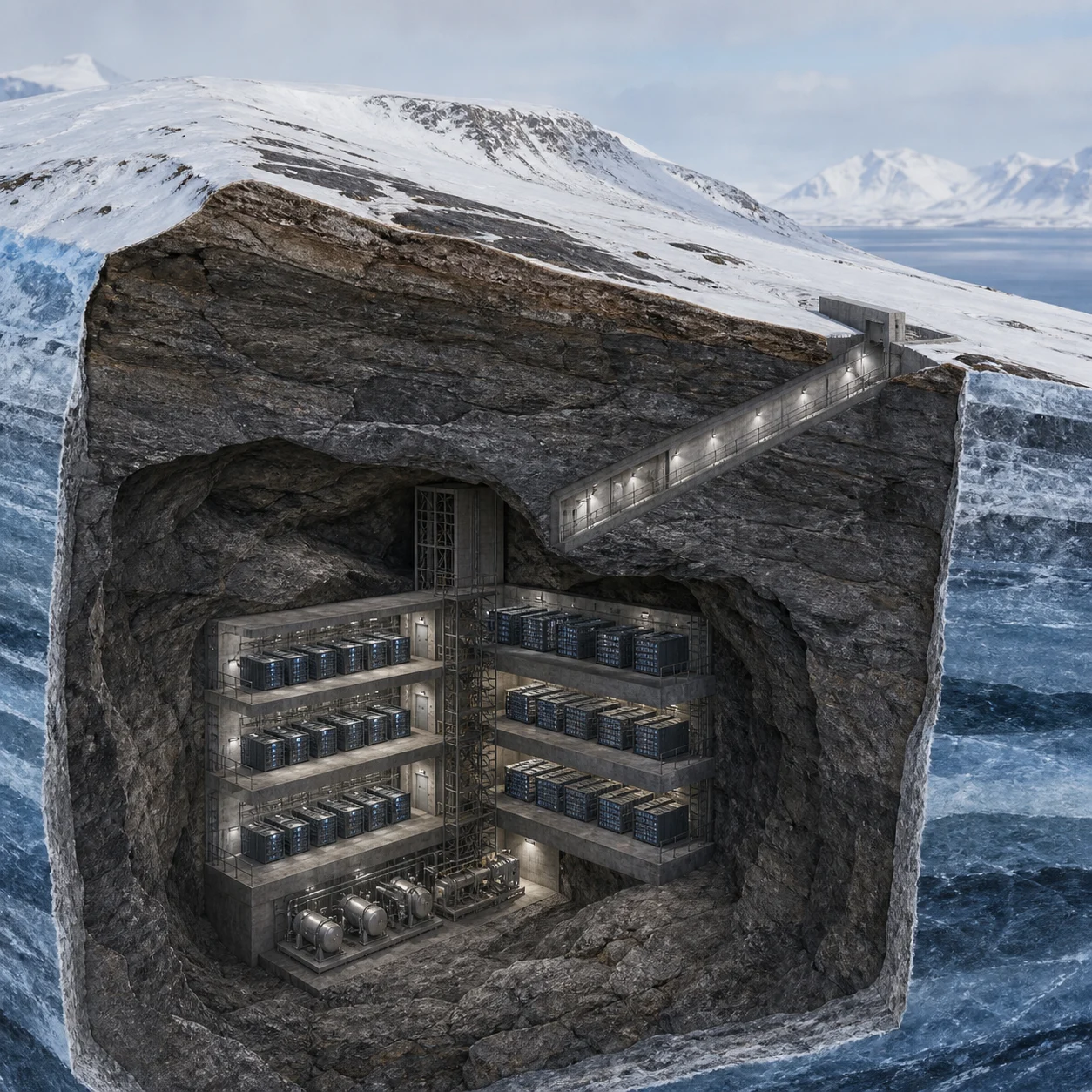
Mechanical refrigeration maintains the seed rooms at minus eighteen degrees Celsius, the storage temperature specified by the program. Permafrost is only the backup: the chamber is not an unpowered freezer that remains permanently at that exact temperature. If power fails, the frozen ground and rock help keep the samples cold. Low temperature and low moisture slow metabolic activity inside the seeds and extend how long many remain viable.
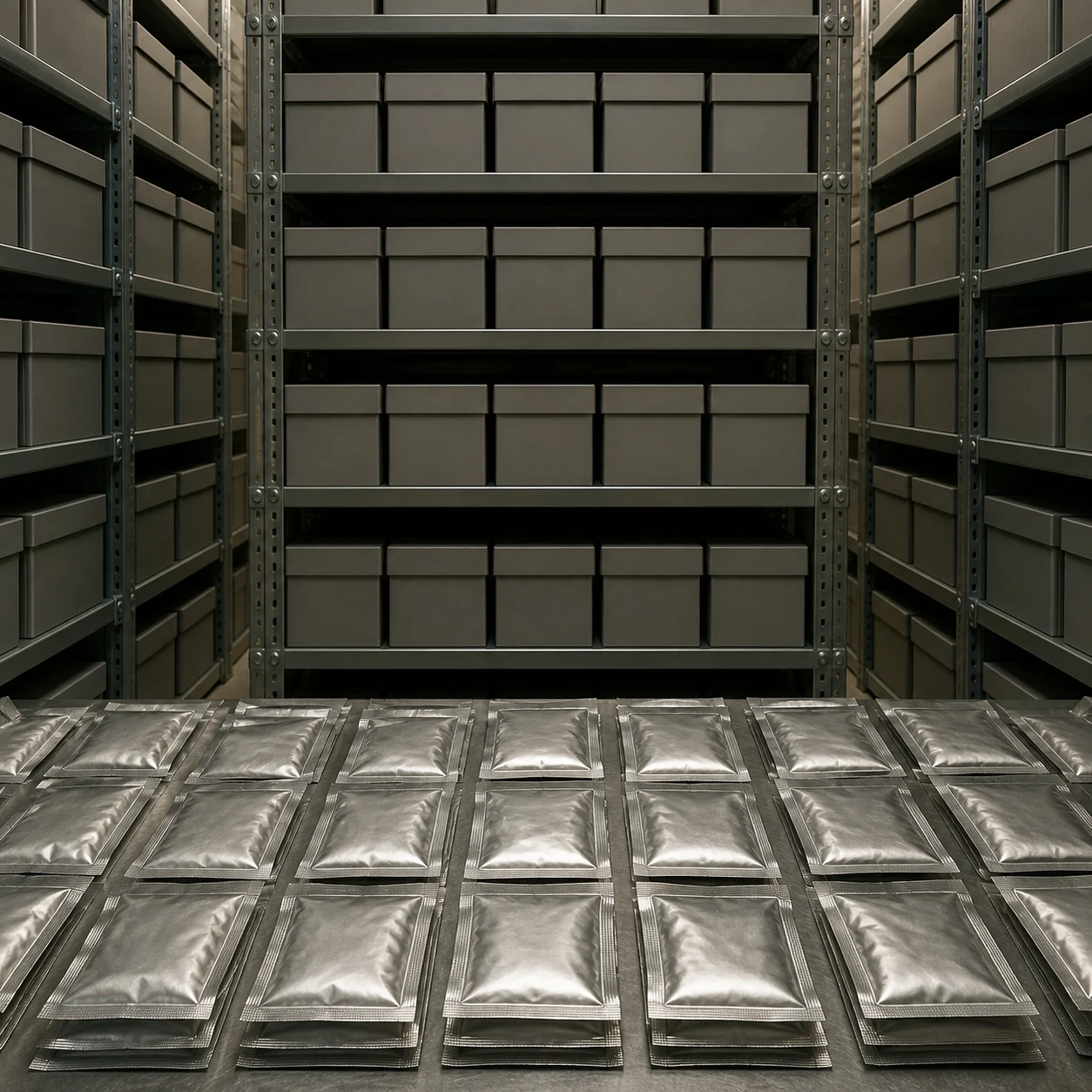
A sample arrives already packed by its depositing genebank. Seeds are sealed inside custom three-ply foil packages, then enclosed in boxes and stacked on tall shelving. A typical sample contains around five hundred seeds. Each crate can contain a maximum of four hundred seed types. The arrangement looks like warehousing because the scientific value sits inside many small, carefully documented packets rather than in one spectacular object.
The vault is a backup system for genebanks, not the world's only crop collection. More than 1,700 genebanks conserve agricultural diversity, but their collections can be vulnerable to conflict, natural catastrophe, poor management, lost funding, or something as ordinary as a failing freezer. A duplicate in Svalbard gives a depositing institution a second copy if its active collection is damaged or lost.
The ownership rules are intentionally conservative. Boxes are stored under “black-box conditions.” Depositing a package does not transfer its legal ownership to Norway, NordGen, or the Crop Trust. Only the institution that deposited a sample may withdraw it. Vault staff safeguard and document the material, but they do not browse the shelves and redistribute another institution's seeds.
That rule has practical meaning. The vault is not a lending library where any breeder can request a packet, and it is not a museum where visitors open boxes. The active work of growing, evaluating, multiplying, and sharing crop material remains with genebanks. Svalbard holds the insurance copy. When a depositor needs to restore material, it can retrieve its own sealed backup and regenerate seed elsewhere.
On June 17, 2026, Norway announced that the collection had reached 1,401,285 seed samples after the vault's seventieth deposit. That round added 15,387 samples from eleven genebanks. The shipments included material from the Americas, Europe, Africa, and Asia; institutions in Burkina Faso and Niger deposited for the first time. The total is therefore a timestamped inventory, not a permanent number.

“Sample” also needs care. One sample packet is not automatically one globally unique crop variety. Related accessions or duplicates can exist in different collections, and the vault's purpose includes deliberate backup. Public descriptions sometimes slide between samples, accessions, and varieties, but the reported milestone counts stored samples. Precision matters most when a giant number sounds like a census of all crop diversity.
Capacity puts the milestone in context. The facility was designed for as many as 4.5 million seed types, with a theoretical maximum around 2.5 billion individual seeds if packets average five hundred. Those figures describe storage potential, not a claim that every crop can be secured there. Some plants are not conserved as ordinary dry seed, and some genebanks must regenerate or multiply material before sending a duplicate.
Norway owns the vault and its Ministry of Agriculture and Food holds overall responsibility for management, security, and funding. Statsbygg maintains the facility. NordGen handles operations inside and communicates with depositing genebanks, while the Crop Trust supports the partnership and broader work to conserve crop diversity. The division of roles makes the mountain part of a distributed global system rather than a solitary Arctic bunker.
The vault's drama is intentionally delayed. Nothing sprouts on its shelves, and the packets are useful precisely because most never need to leave. The visible door, reflective artwork, cold tunnel, sealed foil, inventory database, and distant working genebanks all support one idea: no collection should have only one copy. At the cited milestone, 1,401,285 samples represented that habit of redundancy—agricultural memory stored in a mountain, owned by the institutions that entrusted it there.